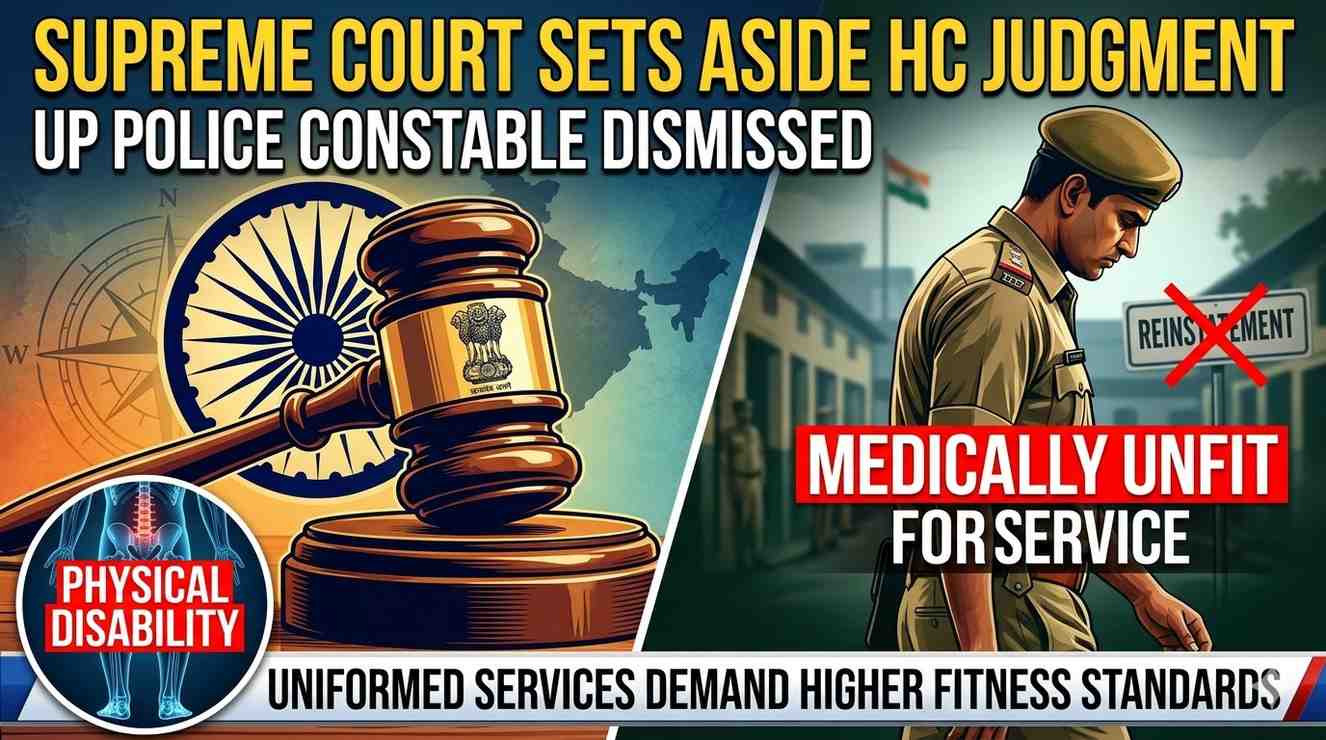
The Supreme Court has set aside an Allahabad High Court judgment and restored the dismissal of a Uttar Pradesh police constable who was found medically unfit for service. A bench comprising Justice Hima Kohli and Justice Ahsanuddin Amanullah emphasized that appointments to uniformed services demand a higher standard of physical and mental fitness, requiring "greater caution" during the recruitment and verification process.
The case involved a constable who had been dismissed from service after a medical re-examination revealed a physical disability that hindered his ability to perform the rigorous duties required of a police officer. While the Allahabad High Court had previously ruled in favor of the constable, directing his reinstatement on humanitarian grounds, the Supreme Court held that such considerations cannot override the functional requirements of the force.
The apex court observed that the integrity and efficiency of a uniformed force are directly linked to the health and fitness of its personnel. It noted that allowing an individual who does not meet the prescribed medical standards to remain in service could compromise public safety and place an undue burden on other members of the unit. The bench clarified that the criteria for "fitness" in the police or military are more stringent than in civil administrative roles due to the nature of the tasks involved, such as maintaining law and order and responding to emergencies.
Furthermore, the Court pointed out that if a candidate is found to be medically unfit at the threshold or during a mandatory review, the department is within its rights to terminate the appointment to maintain the operational standards of the service. The judgment underscores that while the judiciary is sensitive to the livelihoods of employees, it must prioritize the specialized requirements of organizations where physical capability is a non-negotiable prerequisite.
The ruling serves as a significant precedent for recruitment boards across the country, reaffirming that the "strict adherence" to medical and physical standards is a legal necessity for all uniformed services. The Supreme Court concluded that interference by courts in these technical assessments should be minimal unless there is clear evidence of malice or procedural irregularity.