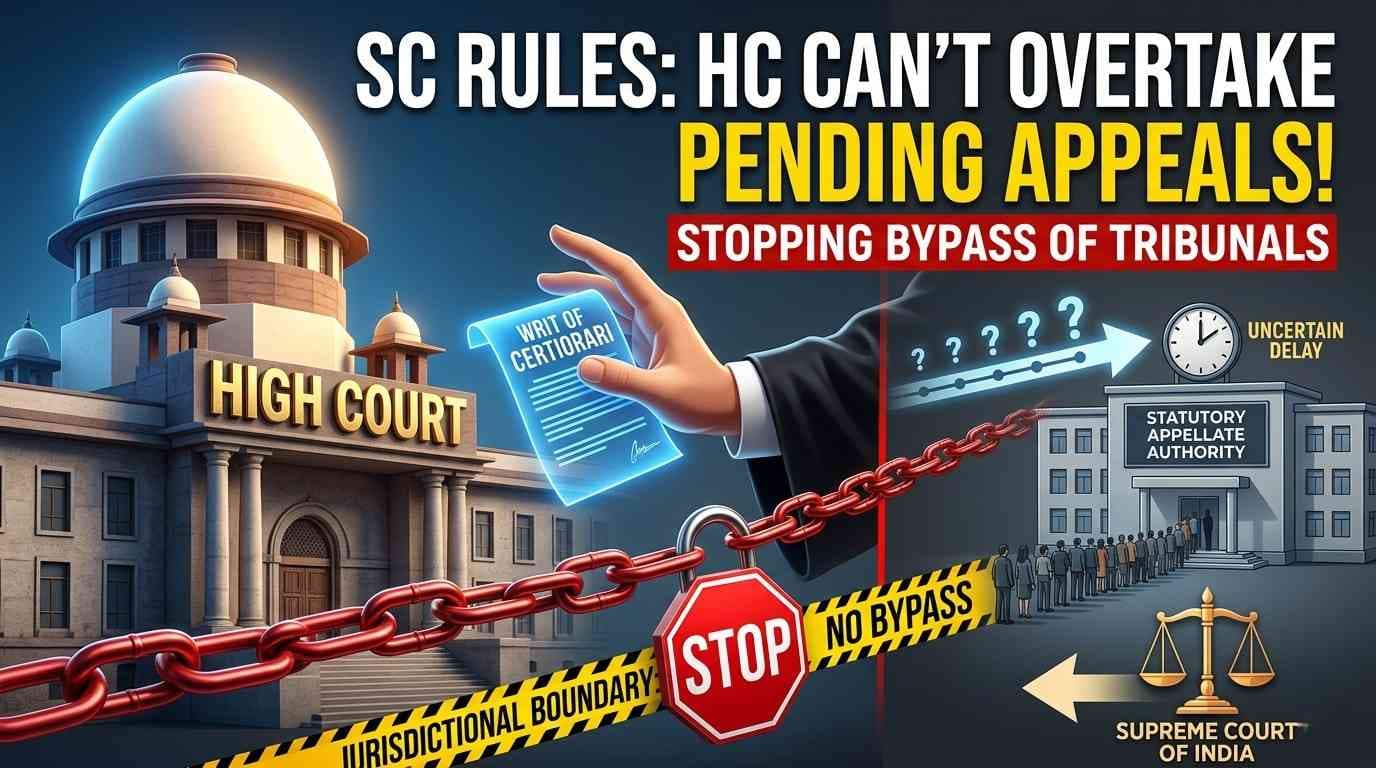
The Supreme Court has clarified the jurisdictional boundaries of the High Courts regarding pending administrative appeals, ruling that a High Court cannot take over and decide a matter that is currently lying before a statutory appellate authority simply because there is a delay in its disposal. A bench comprising Justice Abhay S. Oka and Justice Rajesh Bindal held that while High Courts have broad powers under Article 226, they should not bypass the specific legal machinery created by the legislature.
The apex court observed that when a statute provides a specific forum for appeals—such as a tribunal or a departmental authority—the High Court's role is to ensure that the process functions correctly, not to substitute its own judgment for that of the designated authority. The bench noted that the appropriate remedy for a delay in a statutory appeal is to direct the appellate authority to conclude the proceedings within a fixed timeframe, rather than the High Court adjudicating the merits of the case itself.
The ruling came in response to an instance where a High Court had decided a dispute on its merits while a statutory appeal was still technically pending, citing the "unreasonable delay" by the administrative body. The Supreme Court emphasized that such a practice undermines the hierarchy of the legal system and deprives the parties of the specialized expertise of the statutory body.
Furthermore, the Court cautioned that bypassing statutory remedies could lead to a flood of litigation in the High Courts, further straining the judiciary's resources. The bench reiterated that the exhaustion of alternative remedies is a rule of policy and convenience, and while not an absolute bar, it must be respected to maintain the integrity of the "legislative intent" behind creating specialized appellate forums.
This judgment serves as a significant directive for litigants and the higher judiciary alike, reinforcing the principle that constitutional courts should act as supervisors of the legal process rather than replacements for administrative and statutory bodies.