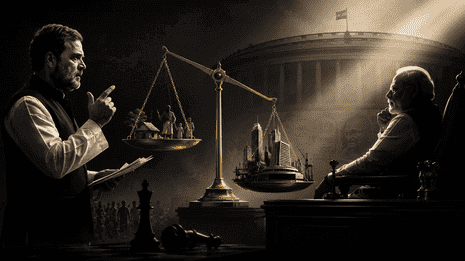
In a series of pointed addresses, Rahul Gandhi has escalated his rhetoric against Prime Minister Narendra Modi, alleging a symbiotic relationship between the Prime Minister’s office and India’s most prominent industrial houses. The core of Gandhi's argument is that the current administration has moved beyond mere policy support, transitioning into what he describes as "trading" national interests and public assets for corporate loyalty and financial backing.
The narrative gained significant momentum following a public challenge by the Prime Minister, who questioned why the Congress leadership had suddenly "stopped" mentioning certain business tycoons. Gandhi responded by suggesting that the Prime Minister is intimately aware of the financial dynamics at play, specifically citing "tempos full of cash." This exchange has shifted the focus of the national debate from general economic policy to specific allegations of crony capitalism.
I find that this shift in strategy reflects a broader attempt to frame the current political struggle as a battle between the common citizen and a small group of influential billionaires. By naming specific corporations and linking them directly to government decisions—ranging from port management to renewable energy contracts—Gandhi is attempting to make the abstract concept of "economic inequality" tangible for the average voter.
The allegations suggest that public wealth is being consolidated into the hands of a few "crony" friends of the Prime Minister. Gandhi argues that this concentration of power has a direct impact on inflation and unemployment, claiming that the government's priorities are skewed toward corporate loan waivers rather than supporting the rural economy or small-scale industries.
From a political communication standpoint, the use of the term "trading" is particularly aggressive. It implies a transactional nature to governance where policies are not formulated for public welfare but are sold for political survival. This rhetoric is designed to bypass traditional policy debates and strike at the perceived integrity of the administration’s "pro-poor" image.
Furthermore, Gandhi has challenged the Prime Minister to a direct debate on these issues, a move that highlights his confidence in this line of attack. He suggests that if the Prime Minister is truly concerned about the influence of these business houses, he should initiate a central investigation into the very "cash" transactions he alluded to in his speeches.
The implications of this discourse are profound for the democratic fabric of the country. It forces a public scrutiny of the funding mechanisms of political parties and the transparency of government tenders. Whether these allegations will lead to a shift in voter sentiment depends largely on the government's ability to counter the narrative with data on inclusive growth.
As we look toward the future of Indian politics, the "Adani-Ambani" narrative has become a litmus test for political transparency. My analysis suggests that this is no longer just a campaign slogan but a fundamental dispute over the economic soul of the nation—deciding whether India's growth model should be top-down and corporate-led or bottom-up and community-focused.