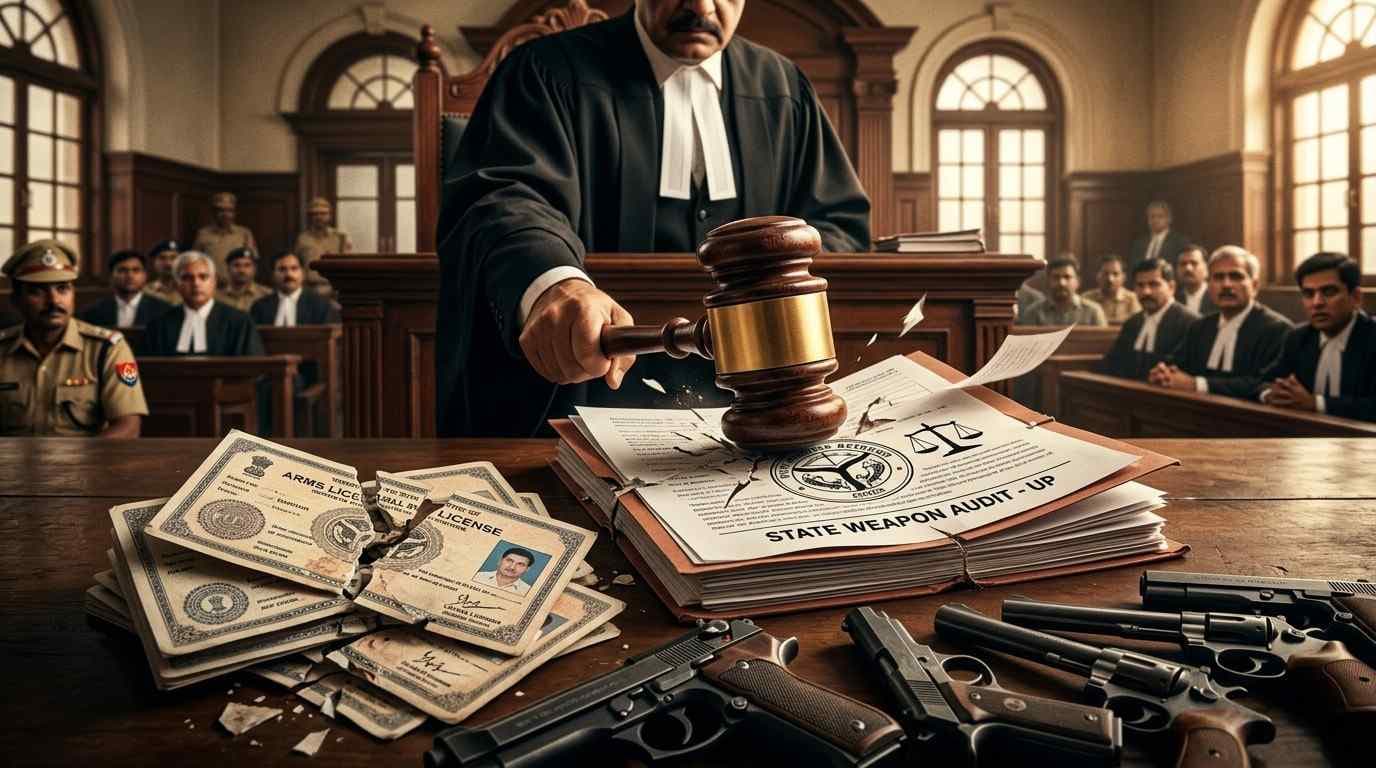
A powerful judicial intervention has sent shockwaves through the administrative and political corridors of Uttar Pradesh. The Allahabad High Court has issued a scathing critique of the state's deeply entrenched weapon culture, openly reprimanding local police authorities for actively concealing critical information regarding firearm licenses granted to high-profile political figures. Despite the state government’s public declarations of maintaining a absolute zero-tolerance policy toward weapon-based intimidation, the court revealed that the system has quietly protected influential individuals, shielding their private armories from public scrutiny and judicial oversight.
The significant confrontation stems from a public interest case focused on the widespread misuse of private firearms across the state's 75 districts. In an ambitious push for transparency, the court had previously ordered a comprehensive, state-wide audit demanding exact figures on every privately held weapon, alongside pending applications. The resulting data exposed a stunning reality: Uttar Pradesh currently harbors over one million active arms licenses. More troubling to the bench was the disclosure that over twenty thousand families possess multiple firearms, and thousands of lethal licenses have been freely granted to individuals carrying active criminal histories.
The judicial focus shifted from structural concern to outright indignation upon a detailed review of the compliance affidavit submitted by the State Home Secretary. The division bench, led by Justice Vinod Diwakar, observed that district magistrates and senior police commissioners across the state had systematically failed to adhere to statutory government orders. The court stated that the vital provisions of the Arms Act of 1959 were being treated as suggestions rather than strict legal mandates, creating a deeply permissive atmosphere where rules were routinely bypassed for the wealthy and powerful.
The most damning revelation in the High Court's order was the deliberate omission of data concerning individuals who wield massive social and political influence. The court specifically named several prominent regional heavyweights, including former BJP MP Brij Bhushan Sharan Singh, MLA Raghuraj Pratap Singh (popularly known as Raja Bhaiya), and former MP Dhananjay Singh. The bench noted with sharp irony that while ordinary citizens face exhausting bureaucratic hurdles to obtain basic security permits, the state’s enforcement machinery conveniently hid the sprawling firearm portfolios belonging to its most controversial political elites.
In a strongly worded philosophical and legal rebuke, Justice Diwakar dismissed the standard defense that widespread private weaponry is necessary for personal safety. The bench clarified that true self-defense is designed to preserve human life and uphold civil order, not to transform shared public spaces into hostile environments defined by dominance and fear. The court emphasized that the blatant public display of weapons creates a toxic, fragile illusion of strength that actively destroys social harmony, generating deep insecurity among ordinary citizens who are forced to navigate these displays of force.
Refusing to let the matter rest, the High Court has demanded an immediate, exhaustive rectification from the state government ahead of the next formal hearing. The administration must now furnish an explicit, unedited breakdown of all gun licenses granted to individuals active in public and political life. Furthermore, the court has forced a unique level of accountability, demanding to know exactly how much government-funded security and police personnel are currently deployed to protect these heavily armed politicians, exposing potential duplications of protection at the taxpayer's expense.
The administrative apparatus now faces a strict ultimatum, with the court warning that any further omissions or structural laxity will be prosecuted as intentional dereliction of duty. This unfolding legal battle marks a critical moment in the fight against feudal power dynamics in northern India. By demanding that the law apply equally to powerful lawmakers and ordinary citizens alike, the Allahabad High Court is attempting to dismantle a historical system where firearms serve as ultimate symbols of political immunity, signaling that a truly civilized society cannot be built on a foundation of state-sanctioned fear.