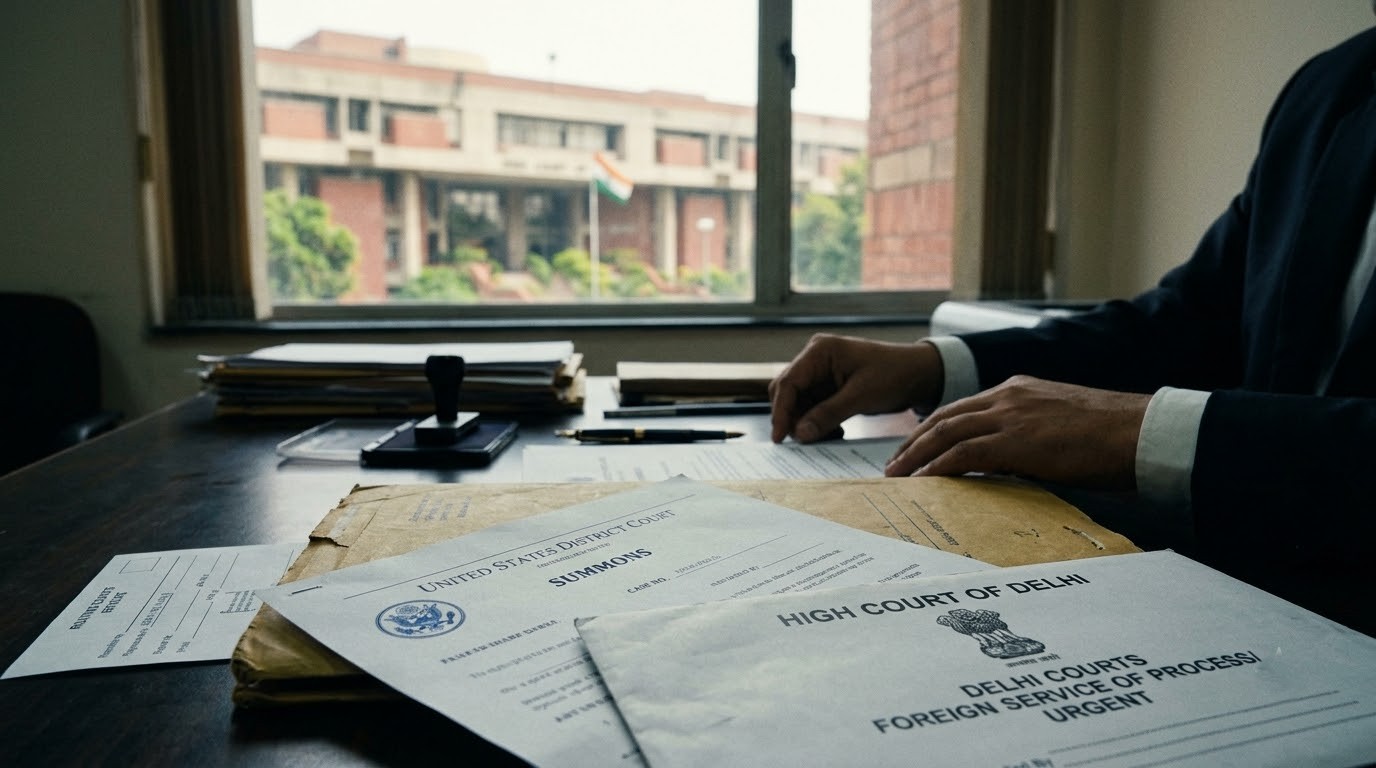
A United States federal court has directed the delivery of summonses to National Security Advisor Ajit Doval and former Research and Analysis Wing chief Samant Goel through district courts in Delhi, marking a significant procedural development in a civil lawsuit filed by Gurpatwant Singh Pannun. The order, dated November 13, was passed by Judge Katherine Polk Failla of the U.S. District Court for the Southern District of New York. The court instructed its clerk to transmit the summonses and accompanying judicial documents to the Patiala House District Court for service on Mr. Doval, and to the Dwarka and Tis Hazari district courts for service on Mr. Goel.
Legal Basis: Hague Convention and Code of Civil Procedure
The U.S. court grounded its request in the Hague Convention on the Service Abroad of Judicial and Extrajudicial Documents in Civil or Commercial Matters, as well as the relevant provisions of the Indian Code of Civil Procedure (CPC). Judge Failla noted that the Convention permits foreign courts to serve summonses on defendants residing in signatory states through the receiving state's judicial machinery. The CPC, specifically Order V Rule 25 and Section 86, provides for the service of summonses issued by foreign civil courts that have been notified by the Central Government, mandating that such summonses be served in the same manner as those issued by domestic courts.
Why Was the Alternative Route Chosen?
The order records that the standard procedure for serving the summonses through India's designated Central Authority under the Hague Convention had been attempted but rejected. The Central Authority for India is the Ministry of Law and Justice. Consequently, the U.S. court authorised an alternative mode of service under Article 19 of the Convention. Article 19 allows a judicial officer of the requesting state to forward documents directly to a judicial officer of the receiving state, provided the receiving state has not objected to this method. The U.S. court determined that this alternative channel was available and appropriate given the rejection of the primary request.
Background of the Civil Action
The underlying civil lawsuit was filed by Mr. Pannun, a dual U.S.-Canadian citizen and legal counsel for the banned organisation Sikhs for Justice (SFJ). Mr. Pannun seeks damages over an alleged attempt on his life. He has accused Mr. Doval of orchestrating the alleged assassination plot with the involvement of India's external intelligence agency. Mr. Pannun is wanted by Indian probe agencies on various terror charges. The civil action is distinct from the criminal proceedings in the same U.S. court involving Indian national Nikhil Gupta and former RAW officer Vikash Yadav over an alleged murder-for-hire plot targeting Mr. Pannun. The U.S. government is not a party to the civil suit.
India's Position on the Proceedings
India has formally rejected the lawsuit. On November 10, the Ministry of External Affairs spokesperson, Randhir Jaiswal, stated that the government rejects the "fabricated and malicious attacks" on its high officials and termed the lawsuits "frivolous." The Ministry emphasised that any request for serving judicial documents in India must be routed exclusively through India's designated Central Authority, the Ministry of Law and Justice. The U.S. court's order bypassing this authority via Article 19 directly contravenes the procedural position articulated by the Indian government.
What is the legal effect of a U.S. court directing Indian district courts to serve summonses under Article 19 of the Hague Convention?
Under Article 19 of the Hague Service Convention, a judicial officer in the requesting state may send documents directly to a judicial officer in the receiving state for service, provided the receiving state has not objected to this method. The Indian district courts receiving the request are not legally bound to comply, as Article 19 creates a facultative channel rather than a mandatory obligation, and India's Central Authority previously rejected the primary request for service.
Procedural Implications for Indian Courts
The summonses are now directed to specific district courts in Delhi—Patiala House for Mr. Doval, and Dwarka and Tis Hazari for Mr. Goel. The Indian judicial officers at these courts possess the discretion to execute or decline the request for service. The CPC framework cited by the U.S. court applies only to summonses issued by foreign courts notified by the Central Government. The operative outcome hinges on whether the concerned district judges accept the transmission as a valid request under the Convention and domestic law, or return the documents citing the Central Authority's prior rejection and the government's stated position on the exclusivity of that channel.
Service Route | Mechanism | Status in this Case |
|---|---|---|
Primary (Central Authority) | Request via Ministry of Law and Justice (Hague Convention Art. 2-5) | Attempted and Rejected |
Alternative (Article 19) | Direct transmission from U.S. Court Clerk to Indian District Courts | Authorised by Judge Failla; Awaiting Execution |
Diplomatic Note | State Department to Indian Embassy, Washington | Attempted previously; Unsuccessful |
The development places the onus on the Delhi district courts to determine the validity of the alternative service request in light of the Central Authority's refusal and the Executive's objection to the lawsuit's merits. The matter remains at the stage of service of process; no adjudication on the merits of the allegations has occurred in either jurisdiction.