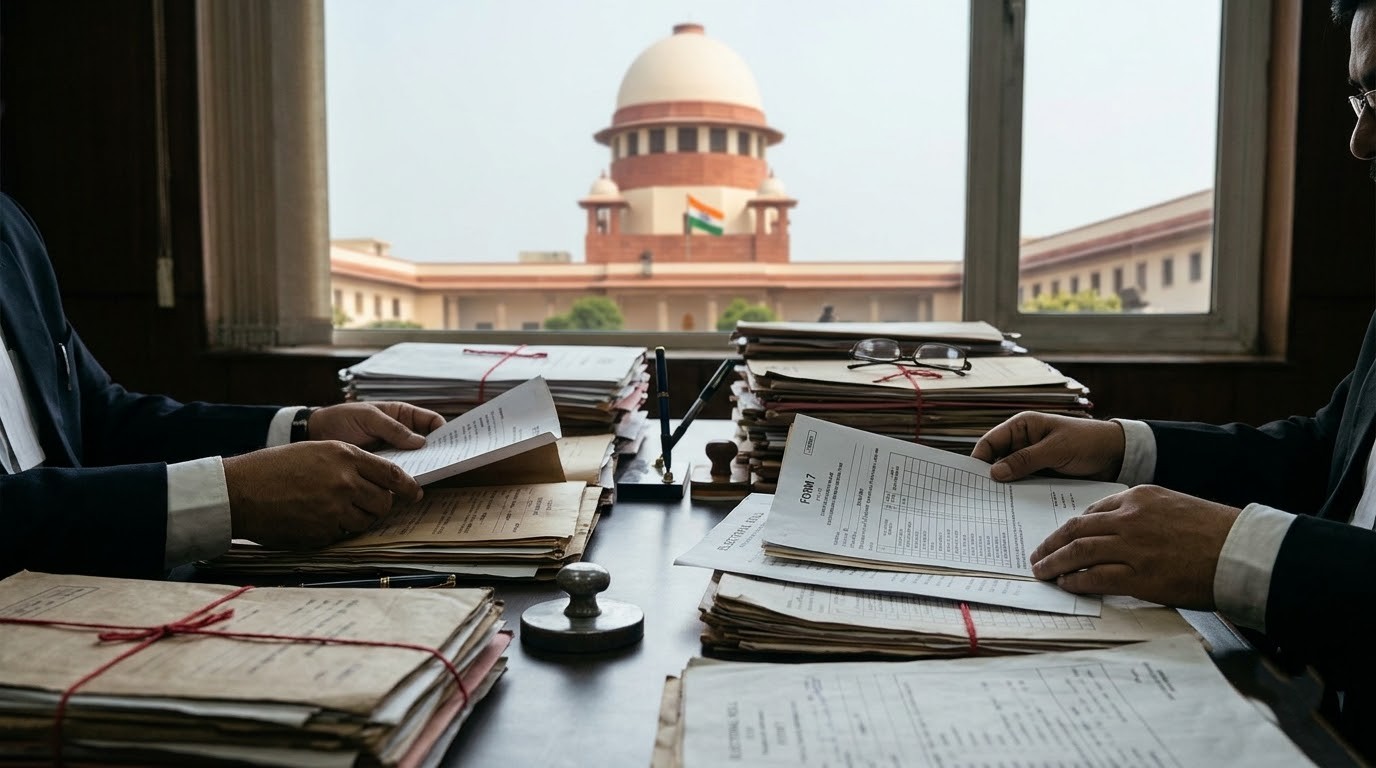
The Supreme Court on Thursday observed that the Election Commission of India (ECI) possesses limited authority to act against Booth Level Agents (BLAs) who submit fraudulent Form 7 applications seeking the deletion of names from electoral rolls. A Bench comprising Chief Justice of India Surya Kant and Justices Joymalya Bagchi and V Mohana held that the poll panel can at best blacklist such agents, as it exercises no direct administrative control over their appointment or conduct.
What Is The Extent Of The Election Commission's Power Over Booth Level Agents?
The Election Commission can only blacklist a Booth Level Agent found to have filed a fraudulent Form 7 application, as BLAs are appointed by political parties and function as their representatives, placing them outside the ECI's direct disciplinary authority.
The observations were made during the hearing of a writ petition filed by Congress leader Ali Mehdi. The petition alleged that fabricated Form 7 objections had been submitted to remove genuine voters from the electoral rolls in Delhi's Mustafabad constituency during the ongoing Special Intensive Revision (SIR) exercise. Form 7 is the prescribed application through which an objection can be raised against the inclusion of a person's name in the electoral roll or a request made for deletion of an existing entry on permissible grounds such as death or permanent shifting of residence.
The petitioner contended that several Form 7 applications had been filed in the names of Booth Level Agents who subsequently denied having signed or authorised them. It was further alleged that voters identified for deletion on the grounds of death or migration were, in fact, alive and residing at their registered addresses. Referring to media reports, the petitioner claimed that 28 voters targeted through the deletion applications were still living at the addresses recorded in the electoral rolls. Counsel for the petitioner informed the Bench that out of 37 Form 7 applications submitted, 36 were found to be false.
During the hearing, Chief Justice Surya Kant remarked that if a booth-level agent makes a fraudulent application, the Election Commission can blacklist him but has no further control. Justice Bagchi concurred, noting that since Booth Level Agents are appointed by political parties and function as their representatives, the Commission's disciplinary authority over them is limited to blacklisting.
The petitioner also complained that despite representations made to the ECI and other authorities, no First Information Reports (FIRs) had been registered to investigate the alleged fraudulent filing. On the issue of alleged police inaction, Justice Bagchi advised the petitioner to approach the jurisdictional Magistrate for appropriate relief. The Bench also noted that the petitioner had referred to earlier directions issued by the Supreme Court concerning the alleged bulk filing of Form 7 applications during the SIR exercise in Uttar Pradesh, indicating that the appropriate authorities would have to examine the complaints in accordance with law.
Ultimately, the Bench declined to examine the allegations on merits, noting that the petitioner had already submitted representations before the police, the Election Commission, and the Delhi Chief Electoral Officer. Disposing of the writ petition, the Court directed the concerned authorities to verify the information furnished by the petitioner and undertake appropriate corrective measures strictly in accordance with law. The Court clarified that it was not expressing any opinion on the veracity of the allegations.
Authority | Power Regarding Fraudulent Form 7 Applications |
|---|---|
Election Commission of India | Limited to blacklisting the Booth Level Agent; no wider disciplinary control as agents are appointed by political parties. |
Police / Magistrate | Petitioner advised to approach jurisdictional Magistrate for relief regarding non-registration of FIR. |
Delhi Chief Electoral Officer / Other Authorities | Directed to verify petitioner's allegations and take necessary remedial measures in accordance with law. |
The proceedings arose from allegations concerning the use of Form 7 applications to remove genuine voters from the electoral rolls during the Special Intensive Revision exercise in Mustafabad. The Court disposed of the matter without returning a finding on whether the applications in question were fraudulent, leaving the verification and corrective process to the designated authorities.