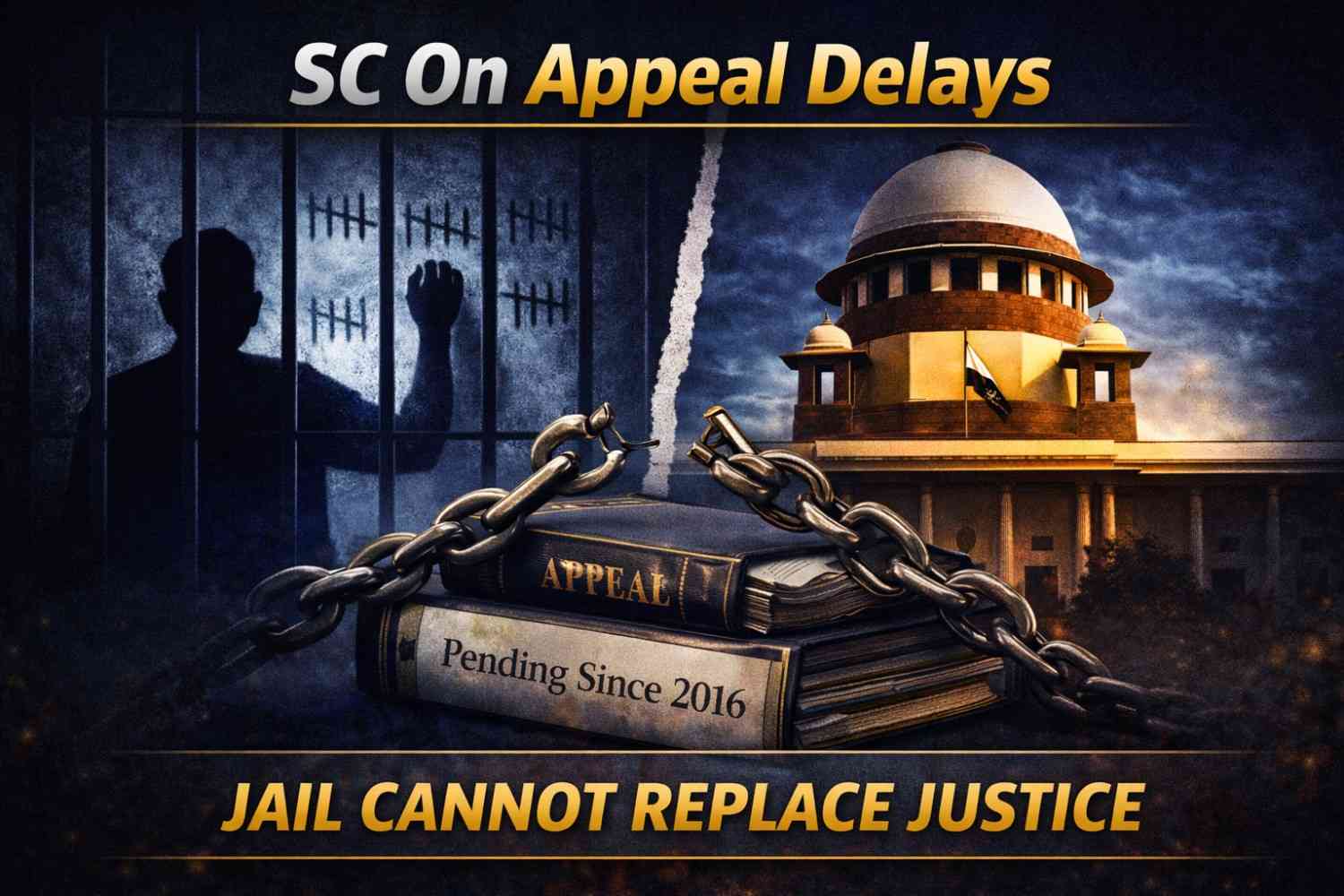
In a significant ruling on criminal justice delays, the Supreme Court of India suspended the life sentence of a murder convict whose appeal had remained pending for nearly a decade before the High Court. The Court held that keeping a convict incarcerated for years while their appeal awaits hearing amounts to a serious miscarriage of justice.
A Bench of Justice Dipankar Datta and Justice S.C. Sharma set aside the refusal of the High Court to fully suspend the sentence and made the interim bail absolute.
Background of the Case
The appellant, Muna Bisoi, had been convicted by a Sessions Court for offences under Sections 302/34 IPC (murder) and Section 27 of the Arms Act, 1959, and sentenced to life imprisonment.
He filed an appeal in 2016.
Despite the passage of almost ten years — and over eleven years of incarceration — the appeal had not been finally heard.
The High Court granted only temporary bail due to delay but refused permanent suspension of sentence. The convict then approached the Supreme Court.
Supreme Court’s Observations
The Bench emphasised that even in serious offences like murder, the right to seek suspension of sentence cannot be denied when the judicial system itself causes prolonged delay.
“Excessive delay in hearing an appeal entitles a convict to suspension of sentence.”
The Court relied on the landmark precedent Kashmira Singh v. State of Punjab (1977), reaffirming that incarceration during pending appeals defeats fairness in criminal justice.
“It would indeed be a travesty of justice to keep a person in jail for years when the appeal cannot be heard within a reasonable time.”
The judges noted there was no material showing the delay was caused by the accused.
Order of the Court
The Supreme Court:
• Suspended the life sentence
• Made the interim bail permanent
• Directed the High Court to decide the appeal expeditiously — preferably within six months
The ruling clarifies that denial of bail solely because of the gravity of the offence cannot override constitutional liberty when appellate delay becomes unreasonable.
This judgment strikes at a chronic structural problem in India’s criminal justice system — appeals pending for years while convicts remain imprisoned.
The Court effectively balanced two competing principles:
- Punishment after conviction
- Presumption of innocence pending final adjudication
By reaffirming the 1977 doctrine, the Court recognised that liberty cannot depend on court backlog.
The ruling strengthens:
• Article 21 — Right to personal liberty
• Fair trial jurisprudence
• Bail jurisprudence post-conviction
The message is clear:
Justice delayed is not just justice denied — it is unlawful detention.
The judgment could significantly impact thousands of prisoners whose appeals remain unheard for long periods, pushing High Courts toward faster criminal appellate disposal.