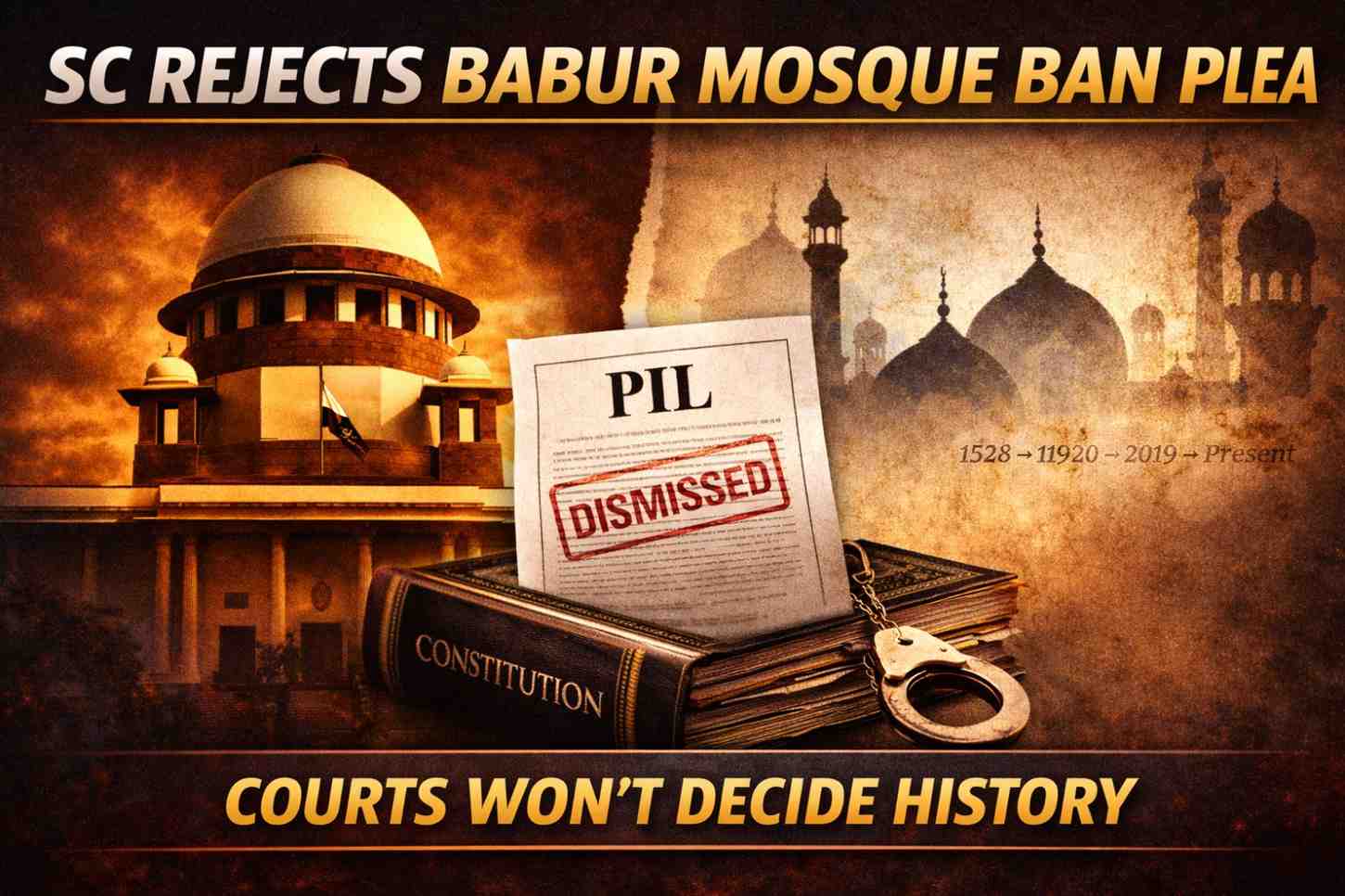
n a significant development touching upon religious freedoms and constitutional limits of judicial power, the Supreme Court of India refused to entertain a Public Interest Litigation seeking a nationwide ban on constructing or naming any mosque after Mughal emperor Babur or “Babri Masjid”.
A Bench comprising Justice Vikram Nath and Justice Sandeep Mehta dismissed the plea at the threshold, effectively halting attempts to obtain judicial directions imposing a blanket restriction on religious structures across the country.
What The Petition Asked
The petitioner sought sweeping directions to the Union and State authorities to restrain the construction, establishment, or naming of any mosque in the name of Babur or “Babri Masjid”.
The plea was framed around historical grievances, alleging that structures linked to Babur were objectionable due to his status as an invading ruler.
The petition also referred to contemporary announcements about constructing mosques bearing the name, arguing that such actions could disturb public sentiment.
However, the Court noted that the petition did not point to any specific statutory violation or enforceable legal right being breached.
Court’s Observations
The Bench expressed clear reluctance to convert ideological disagreement into a constitutional cause of action. The judges indicated that courts cannot be transformed into forums for adjudicating historical narratives or imposing nationwide cultural prohibitions.
“A broad, nationwide prohibition cannot be granted in absence of a legal foundation.”
After the Bench showed disinclination to proceed, the petitioner withdrew the plea. The Court accordingly dismissed the matter.
Constitutional Context
The decision reflects the Court’s consistent approach — judicial review operates within constitutional boundaries, not historical or political sentiment.
Religious naming, in the absence of illegality, falls within the domain of personal belief and administrative regulation rather than judicial prohibition.
The ruling also aligns with the principle that courts do not issue generalized directives affecting the entire country without a concrete legal cause of action.
This order is important for three reasons:
- Limits of PIL Jurisdiction: The Court reaffirmed that Public Interest Litigation cannot be used to pursue ideological or historical agendas without legal injury.
- Religious Freedom: Naming of religious structures — unless unlawful — remains protected under constitutional freedoms.
- Judicial Restraint: Courts will not regulate historical memory or collective sentiment through blanket bans.
The ruling reinforces a key constitutional principle:
Courts adjudicate legality — not history.