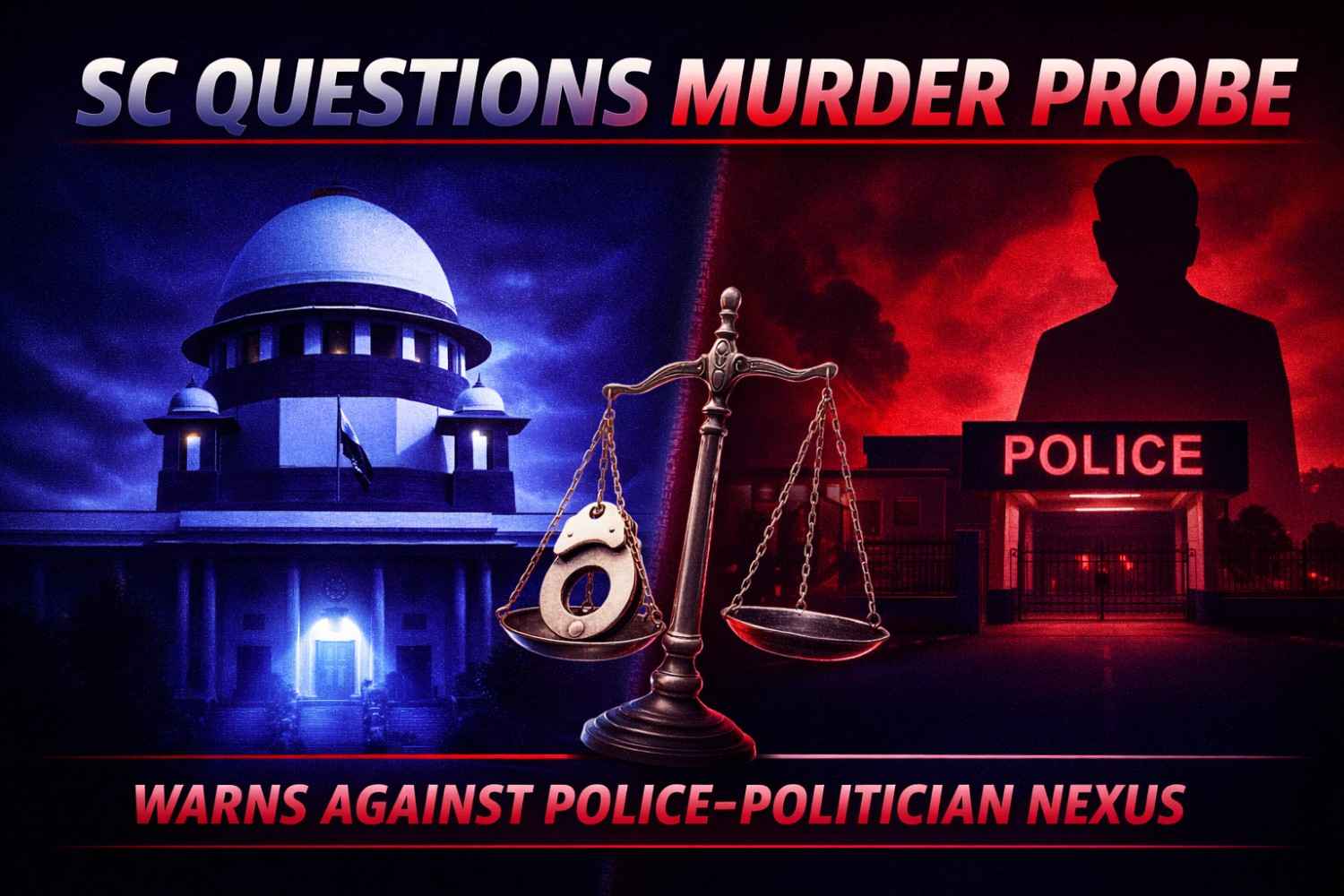
The Supreme Court of India has strongly criticised the Andhra Pradesh Police for what it described as a “casual and ineffective” investigation in a murder case allegedly involving YSRCP MLC Udaya Bhaskar.
The Court’s remarks came while hearing petitions alleging manipulation of the probe and shielding of influential accused persons, raising concerns over a possible police-politician nexus affecting the fairness of criminal investigation.
Allegations Before The Court
The case relates to the suspicious death of a victim under circumstances suggesting homicide. Petitioners contended that:
- Crucial evidence was ignored
- Witnesses were not properly examined
- Investigation was deliberately diluted
- Politically influential accused were protected
The plea sought an independent investigation, arguing that public confidence in the probe had eroded.
Supreme Court’s Observations
The Bench expressed deep dissatisfaction with the manner in which the investigation had progressed.
“If the investigation is seen as protecting influential persons, it shakes public faith in the rule of law.”
The Court noted that the case records indicated selective examination of evidence and failure to pursue logical investigative leads.
“The criminal justice system cannot function if investigation agencies appear compromised.”
The judges emphasised that the police are constitutionally obligated to act impartially, irrespective of the political position of an accused.
On Police Independence
The Court underscored that criminal investigation is a statutory duty — not a political discretion.
It warned that failure to conduct fair investigation:
• Violates due process
• Undermines Article 21 rights
• Damages institutional credibility
The Bench indicated that courts will intervene whenever investigation appears tainted by external influence.
Possible Consequences
The Court signalled that it may consider transferring the investigation or issuing monitoring directions if deficiencies persist.
The observations serve as a caution to law-enforcement authorities that investigative neutrality is not optional but a constitutional obligation.
This case touches the core of criminal justice integrity.
Courts generally avoid supervising police investigations. However, when influence is suspected, judicial oversight becomes necessary to protect:
- Fair trial rights
- Victim justice
- Public confidence in law enforcement
The ruling reinforces a vital constitutional principle:
Equality before law applies equally to ordinary citizens and powerful political figures.
By questioning investigative impartiality, the Court sends a strong message — the legitimacy of democracy depends not only on elections, but on unbiased enforcement of criminal law.