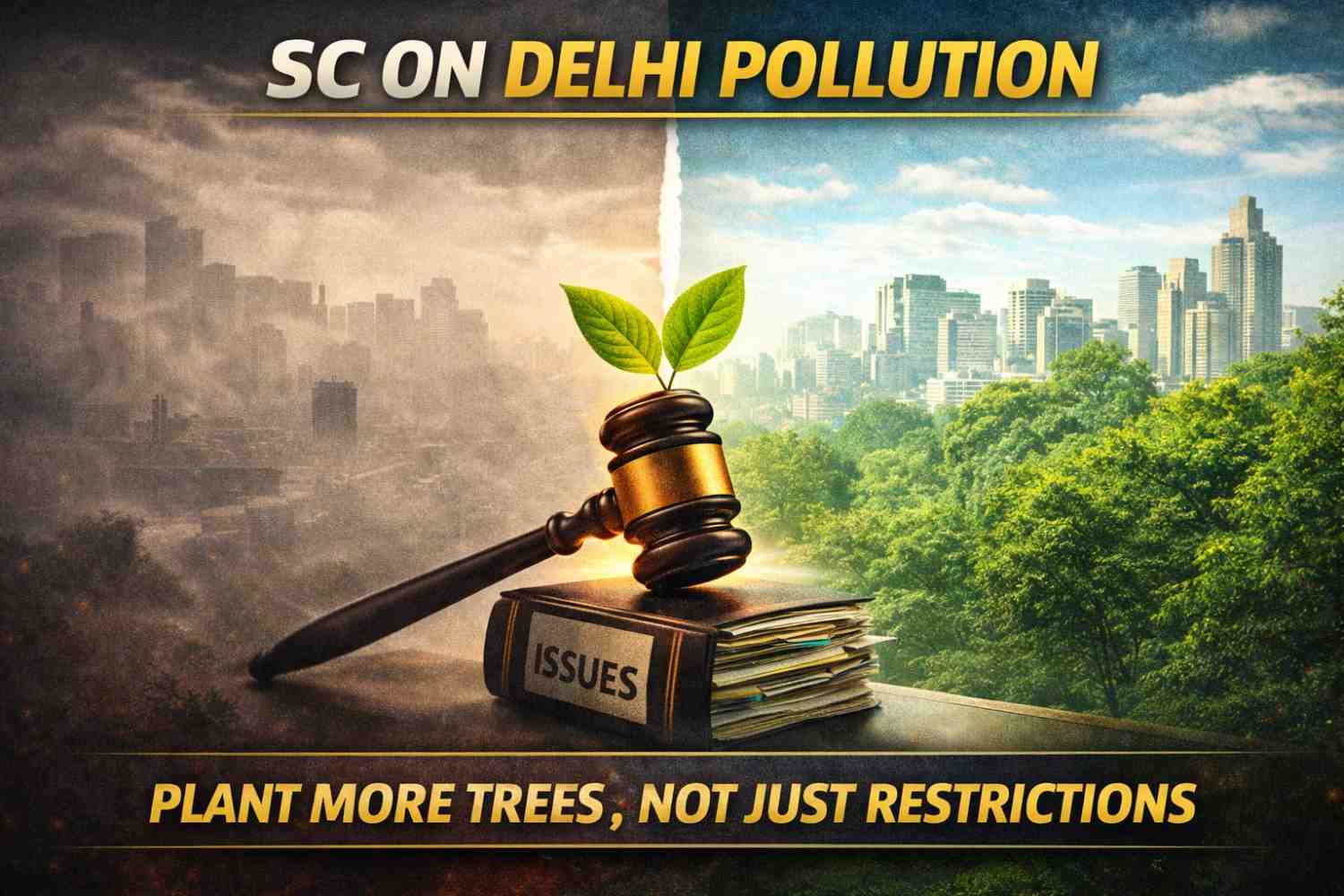
While hearing matters concerning Delhi’s worsening air quality, the Supreme Court of India observed that increasing green cover is one of the most effective long-term solutions to improve the Capital’s Air Quality Index (AQI).
The Court underscored that recurring seasonal restrictions — such as construction bans and vehicle limitations — cannot permanently solve pollution unless ecological measures are adopted.
Court’s Concern Over Recurring Pollution Cycle
The Bench was examining compliance with air-pollution mitigation measures implemented each winter under environmental regulations and graded response mechanisms.
During the hearing, the Court noted that authorities repeatedly resort to temporary measures, yet the pollution crisis resurfaces every year.
“We keep imposing restrictions season after season. We need a permanent solution.”
The judges pointed out that reactive policies address symptoms rather than causes.
Green Cover As Structural Solution
The Court highlighted that expanding urban tree cover offers multiple environmental benefits:
- Absorbs particulate matter
- Reduces heat island effect
- Improves humidity balance
- Enhances oxygen levels
“Increasing green cover is a far more effective and lasting method to improve air quality.”
The Bench suggested that urban planning authorities must incorporate ecological design into development policy rather than treating it as an afterthought.
Accountability of Authorities
The Court questioned authorities on whether long-term planning was being undertaken beyond emergency enforcement actions.
The judges stressed that environmental governance must transition from crisis response to prevention strategy:
• Urban planning reforms
• Forest and roadside plantation
• Protection of existing trees
• Scientific monitoring of ecological impact
The Court made it clear that environmental protection cannot rely solely on bans imposed during peak pollution months.
The order marks an important jurisprudential shift in environmental litigation.
For years, pollution cases have resulted in temporary prohibitory orders — vehicle restrictions, school closures, construction halts — providing short relief but no lasting impact.
The Court now emphasises preventive environmental governance over reactive regulation.
This approach aligns with constitutional environmental principles under:
- Right to life and clean environment
- Sustainable development doctrine
- Intergenerational equity
The message is clear:
Delhi’s air quality crisis is not just an enforcement failure — it is a planning failure.
Unless cities are designed with ecological balance in mind, seasonal emergency orders will continue indefinitely.
The Court’s remarks therefore push policy from courtroom-managed crisis control toward long-term environmental architecture — a significant evolution in India’s environmental jurisprudence.