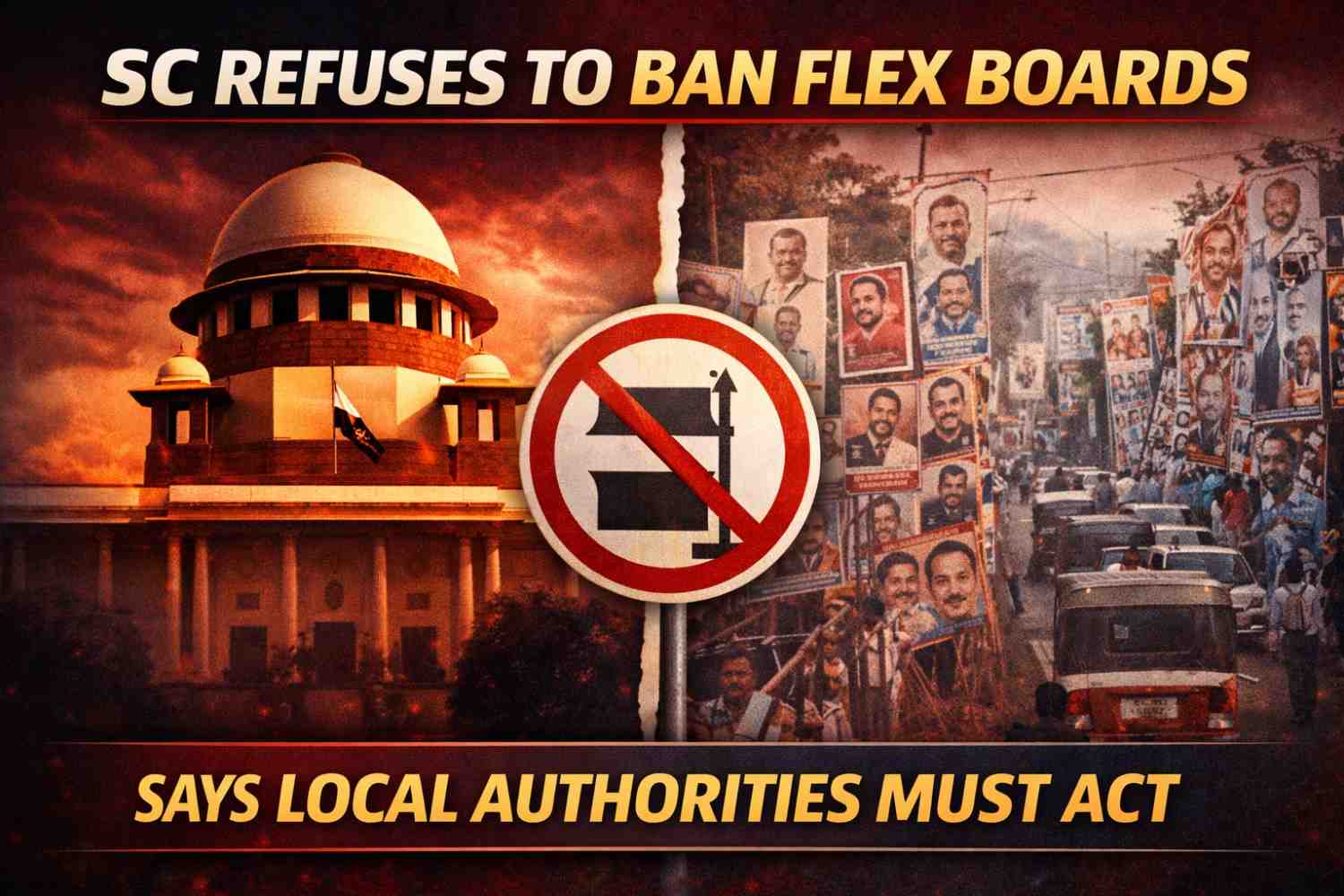
The Supreme Court of India has declined to intervene in a petition seeking directions against the widespread use of unauthorised flex boards and hoardings in Kerala, observing that such matters fall within the domain of local administrative authorities.
The Bench emphasised that the Court cannot be converted into a supervisory body for enforcement of municipal laws and directed the petitioner to approach appropriate state authorities.
What The Petition Alleged
The Public Interest Litigation claimed that illegal flex boards:
- Pose serious road safety hazards
- Obstruct pedestrian pathways
- Cause visual pollution
- Continue despite regulatory guidelines
The petitioner sought directions to authorities for strict enforcement and removal drives across the State.
Supreme Court’s Observations
The Court declined to issue pan-India judicial directions, noting that enforcement of local civic regulations must be handled by designated statutory bodies.
“Such issues must be addressed by the competent authorities under the municipal and police laws.”
The Bench remarked that the Constitution does not envisage the Supreme Court acting as a day-to-day regulator for local governance failures.
The judges cautioned against filing petitions directly in the apex court when alternative remedies exist under statutory frameworks.
The Court reiterated a consistent judicial principle:
Courts intervene when law fails — not when administration fails to act initially.
Citizens must first:
• Approach municipal corporations
• File complaints before district authorities
• Seek remedies before High Courts if necessary
Only then can constitutional jurisdiction be invoked.
“We cannot monitor implementation of local regulations in every State.”
The ruling reinforces the doctrine of judicial restraint and federal balance.
If every civic complaint — from potholes to illegal banners — reaches the Supreme Court, constitutional courts would become municipal complaint centres, paralysing their primary function of constitutional adjudication.
The order sends a clear message:
- Public Interest Litigation is not a shortcut
- Administrative accountability begins locally
- Supreme Court jurisdiction remains exceptional
The judgment therefore protects both federal governance structure and judicial efficiency, reminding litigants that constitutional courts are guardians of rights — not substitutes for civic administration.