Skip to content

    Supreme Court to Hear PIL for Mandatory Regulation of Educational Institutions Under 14

    SC News

    1. Home
    2. /SC News

    Supreme Court to Hear PIL for Mandatory Regulation of Educational Institutions Under 14

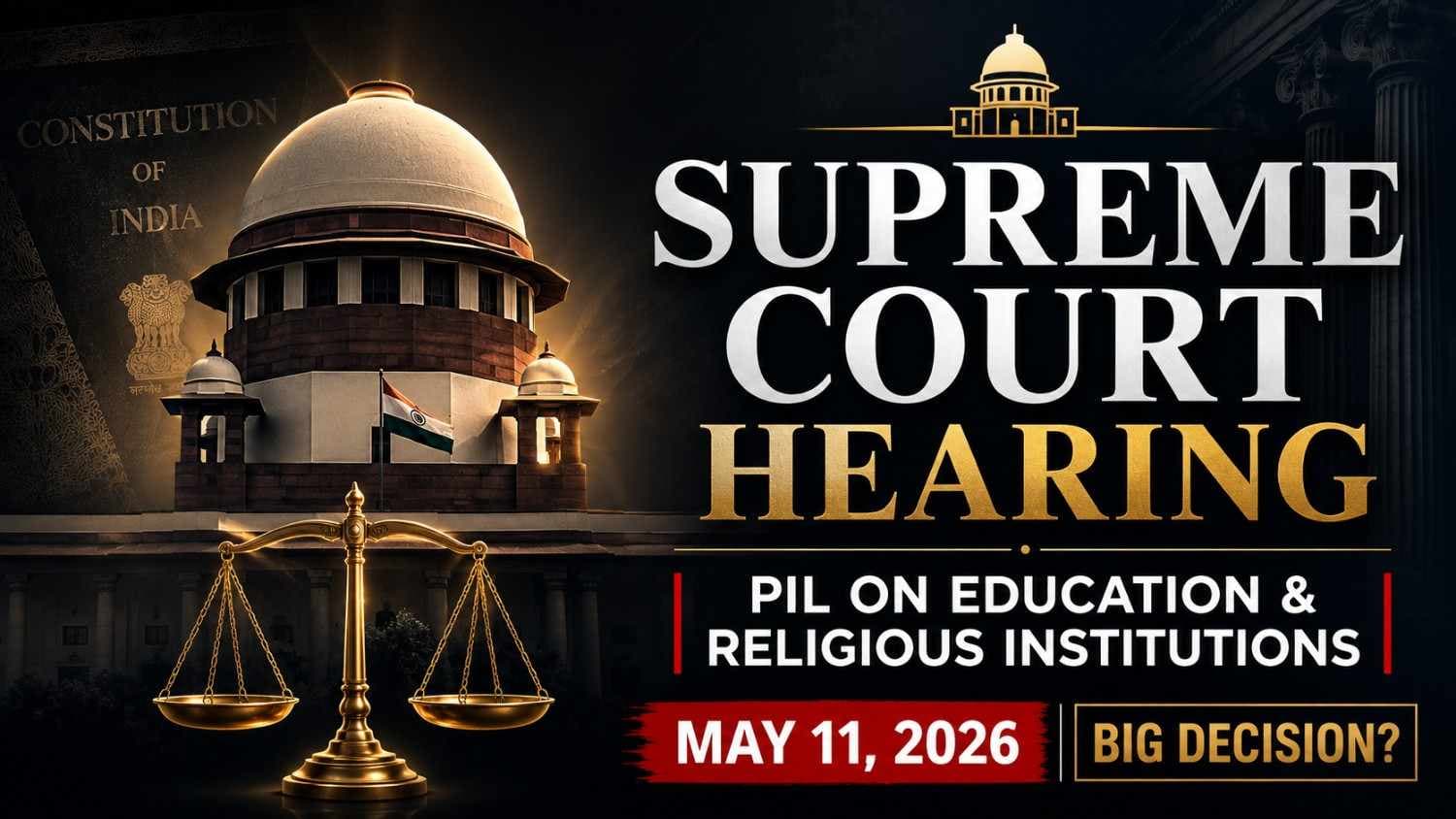
    The Supreme Court is set to hear a PIL on May 11 seeking mandatory registration and oversight for all secular and religious educational institutions for children below 14.

    Hydar Choudhury
    May 10, 2026·4 min read
    Supreme Court to Hear PIL for Mandatory Regulation of Educational Institutions Under 14

    ​The Supreme Court of India is scheduled to hear a significant Public Interest Litigation (PIL) on May 11, 2026, seeking comprehensive directions to the Union and State governments to regulate all institutions imparting education or religious instruction to children below the age of 14. A bench comprising Justices Dipankar Datta and Satish Chandra Sharma will preside over the matter, which raises critical questions about the state's role in monitoring "unregistered and unrecognized" institutions that currently operate outside the standard regulatory framework.

    ​The plea, filed by advocate Ashwini Kumar Upadhyay through advocate Ashwani Dubey, argues that the lack of effective oversight for institutions catering to children in their "tender and gullible age" is a matter of national security. The petitioner claims that during visits to border districts in Uttar Pradesh, he discovered numerous unregistered institutions operating without any official recognition. The petition contends that without state monitoring, these environments could become hubs for manipulation or indoctrination, thereby necessitating a structured system for registration, recognition, and supervision.

    ​Central to the legal challenge is the interpretation of Article 30 of the Constitution, which grants minorities the right to establish and administer educational institutions. The petitioner seeks a declaration that Article 30 is merely a "specific reiteration" of the right to practice any profession or carry on any occupation under Article 19(1)(g) and does not confer additional, unchecked privileges. The plea argues that while the state must respect minority rights, it maintains a "heightened responsibility" under Article 21A (Right to Education) to ensure that every child—regardless of the type of institution—receives a safe and standardized education.

    ​The petition further invokes Article 39(f), Article 45, and Article 51-A(k), emphasizing that children are the backbone of the nation’s growth. It highlights that the current absence of regulation leads to a lack of institutional accountability, unqualified teaching staff, and non-standardized curricula. By treating pre-primary and religious education as a "constitutional blind spot," the state may be failing in its duty to protect the fundamental rights of its youngest citizens to a quality education and a safe environment.

    Advertisement

    Hydar Choudhury

    See more from Hydar →
    Jurisight logoJurisight logo

    Simplifying legal knowledge for professionals and citizens. Your daily source for Supreme Court, High Court, and Business Law updates.

    Platform

    HomeAll ArticlesTop NewsSC UpdatesHC Updates

    Categories

    Business LawConstitutionalCriminal LawCivil LawKnow Your Law

    Weekly Digest

    Join 15,000+ others and get the week's most important legal updates.

    © 2026 Jurisight. All rights reserved.
    Privacy PolicyCookie PolicyCookie ConsentLegal Disclaimer
    Advertisement

    ​From an expert legal standpoint, this case touches upon the "Essentiality" and "Reasonable Restriction" doctrines. The Supreme Court will have to balance the autonomy of religious and minority institutions with the state’s power to regulate "secular activities" associated with education. If the court favors the petitioner, it could lead to a massive administrative overhaul, requiring thousands of madrasas, Vedic pathshalas, and private pre-schools to comply with the same rigorous standards as recognized primary schools.

    ​The institutional implications are vast, particularly for institutions operating in sensitive border regions. The plea explicitly links the absence of regulation to potential "brainwashing," framing the issue as one of communal and national integrity. This framing places the judiciary in a position to define where "religious instruction" ends and "secular education" begins, and whether the state can mandate a core curriculum even in institutions protected by personal laws or minority rights.

    ​Furthermore, the timing of the PIL coincides with broader national discussions on the implementation of the National Education Policy (NEP) and the push for uniform educational standards. A judicial order mandating the "supervision and monitoring" of all such institutions would effectively bridge the gap between formal schooling and informal religious or community-led learning centers. It would empower the state to inspect facilities, vet teaching staff, and ensure that the welfare of children remains paramount.

    ​Ultimately, the Supreme Court’s hearing on May 11 will be a litmus test for the limits of institutional autonomy in India. By bringing "unrecognized" centers under the judicial scanner, the court is addressing a long-standing grievance regarding the "shadow education" system. The outcome could redefine the educational landscape for millions of children, ensuring that the promise of the Right to Education is not limited by the walls of the specific institution they attend.

    Explore related legal coverage

    Continue with reporting and analysis connected to this article.

    Browse SC News

    More from this court

    • "Arrest and Remand Illegal If Written Grounds of Arrest Not Communicated at Least Two Hours Before Magistrate Appearance: SC"

      Supreme Court of India

    • Adani Enterprises Rs 126 Crore Arbitral Award Upheld By SC

      Supreme Court of India

    Statutes and provisions

    • Menstrual Health is a Shared Responsibility, Not Just a "Women’s Issue": Supreme Court Recognizes Right to Menstrual Hygiene Under Article 21

      Article 21A

    • Department Of Education Cannot Impose Recruitment Restrictions On Aided Minority Schools: Delhi High Court

      Article 30

    Related legal topics

    • Revenue Records Don't Confer Title: Supreme Court Summarizes Key Principles on Land Ownership and Revenue Entries

      SC News

    • Supreme Court: Judgments Must Address All Issues, Not Just One Winning Point

      SC News

    Advertisement