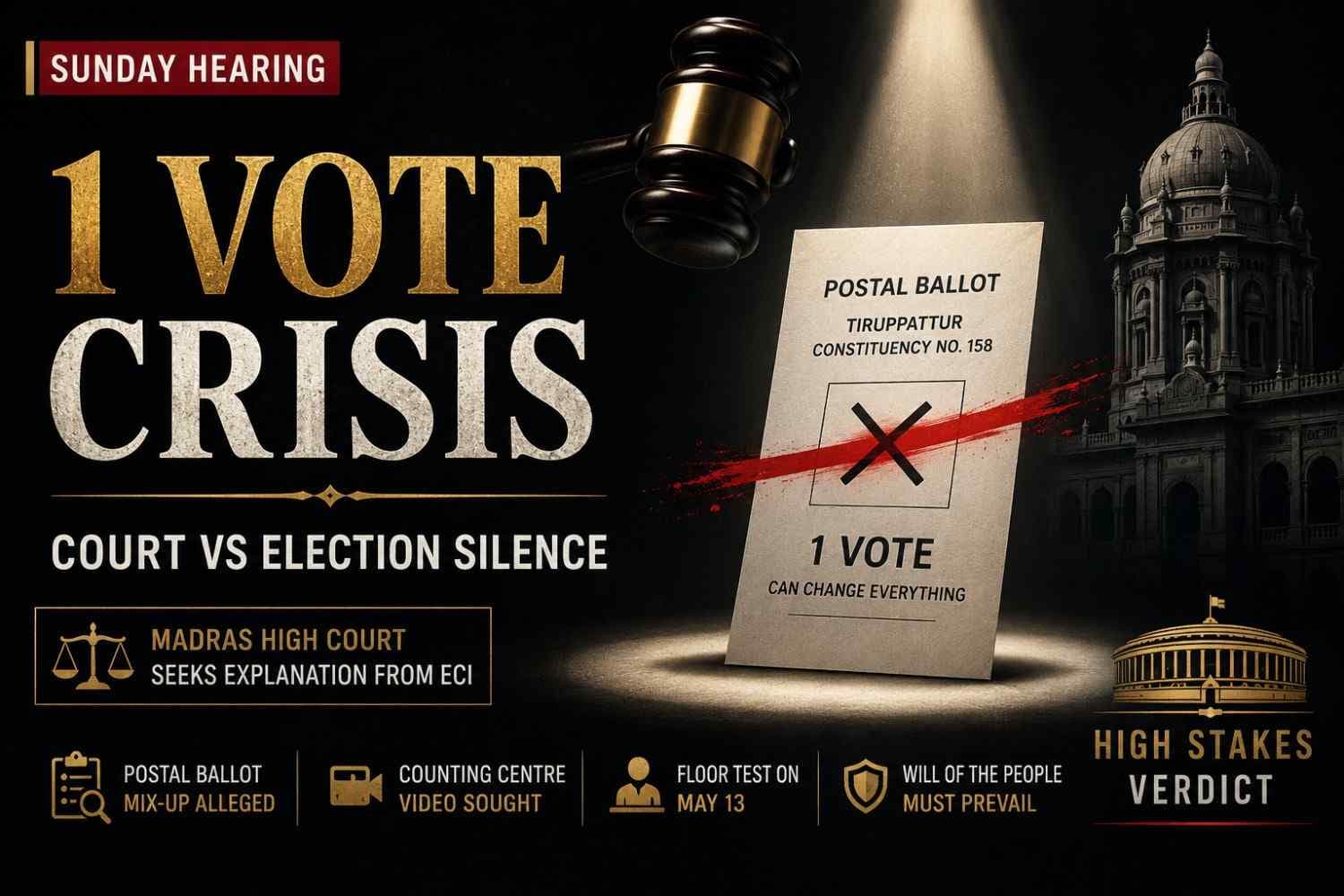
In an extraordinary special Sunday hearing on May 10, 2026, the Madras High Court sought an immediate explanation from the Election Commission of India (ECI) regarding its silence on a petition filed by DMK leader KR Periakaruppan. The former minister, who contested from the Tiruppattur constituency in the 2026 Assembly elections, lost by a razor-thin margin of just one vote to the Tamilaga Vettri Kazhagam (TVK) candidate, Seenivasa Sethupathi. The court’s intervention underscores the gravity of electoral precision when the stakes of government formation are so high.
The core of the dispute involves a potential administrative mix-up regarding postal ballots. Periakaruppan alleges that one postal ballot belonging to his constituency (No. 158 Tiruppattur, Sivaganga district) was mistakenly sent to and counted in another constituency with the same name (No. 50 Tiruppattur, Vellore district). The DMK leader contends that despite repeated representations to election officials during the counting process, his objections were ignored, and a recount of postal ballots was denied.
A vacation bench comprising Justice L. Victoria Gowri and Justice N. Senthil Kumar questioned the ECI on the specific protocols available for such a "rare and unique" situation. The court inquired whether any mechanism exists to retrieve and re-verify a ballot paper once it has been wrongly funneled into the count of a different constituency. Senior Advocate Mukul Rohatgi, appearing for the DMK candidate, argued that common sense and democratic fairness dictate that a single vote—which could flip a seat—must be meticulously accounted for.
The timing of this hearing is particularly sensitive as the state is currently undergoing a leadership transition. While TVK leader C. Joseph Vijay was sworn in as Chief Minister earlier today, the victory of the TVK candidate in Tiruppattur is crucial for the party's numbers ahead of a mandatory floor test scheduled for May 13. Any judicial order restraining the TVK MLA from participating in legislative proceedings could significantly impact the new government’s ability to prove its majority in a potentially hung assembly.
The petitioners have also requested that the court direct the production of video footage from the counting center to verify if the re-verification process followed the ECI's "Handbook for Returning Officers." The DMK argues that without judicial oversight, the "wafer-thin" victory of 83,365 votes to 83,364 remains legally suspect. The court’s decision to hold a special sitting on a Sunday reflects the urgency of resolving electoral disputes before they can result in irreversible legislative outcomes.
From an expert legal standpoint, this case highlights a significant procedural gap in the management of constituencies with identical names. It raises the question of whether the ECI’s current digital and manual tracking systems are robust enough to handle the complexities of postal ballots in high-stakes elections. The court's demand for a response by tomorrow morning indicates that the judiciary is prepared to act swiftly to ensure that the "will of the people" is not subverted by a clerical error.
The institutional implications for the ECI are profound. A ruling in favor of the petitioner could necessitate a historic "cross-constituency" recount or a partial stay on the results. It serves as a reminder to the election machinery that in a democracy, every single vote carries the weight of the entire system. As the state waits for the ECI’s reply, the integrity of the 2026 mandate hangs on the verification of a single slip of paper.
Ultimately, the Madras High Court’s intervention is a safeguard against administrative inertia. By requiring the ECI to break its silence, the judiciary is ensuring that the electoral process is not just completed, but seen to be fair and accurate. The outcome of this "one-vote" battle will be a litmus test for the resilience of India's democratic infrastructure in the face of unprecedented political competition.