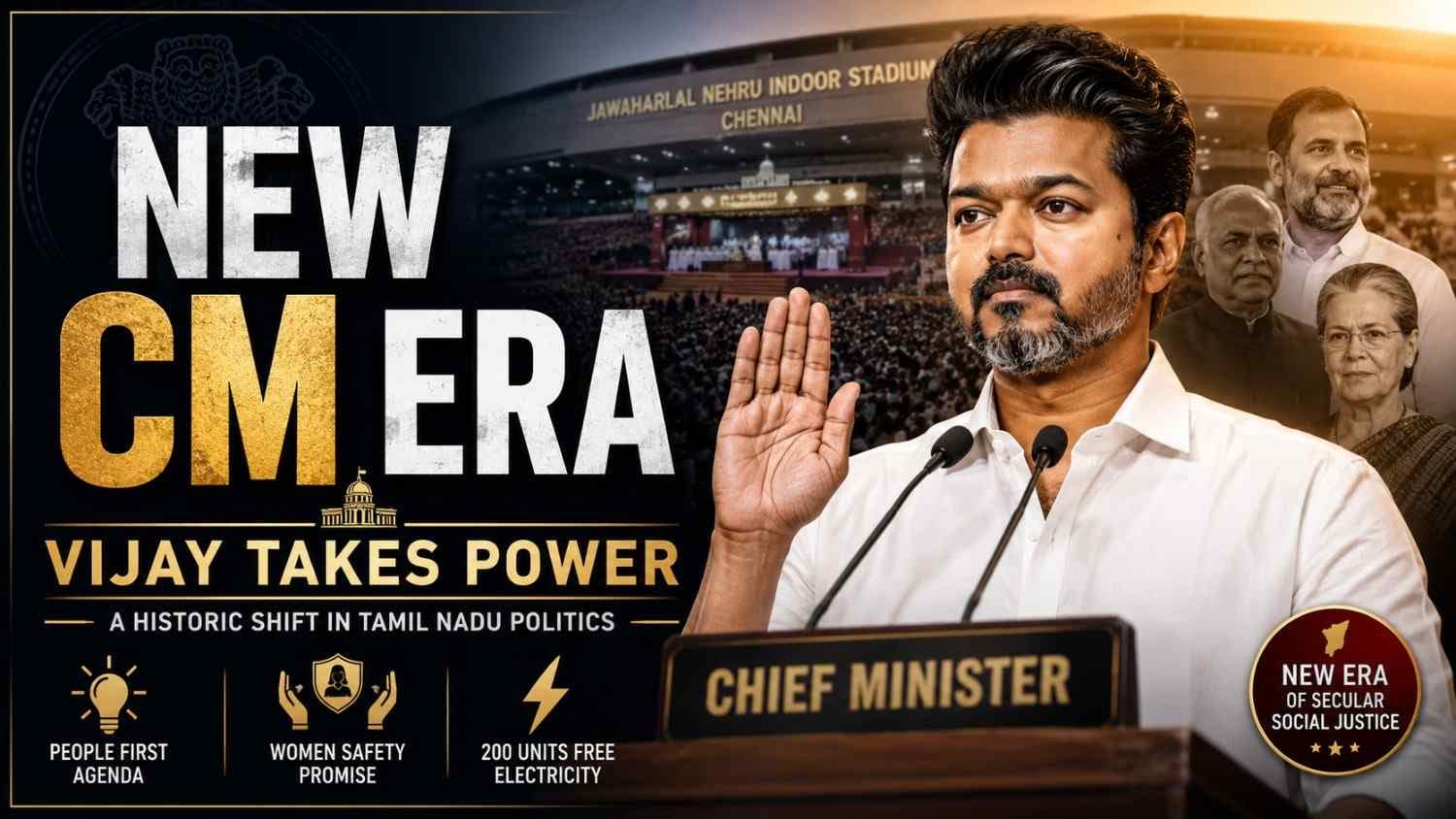
In a historic shift that has redefined the political landscape of Southern India, Tamilaga Vettri Kazhagam (TVK) president C. Joseph Vijay was sworn in today as the Chief Minister of Tamil Nadu. The high-profile ceremony, held at the Jawaharlal Nehru Indoor Stadium in Chennai, was a spectacle of both political might and emotional connection. Surrounded by his parents, national leaders like Rahul Gandhi, and a sea of supporters, the actor-turned-politician officially marked the end of the nearly six-decade-long duopoly held by the DMK and AIADMK.
Addressing the massive gathering in his first official speech, Vijay struck a deeply personal note that resonated with his "Gen Z" and grassroots base. "I do not come from a royal family or a prince's household," he declared, framing his entry into politics as a repayment of a debt to the people. By positioning himself as a "son" and a "brother" to every household, he signaled a departure from the traditional image of a distant political patriarch. His emotional appeal included a specific shout-out to his youngest supporters, assuring them that "Vijay Mama" would always be there to secure their future.
The TVK’s ascent to power is a feat of strategic alliance-building. After winning 108 seats in the 234-member Assembly, the party fell short of the 118-seat majority mark. However, Vijay successfully negotiated the support of former DMK allies, including the Congress, VCK, CPI, CPI(M), and IUML, bringing the coalition’s total to 120 MLAs. This formation represents the first truly successful "third pole" in Tamil politics, successfully capitalizing on anti-incumbency and a desire for fresh leadership among the state’s 1.7 crore voters.
Immediately after taking the oath administered by Governor Rajendra Vishwanath Arlekar, the new Chief Minister signed his first executive orders on the stage itself. These initial policy moves were highly symbolic, focusing on welfare and safety: the provision of 200 units of free electricity for all households and the formation of a dedicated "Women Protection Force." These actions fulfill key pre-election promises and suggest that the TVK administration intends to lead with a "people-centric" agenda that prioritizes immediate economic relief and social security.
The composition of Vijay's maiden cabinet reflects a mix of loyalists and strategic regional representatives. Nine ministers, including close confidante N. Anand and veteran K.A. Sengottaiyan, took the oath alongside him. By including diverse voices from the "Secular Social Justice" platform, Vijay is attempting to build a stable coalition that can navigate the complexities of a hung assembly. The presence of national leaders like Rahul Gandhi on the dais also hints at a broader shift in national-level alignments ahead of future general elections.
From an expert legal and political perspective, this transition marks a major stress test for the "Dravidian Model." While Vijay has embraced his Christian identity and secular politics, his rhetoric often mirrors the populism of former stars-turned-leaders like M.G. Ramachandran (MGR). The challenge for the TVK will be to translate this star-power and emotional "brotherhood" into effective governance. A promised "white paper" on state finances suggests that the new administration is bracing for a difficult economic reality as it attempts to fund its ambitious welfare schemes.
The reaction from the national stage has been one of cautious optimism. Prime Minister Narendra Modi congratulated the new Chief Minister on X, pledging that the Central Government would work with the state to improve the lives of its citizens. However, the path ahead is not without obstacles. With the DMK and AIADMK now in the opposition, the TVK-led coalition will face intense scrutiny in the Assembly. Vijay’s ability to maintain the unity of his diverse allies—many of whom have vastly different ideological backgrounds—will determine the longevity of this historic government.
Ultimately, the oath ceremony was more than a political event; it was a cultural milestone for Tamil Nadu. By bridging the gap between cinema and the secretariat in record time, Vijay has proven that the state's appetite for charismatic, alternative leadership remains strong. As the "new era of secular, social justice" begins, the focus remains on whether "Thalapathy" can successfully transition from the screen to the seat of power, transforming his cinematic image into a lasting administrative legacy.