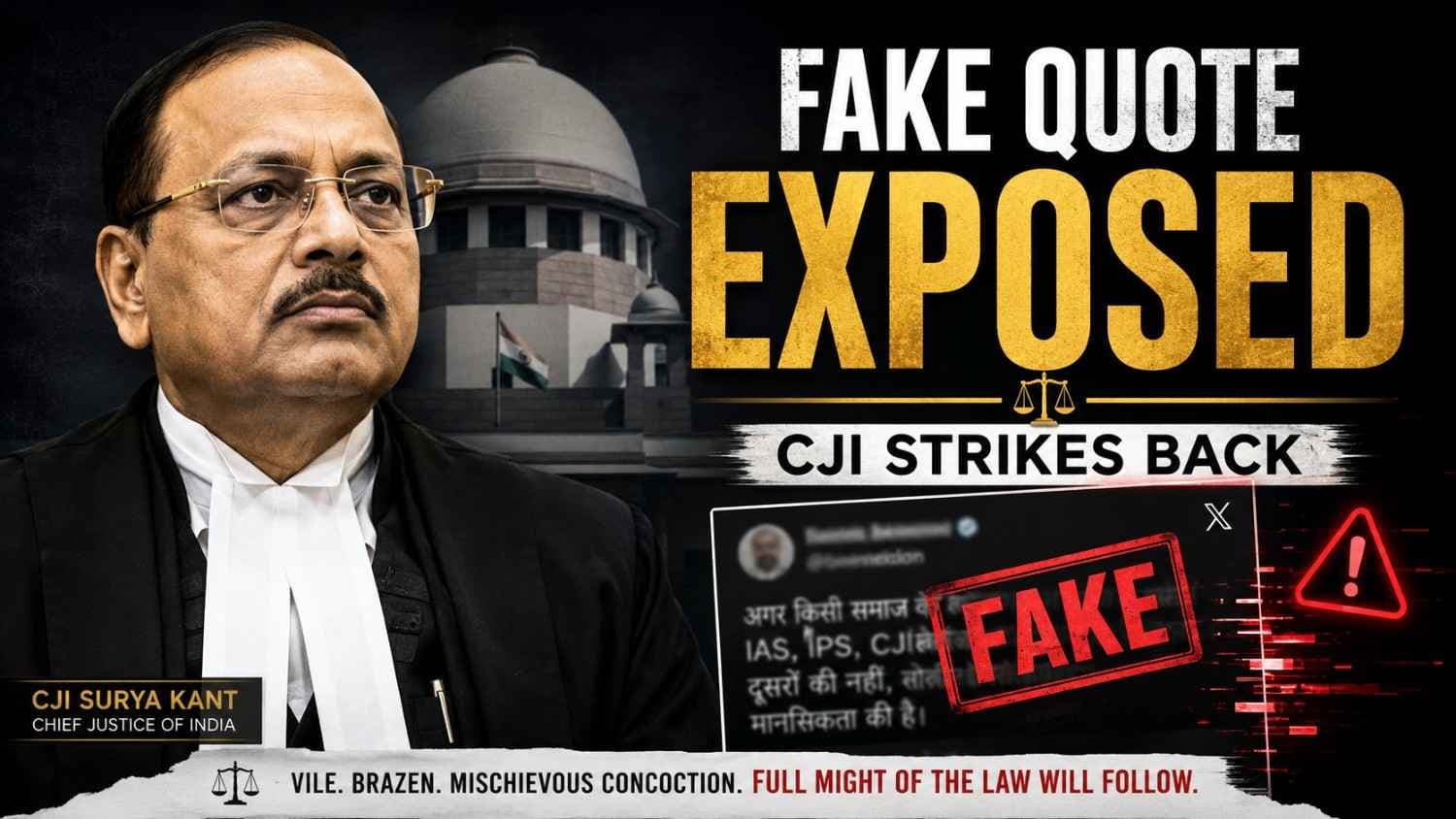
In a rare and forceful direct pushback, Chief Justice of India (CJI) Surya Kant has categorically denied and condemned a fabricated social media post that falsely attributed a casteist statement to him. The Office of the CJI issued a formal statement on May 10, 2026, describing the circulation of the fake graphic as a "vile, brazen, and mischievous concoction" designed to incite social discord and undermine public trust in the judiciary. The CJI warned that he is prepared to bring the "full might of the law" to ensure those responsible for the misinformation face severe repercussions.
The controversy stems from a post shared on X (formerly Twitter) by an account named "@UnreservedMERIT." The post included a photograph of the Chief Justice alongside a fabricated quote in Hindi suggesting that if a society remains exploited despite its members holding high offices like IAS, IPS, or CJI, the fault lies with that society's mentality rather than others. The Supreme Court's official response clarified that these remarks are "wholly baseless, malicious, and demonstrably false," emphasizing that they do not reflect the words, views, or character of the Chief Justice.
The statement from the CJI’s office highlighted that manufacturing fictitious quotes and attributing them to the highest judicial office in the land is an act of "rank dishonesty." It characterized the post as an attempt at "deliberate social incitement" and a direct contempt for constitutional values. By using the CJI's image to lend a veneer of authority to caste-sensitive rhetoric, the perpetrators aimed to strike at the very foundation of the rule of law and the impartiality of the Indian judicial system.
Beyond the specific denial, the CJI called upon citizens, media organizations, and social media platforms to exercise restraint. He urged the public to verify sources before amplifying unverified and misleading content that can cause widespread social harm. The Supreme Court’s intervention underscores a growing concern within the judiciary regarding the weaponization of social media to target individual judges and the institution at large with sophisticated misinformation campaigns.
From an expert legal standpoint, this incident underscores the urgent need for robust mechanisms to tackle digital forgery and "deep-fake" text attributions. The CJI’s warning of "legal consequences" suggests that the matter may be handed over to investigative agencies for a criminal probe into charges of forgery, defamation, and inciting communal or social hatred. This proactive stance marks a shift in how the apex court handles online trolling and disinformation, moving from silent tolerance to active legal deterrence.
The institutional implications are significant, as the judiciary seeks to maintain its sanctity in an era of viral misinformation. The court noted that such reckless conduct forces the judiciary to spend valuable time correcting the record rather than focusing on its primary task of justice delivery. The statement serves as a stern reminder that the freedom of speech on digital platforms does not extend to the fraudulent appropriation of a public official’s identity to spread divisive narratives.
Furthermore, the timing of this pushback is crucial, as the judiciary faces increasing scrutiny on social media platforms. By naming the specific account and the nature of the fraud, the Office of the CJI has provided a clear blueprint for how public institutions can confront digital falsehoods head-on. This move is expected to pressure social media intermediaries to act more swiftly in removing content that impersonates or falsely attributes statements to constitutional authorities.
Ultimately, CJI Surya Kant’s response reaffirms that judicial integrity is a non-negotiable pillar of Indian democracy. By threatening to use the full force of the law against the creators of the fake quote, the Chief Justice has signaled that the bench will not be intimidated or misrepresented by digital actors. The outcome of the ensuing legal actions will likely set a major precedent for how the state handles the intersection of high-office identity and social media misinformation in the future.