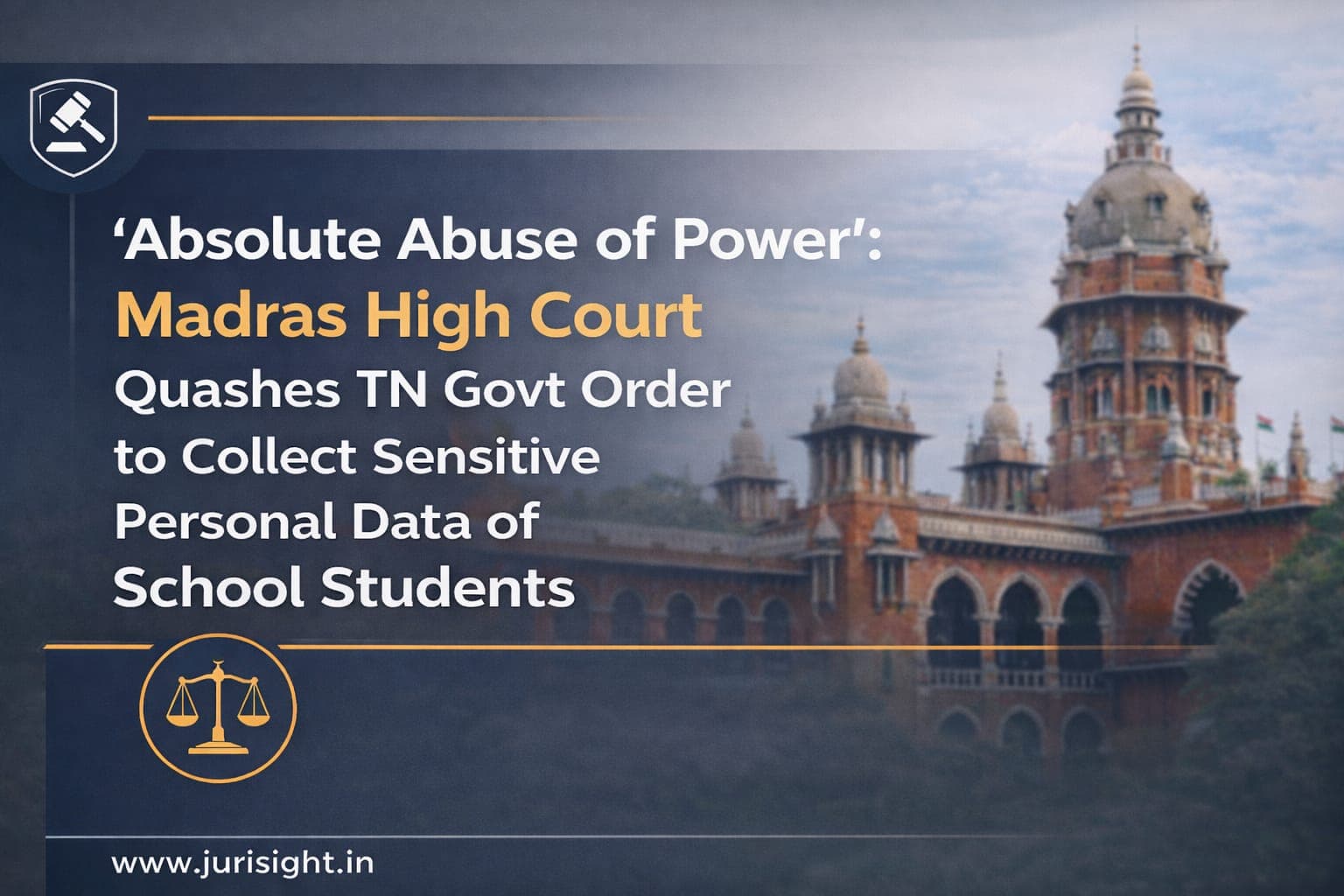
In a landmark judgment championing the privacy rights of minors, the Madurai Bench of the Madras High Court has quashed a controversial directive issued by the Tamil Nadu Education Department. The directive sought to collect highly sensitive personal and social background data from students in government-run Model Schools.
Terming the move an "absolute abuse of power," a Division Bench comprising Justice G. Jayachandran and Justice K.K. Ramakrishnan held that such data collection without a clear, justified purpose is a gross violation of the right to privacy and leads to the "stigmatization" of vulnerable children.
The legal battle began following a circular issued on September 4, 2025, by the Member Secretary of the Model School wing under the Tamil Nadu Education Department. The order directed teachers of government-run Model Schools to interview students from Classes 9 to 12 and upload their responses to the Education Management Information System (EMIS) portal.
The questionnaire consisted of 25 deeply personal questions. Students were asked to disclose:
- Whether they belonged to refugee, nomadic, or gypsy communities.
- If they were migrants from other states or from oppressed caste backgrounds.
- Whether they faced gender non-conformity issues.
- Details regarding any history of abuse, violence, or substance abuse within their families.
The petitioner, Ameer Alam, represented by Advocate M. Aboobacker Siddik, challenged this directive through a writ petition. The petitioner argued that forcing children to reveal such sensitive information—often in front of peers or teachers—violated their fundamental right to privacy and exposed them to discrimination and social stigma.
The High Court Bench was categorical in its disapproval of the State's methodology. The January 5 ruling emphasized that the collection of such data, and the manner in which it was being documented, constituted "clear discrimination and ill-treatment."
The Bench noted that instead of supporting students, such a process would "demoralize" those coming from difficult social backgrounds.
"This Court finds that it is an absolute abuse of power to demoralise the students who have a stigmatic background," the judgment stated.
The Court further observed that privacy is not a right that a student surrenders simply because they are in a public institution like a government school. Drawing from established legal principles, the Bench reiterated that privacy is an essential facet of human dignity that attaches to the person, regardless of their location.
During the proceedings, the State government and the Model School authorities, represented by Government Pleaders M. Thilak Kumar and Kavitha Deenadhayalan, attempted to justify the move.
They argued that the information was being collected under the principle of parens patriae (the State acting as a legal guardian). The authorities claimed that the goal was to identify students who required "special attention" and tailored support due to their vulnerable backgrounds.
However, the Court remained unconvinced. The Bench pointed out that the authorities failed to provide a concrete plan on how this sensitive data would actually benefit the students.
"It is not explained as to what is the special attention they are going to show to the students. The information sought is very sensitive, and the manner in which they are going to collect it will necessarily traverse into the privacy of the young students," the Bench held.
This judgment is a significant addition to India’s evolving privacy jurisprudence, specifically concerning the rights of children. Legal experts suggest that the ruling sets three important precedents:
- Purpose Limitation: The State cannot collect sensitive data under the guise of "welfare" without proving exactly how that data will be used to achieve a specific, beneficial outcome.
- Protection Against Stigma: The Court recognized that "categorizing" children based on caste, family history of substance abuse, or trauma can lead to institutional bias and social shaming.
- Dignity in Education: By quashing the order, the Court has sent a clear message that the dignity of a student is paramount, and government schools cannot be used as hubs for intrusive data mining.
By allowing the writ petition and quashing the September 2025 order, the Madras High Court has protected thousands of students from potential profiling. The ruling serves as a reminder to administrative bodies that while data-driven governance is a modern tool, it cannot bypass the constitutional safeguards of privacy and dignity.
For the students of Tamil Nadu’s Model Schools, the ruling ensures that their school remains a place for learning and growth, rather than an environment where their personal tragedies and social backgrounds are documented for the digital record.
- Case Title: Ameer Alam Vs State of Tamil Nadu
- Bench: Justice G. Jayachandran and Justice K.K. Ramakrishnan
- Date of Order: January 5, 2026