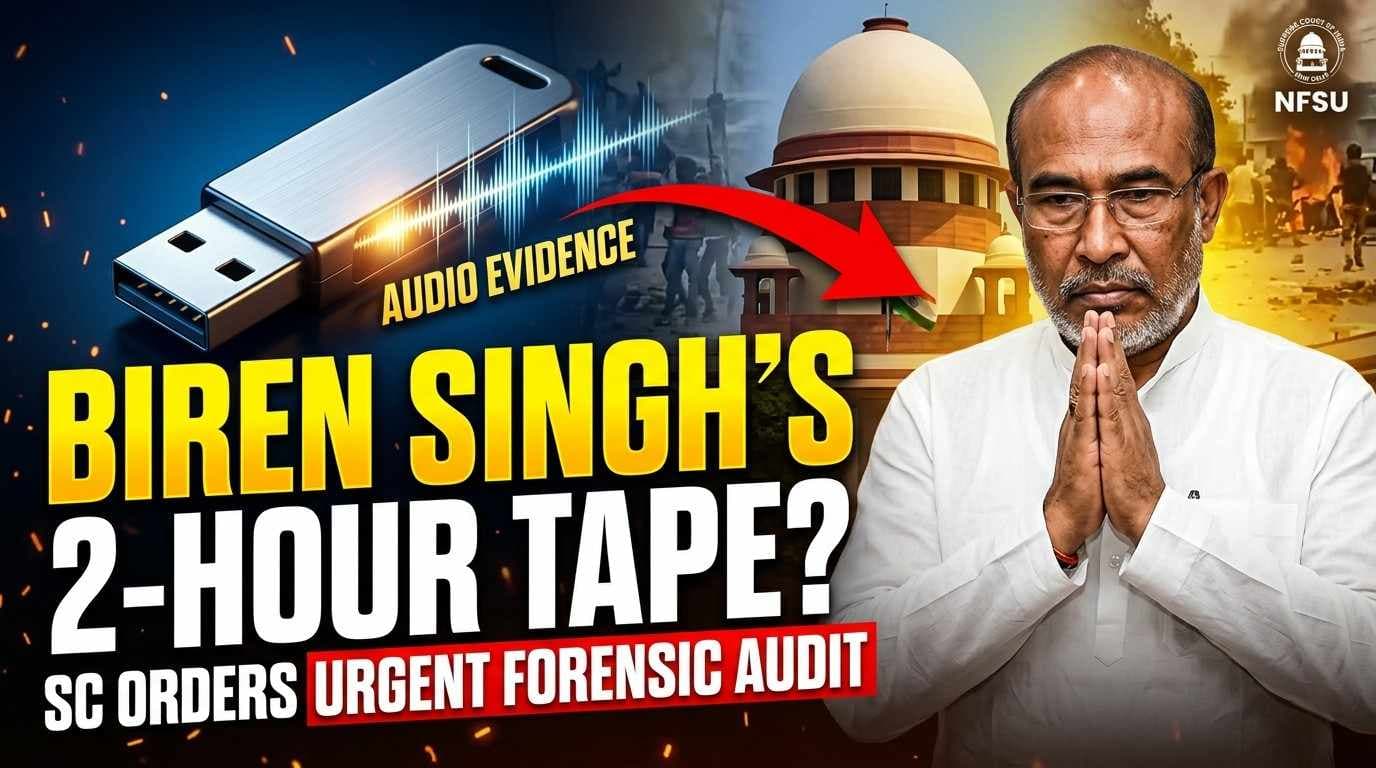
In a significant advancement of the investigation into the Manipur ethnic violence, the Supreme Court of India has ordered a comprehensive forensic examination of a lengthy audio recording allegedly linking former Chief Minister N Biren Singh to the unrest. On Thursday, April 30, 2026, a Bench of Justices Sanjay Kumar and Vinod Chandran directed the National Forensic Sciences University (NFSU) in Gujarat to analyze the complete 2-hour and 26-minute recording.
The case, initiated by the Kuki Organisation for Human Rights Trust, centers on explosive allegations that the former Chief Minister admitted in these recordings to "fuelling insurgency" and "protecting those who looted arms" during the state's prolonged crisis. While the petitioners had initially relied on a shorter, 48-minute clip, the NFSU previously reported that the version appeared truncated and edited, making a conclusive voice match impossible.
During the hearing, Advocate Prashant Bhushan informed the Court that the petitioners are now placing the full, unmodified audio on record. This "first-generation copy," transferred from the original recording device to a pen drive, will now be the subject of a rigorous technical audit. The Court has directed the NFSU to compare the voice in this recording with "admitted voice samples" of Singh—sources that may include official interviews or public speeches.
Additional Solicitor General (ASG) Aishwarya Bhati, appearing for the Centre, underscored the technical difficulties faced by forensic experts thus far. She noted that earlier samples showed "variations at different intervals," compromising the integrity of the speech parameters. The ASG pointed out that "untampered portions cannot be reliably identified" in edited clips, which is why the submission of the full, raw file is critical for scientific validity.
Justice Sanjay Kumar reiterated the importance of using the most direct copy of the evidence, noting that "copies of copies" often lead to digital corruption that can thwart forensic analysis. By providing the NFSU with the full recording, the Court aims to move past the ambiguity of the shorter clips and establish whether the voice heard is indeed that of N Biren Singh and if the content has been manipulated via signal alterations.
The NFSU has been asked to complete this high-priority exercise within six weeks. The results of this forensic audit are expected to be a cornerstone of the legal proceedings, as they will determine whether the alleged admissions by a top constitutional official are authentic or a result of sophisticated digital processing.
As Manipur continues to navigate its path toward peace, this judicial scrutiny of digital evidence highlights the increasing role of forensic science in resolving complex political and human rights disputes. The Supreme Court's insistence on a "full audio" examination ensures that the final determination will be based on the highest standards of evidentiary proof.
The matter is set to be taken up again in six weeks, following the submission of the NFSU’s report.