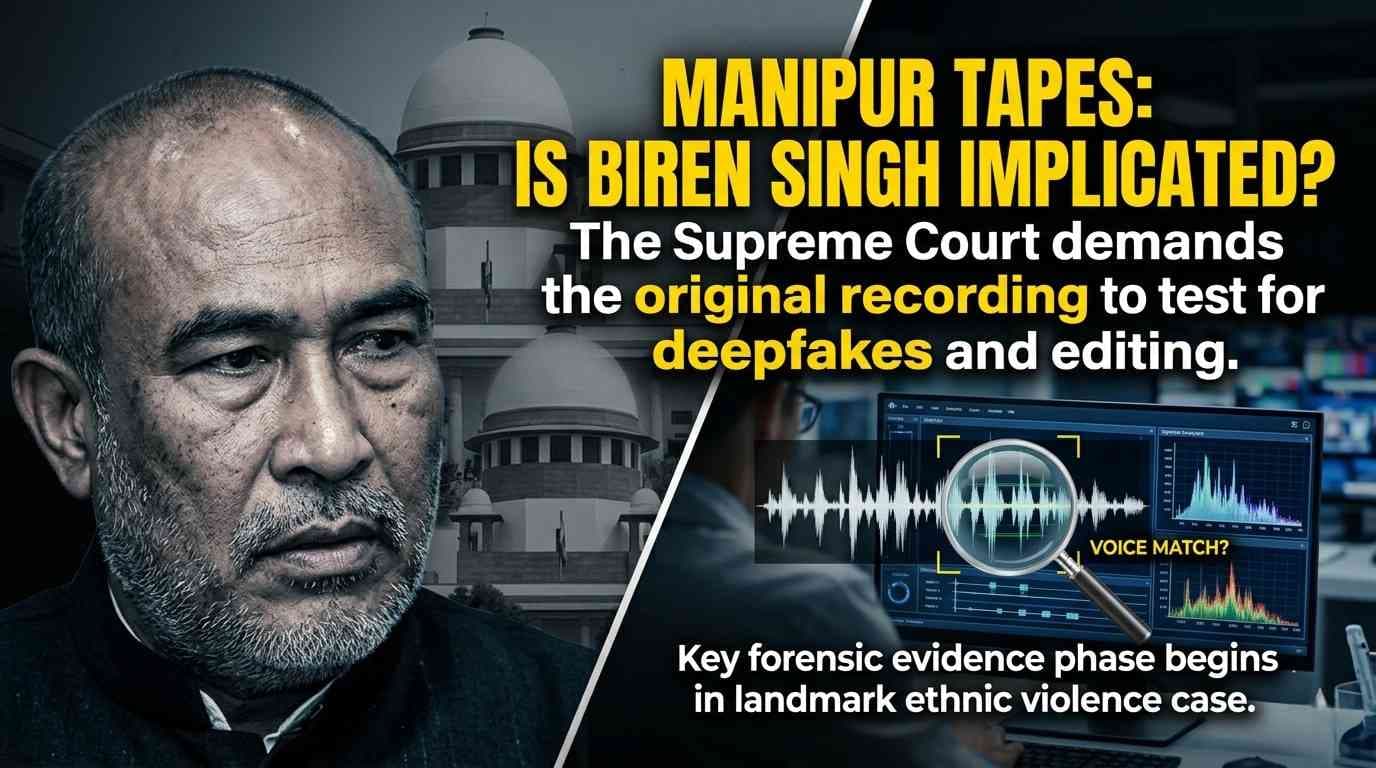
The Supreme Court’s investigation into the ethnic violence in Manipur has entered a critical evidentiary phase. On Thursday, April 30, 2026, a Bench comprising Justice Sanjay Kumar and Justice K Vinod Chandran directed a whistleblower to submit the "first-generation copy" of an audio recording that allegedly implicates former Chief Minister N Biren Singh in the state’s unrest.
The case, brought forward by the Kuki Organization for Human Rights, centers on an audio clip lasting approximately 2 hours and 26 minutes. While petitioners claim the recording contains incriminating statements, previous attempts at forensic verification have been inconclusive. Reports from the Central Forensic Science Laboratory (CFSL) in Guwahati and the National Forensic Sciences University (NFSU) suggested that the audio might have been modified or degraded, making a definitive voice comparison impossible.
During the hearing, Advocate Prashant Bhushan, appearing for the petitioners, informed the Court that the whistleblower had deleted the original recording from their mobile phone out of fear for their safety. However, a copy had been transferred to a pen drive before deletion. The Court emphasized that for a valid forensic comparison, the NFSU requires the most direct copy possible—a "raw file" without alterations—as "copies of copies" lead to digital degradation similar to how WhatsApp images lose quality.
"There is no point in giving a copy of a copy of a copy," Justice Sanjay Kumar observed, highlighting the technical necessity of preserving the digital hash value to ensure the evidence's integrity.
In a move to facilitate an accurate comparison, the Supreme Court has also directed the State of Manipur to furnish "admitted voice recordings" of Biren Singh—such as those from Doordarshan interviews—to the NFSU. This will allow forensic experts to map the voice patterns of the alleged clip against a confirmed sample of the former Chief Minister’s speech.
The NFSU has been given a six-week window to complete this exercise. The University’s task is to determine whether the voice in the 146-minute recording matches that of N Biren Singh and to detect any signs of deepfake technology or manual editing that could compromise the evidence.
The hearing also touched upon the safety of the whistleblower. While Bhushan expressed concerns that providing original hardware could expose the individual's identity, the Court accepted the Additional Solicitor General’s (ASG) assurance that only the raw digital file on a pen drive is necessary, rather than the physical mobile device.
This ruling underscores the judiciary’s commitment to using advanced science to navigate the murky waters of digital evidence in high-stakes human rights cases. By insisting on first-generation files and admitted samples, the Court is ensuring that the eventual findings—whether they implicate or exonerate—stand on a foundation of scientific certainty rather than political speculation.
As the NFSU begins its six-week analysis, the legal and political communities in Manipur and across India await a report that could potentially redefine the narrative of the state’s tragic ethnic conflict. The next chapter of this case will depend entirely on what the "raw files" reveal.