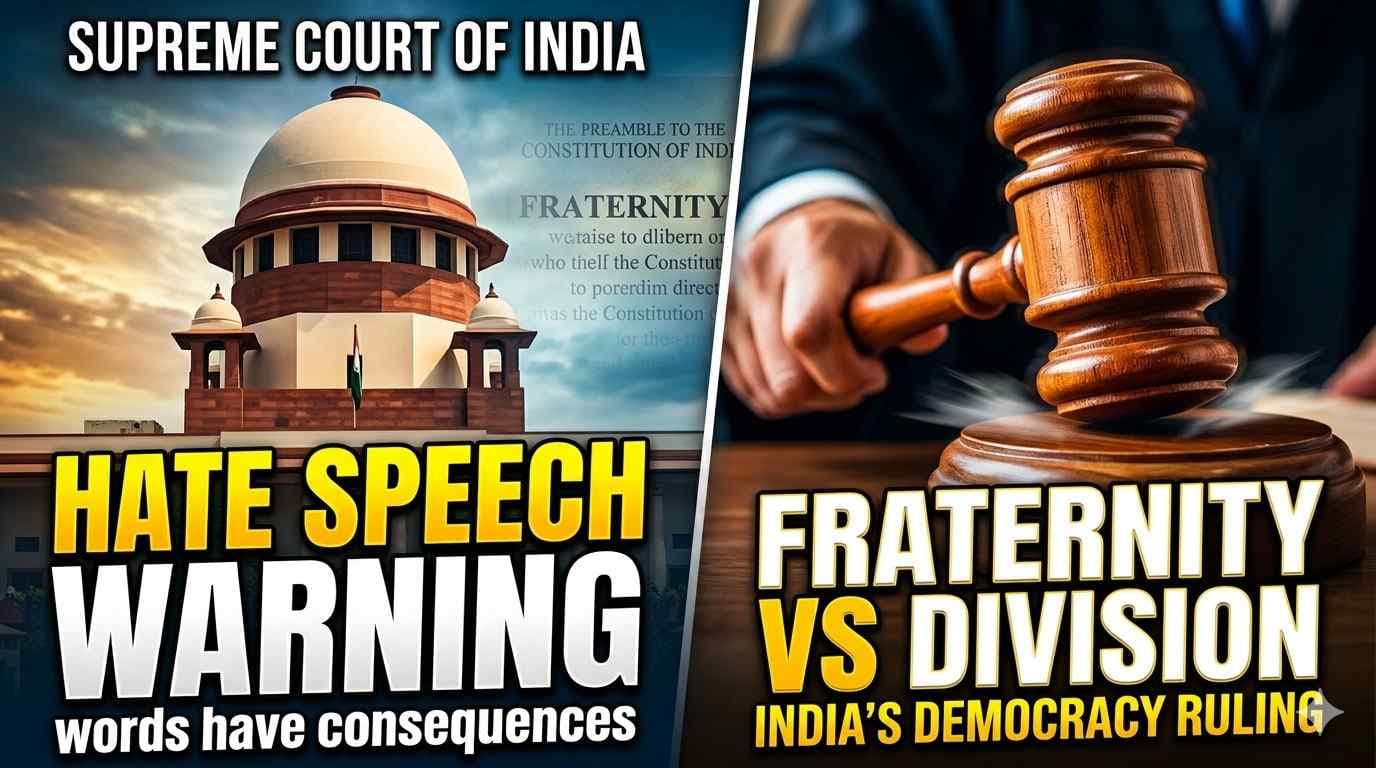
In a significant observation regarding the nature of public discourse in a constitutional democracy, the Supreme Court of India has cautioned that individuals and public figures must remain mindful that "words have consequences," particularly in a society as diverse as India’s. On Wednesday, April 29, 2026, the Court underscored that while the right to free speech is fundamental, it cannot be used as a vehicle to promote hostility or inflame communal divisions.
A Bench comprising Justice Vikram Nath and Justice Sandeep Mehta noted that hate speech is fundamentally antithetical to the constitutional value of fraternity. "Fraternity," the Court observed, was consciously incorporated as a constitutional ideal to bind the nation together. Hate speech, by its very nature, strikes at this moral fabric and distorts the civilizational ethos of the Republic.
The Bench’s remarks came as part of a wider discussion on the responsibilities of those in the public eye. The Court stated that public discourse carries a corresponding duty of restraint. Institutions and public figures alike are expected to act as stewards of harmony rather than instigators of discord. The Court warned that inflammatory remarks not only corrode social cohesion but also threaten the constitutional order.
Interestingly, the Court declined to issue new general guidelines or directions to curb hate speech, observing that there is "no legislative vacuum" on the subject. The Bench pointed out that the existing legal framework in India—including various sections of the penal law—is adequate to address such crimes. Whether further amendments are needed is a matter the Court left to the "wisdom of the Union and the States."
While the Court did not find that specific recent cases met the threshold of a cognisable offence for immediate FIR registration, it used the opportunity to reinforce the spirit of inclusivity. It appealed to all citizens to imbibe a sense of fraternity and cautioned that the propagation of "communally divisive remarks" has no place in a healthy democracy.
This judicial caution serves as a timely reminder of the balance between liberty and responsibility. For public figures, the ruling clarifies that their platform comes with a high degree of accountability. In a "diverse society like ours," the Court noted, the impact of a single statement can ripple far beyond its immediate audience, potentially causing lasting damage to the nation's social harmony.
As the legal debate around hate speech continues to evolve, the Supreme Court’s emphasis on fraternity provides a clear moral and constitutional compass. The message to the public and political leaders is clear: free speech is not a license for division, and the preservation of dignity and order is a collective duty.