Introduction
In a strong reaffirmation of judicial responsibility, the Supreme Court ruled that courts cannot avoid deciding disputes by repeatedly directing authorities to merely “consider” representations.
A Bench of Justice P. S. Narasimha and Justice Alok Aradhe held that where a legal right exists, courts must grant relief then and there instead of remanding the matter and forcing litigants into endless litigation.
The Case Background
The dispute concerned lecturers appointed in 1993 at a postgraduate college in Uttar Pradesh. After the State withdrew financial assistance to non-aided colleges in 2000, they sought payment of salaries from the government.
Instead of deciding the issue, the High Court repeatedly directed authorities to “consider” their claims. Each time:
- Authorities rejected the claim
- Petitioners returned to court
- Fresh writ petitions were filed
The litigation continued for over 16 years, eventually leading to contempt proceedings.
Supreme Court’s Observations
The Supreme Court criticized what it termed a growing judicial trend — courts avoiding final adjudication by remanding matters back to authorities without clear directions.
“When a claim of a right is legal and justified, relief must follow.”
“The ‘consider jurisprudence’… to throw the ball out of the Court is counterproductive and harms the system.”
The Bench clarified that remand is permissible only if the court clearly states:
- existence of the right
- violation of the right
- precise compliance required
Otherwise, remand becomes judicial evasion.
Clear Directions to High Courts
The Court instructed that when a matter comes before a High Court:
- It must either grant relief
- Or dismiss with reasons
- But not simply send parties back to authorities repeatedly
“If a case deserves relief, it must be granted then and there.”
The High Court was specifically directed not to remand the matter again, and to pass a final reasoned order.
This ruling significantly reshapes writ jurisprudence.
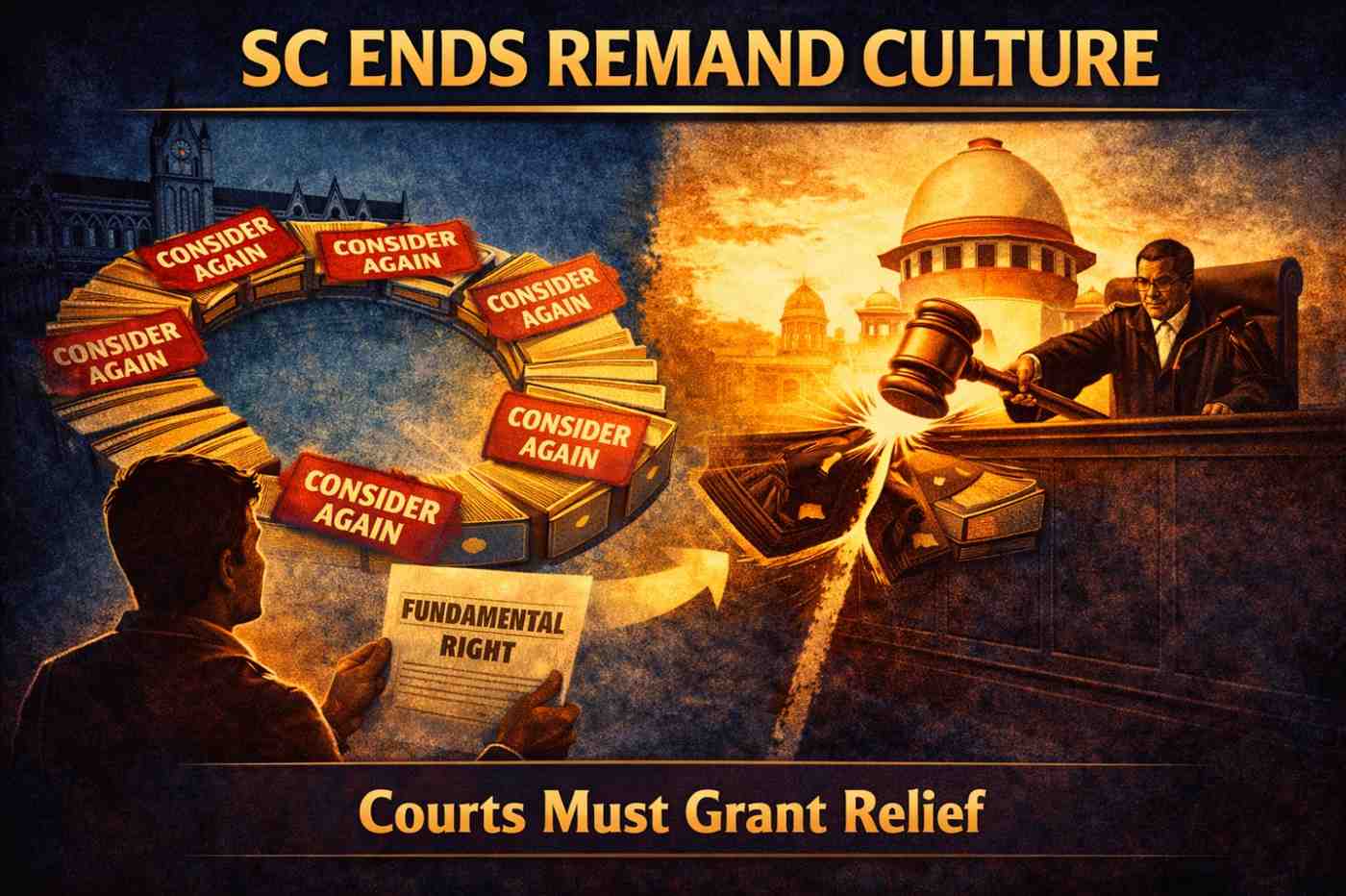
For years, litigants have faced a familiar loop:
Authority → Rejection → Writ Petition → “Consider Again” → Rejection → Fresh Petition
The Supreme Court has now declared this practice unacceptable.
Impact
- Strengthens Article 226 remedies
- Prevents harassment through administrative cycles
- Reduces judicial backlog
- Forces courts to exercise constitutional responsibility
The judgment restores the fundamental idea that courts exist to decide rights — not defer them.
The message is clear: justice delayed by procedural avoidance is justice denied.