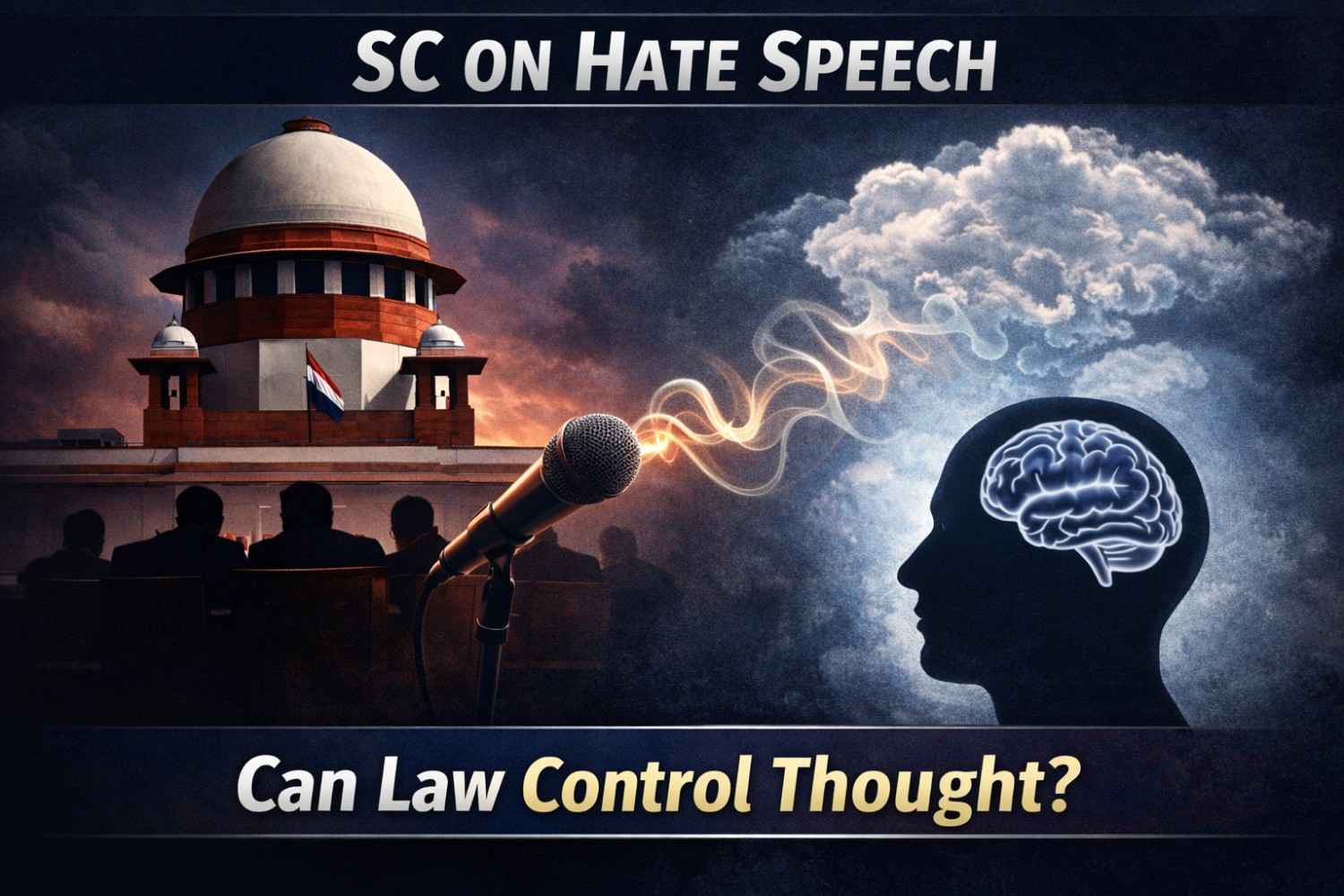
The Supreme Court of India on Tuesday expressed clear hesitation in entertaining another public interest litigation seeking new guidelines against hate speech by constitutional functionaries, remarking that regulation cannot begin merely at the stage of spoken words.
A Bench comprising Chief Justice of India Surya Kant, Justice B.V. Nagarathna and Justice Joymalya Bagchi was hearing a petition seeking a declaration that speeches by persons in public office must not violate fundamental rights.
At the outset, the Bench questioned the framing of the petition and cautioned against targeting individuals rather than addressing systemic issues.
CJI Surya Kant observed that any such plea must be neutral and comprehensive.
“It should be against everyone… not selectively chosen few.”
The Court advised the petitioner to file a broader challenge examining existing safeguards and how they are allegedly violated by political parties.
During the hearing, the Bench emphasized that the real issue lies deeper than regulation of spoken expression.
Justice B.V. Nagarathna made a philosophical yet legally significant observation:
“Origin of speech is thought. How do you control thought? We must erase those thoughts which go against constitutional ethos.”
The Bench underlined that legal frameworks alone cannot eliminate divisive rhetoric unless societal and political actors adopt responsibility.
The judges stressed that the Supreme Court has already laid down several principles governing hate speech jurisprudence.
Justice Joymalya Bagchi noted:
“From Kaushal Kishore to Amish Devgan, how many guidelines have we laid down? Responsibility lies with political parties to implement them.”
Justice Nagarathna also cautioned that judicial directions cannot substitute civic restraint.
“There has to be restraint on all sides. Political leaders must foster fraternity. Suppose we lay down guidelines… who will follow it?”
The Court further clarified that public officials are already bound by service conduct rules and constitutional obligations.
CJI Surya Kant remarked that public servants must adhere to constitutional morality rather than wait for judicial supervision.
“Public servants have to follow rules… one has to follow the boundary of constitutional morality.”
Finding the plea vague, the Court granted time to modify it rather than proceed on its present formulation.
The hearing reflects a crucial constitutional position: courts cannot become permanent regulators of political speech.
The Supreme Court signaled three broader principles:
- Hate speech control is not solely a judicial function — it requires political accountability.
- Repeated guidelines may dilute effectiveness if compliance culture is absent.
- Constitutional morality must operate as a societal standard, not merely a courtroom doctrine.
The message is unmistakable — the judiciary can interpret rights, but democracy ultimately depends on restraint exercised outside the courtroom. The Constitution’s spirit cannot be enforced only through litigation; it must be practiced in public discourse.