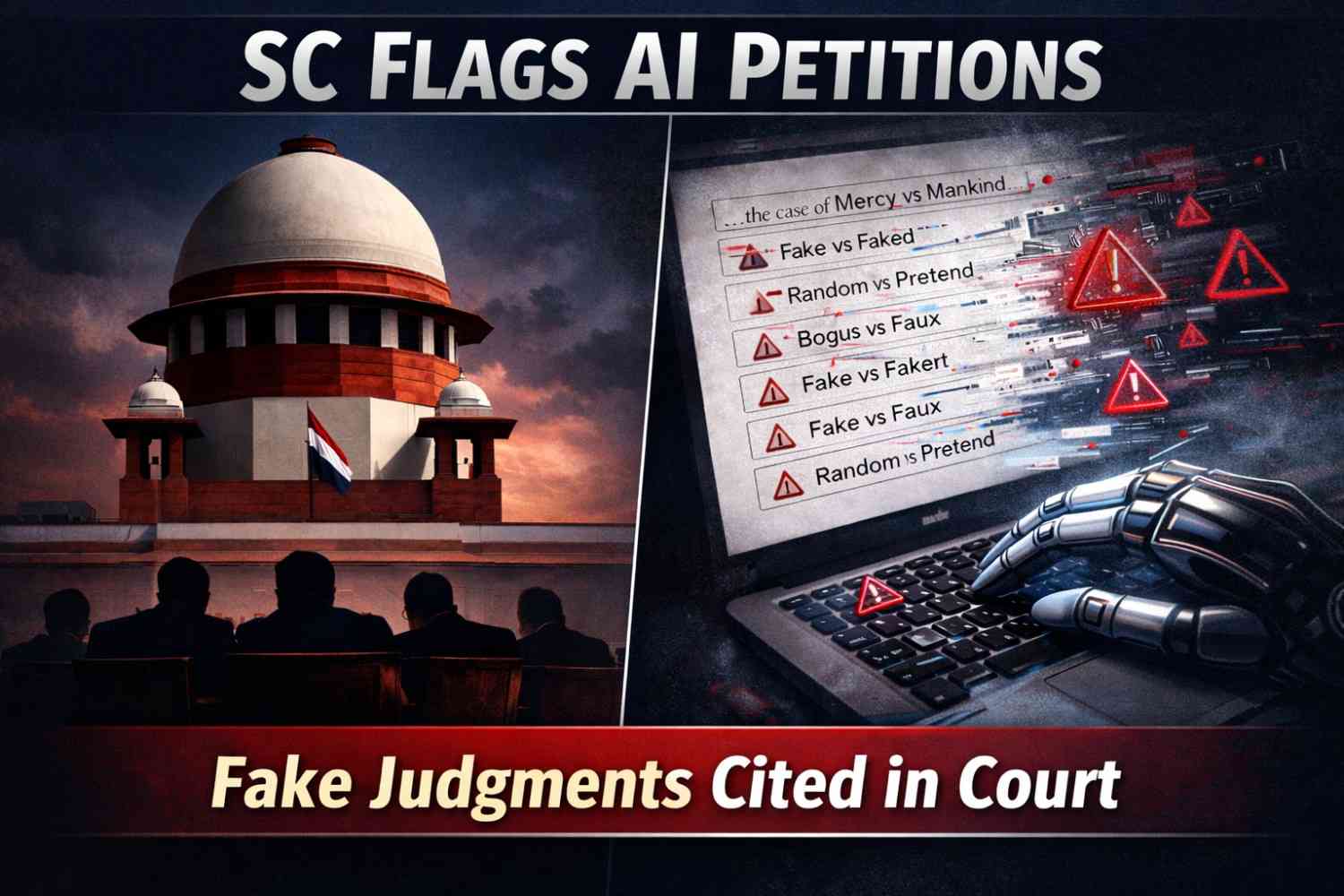
The Supreme Court of India has raised serious concerns over the growing use of artificial intelligence in drafting legal pleadings after encountering petitions citing non-existent case laws and fabricated quotations.
A Bench comprising Chief Justice of India Surya Kant, Justice B.V. Nagarathna and Justice Joymalya Bagchi expressed alarm while hearing a matter where the pleadings appeared to be generated through AI tools without proper verification.
During the proceedings, the Bench noted that recent filings increasingly contain inaccurate legal references, indicating over-dependence on automated drafting systems.
CJI Surya Kant observed:
“We have been alarmingly told that some lawyers have started using AI for drafting.”
The Court emphasized that technology may assist research, but legal pleadings cannot rely on unverified outputs.
Justice B.V. Nagarathna recounted a striking example where a completely fictitious precedent had been cited before the Court.
“There was a case of Mercy vs Mankind which does not exist.”
The Bench also referred to another instance where a matter before Justice Dipankar Datta relied entirely on fabricated precedents.
“All precedents cited never existed.”
Even in cases involving real judgments, the Court found that lawyers sometimes quoted passages that were not part of the original decision.
“Some are citing real Supreme Court cases but those quoted portions do not even exist in the judgment.”
The Court clarified that while AI can assist in research, drafting responsibility remains with the advocate and the court officer filing the pleading.
Judges reiterated that every citation must be verified using authorised sources before being placed on record. The Bench cautioned that inaccurate pleadings undermine the integrity of judicial proceedings and waste valuable court time.
This development marks one of the clearest judicial warnings in India regarding AI-generated legal work.
The message is significant for three reasons:
- Professional accountability remains human — AI cannot replace legal reasoning or due diligence.
- Fabricated citations can mislead courts, affecting justice delivery.
- Courts may increasingly scrutinize pleadings for authenticity in the digital age.
The ruling signals a turning point: technology is welcome in legal practice, but blind reliance is not. The Supreme Court has effectively drawn a red line — AI may assist advocacy, but it cannot substitute legal responsibility.