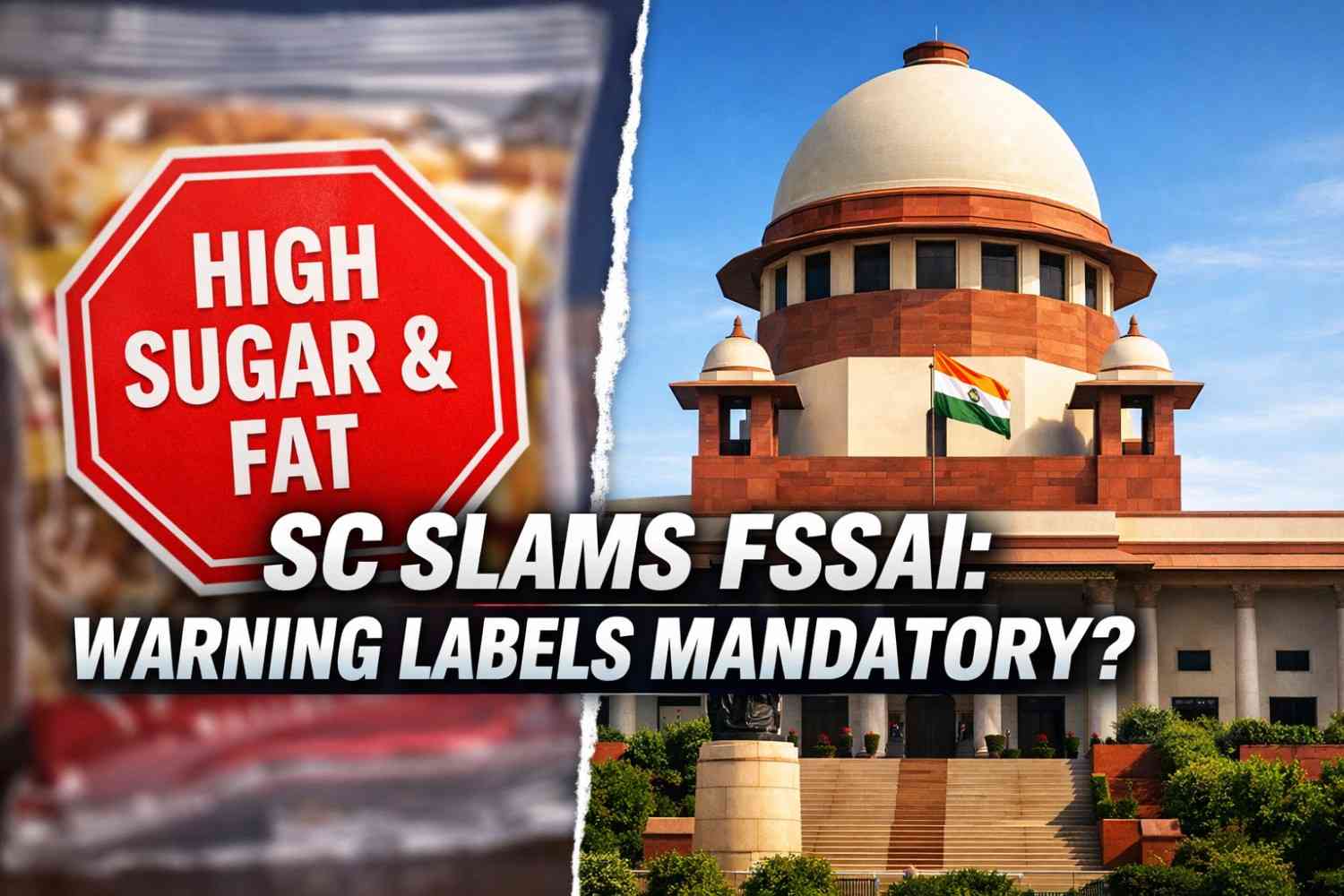
In a significant move aimed at protecting public health, the Supreme Court of India has expressed its strong dissatisfaction with the Food Safety and Standards Authority of India (FSSAI) over the lack of concrete progress in implementing mandatory "Front-of-Package" (FoP) warning labels on packaged foods.
A Bench comprising Justice JB Pardiwala and Justice KV Viswanathan observed that the efforts made by the food regulator so far have not yielded any "positive or concrete results." The Court emphasized that the issue at hand directly impacts the "Right to Health" of millions of Indian citizens, particularly in an era where lifestyle diseases like diabetes and hypertension are on the rise due to the consumption of processed foods.
Most packaged foods in India currently hide their nutritional information—such as high levels of sugar, salt, and saturated fats—in small print on the back of the packet. Most consumers find these charts difficult to read or understand.
"Front-of-Package Labeling" (FoPL) refers to clear, bold warning symbols or ratings placed on the front of the wrapper. These labels are designed to give consumers an immediate warning if a product contains unhealthy levels of:
- Sugar (linked to diabetes and obesity)
- Salt/Sodium (linked to high blood pressure and heart disease)
- Saturated Fats (linked to cholesterol and heart issues)
The Court noted that such labels are already "internationally prevalent" and help consumers make informed, healthier choices at a single glance.
The matter reached the Supreme Court through a Public Interest Litigation (PIL) filed by the NGO '3S and Our Health Society'. While the main petition was disposed of in April 2025 after FSSAI promised to take action, the case was recently revived to check for compliance.
During the hearing on February 14, 2026, the Court examined a compliance affidavit filed by FSSAI. The regulator informed the Bench that:
- There is no "consensus" among stakeholders (food companies and experts) regarding the proposed star-rating model.
- FSSAI wants to conduct more research, map out thousands of products, and hold more surveys before making a final decision.
- The proposal to make nutritional information "bold" on labels was deferred during a meeting in November 2025.
The Bench was not pleased with these justifications. Justice Pardiwala remarked that the PIL was filed with a specific purpose and that the current delay is not serving the public interest. The Court observed that while the authority claims to be "studying" the matter, the health of the citizens remains at risk.
The Supreme Court has long held that the Right to Life (Article 21) includes the Right to Health. By failing to provide clear warnings about the harmful ingredients in packaged food, the regulator is essentially leaving citizens in the dark about what they are consuming.
The petitioner’s counsel suggested that instead of complex star ratings (which can sometimes be manipulated by companies), there should be simple, high-visibility warning labels on the front of the packet. The Court agreed that this suggestion "makes some sense" and directed FSSAI to consider this specific approach seriously.
The Supreme Court has granted FSSAI four weeks to file a fresh response. The Court expects the regulator to come back with a more concrete plan rather than just more "research proposals."
For the average Indian consumer, this case is a landmark. If the Supreme Court mandates these warning labels, India will join the ranks of countries like Chile and Mexico, where "black hex" warning labels have successfully led to a significant reduction in the consumption of unhealthy snacks and sugary drinks.
The Supreme Court's intervention serves as a wake-up call for the FSSAI. As packaged food becomes a staple in Indian households, the need for transparency is no longer just a regulatory requirement—it is a fundamental right. The next hearing will likely determine whether Indian snacks will finally carry the warnings they deserve.
Case Title: 3S and Our Health Society v. Union of India
Bench: Justice JB Pardiwala and Justice KV Viswanathan