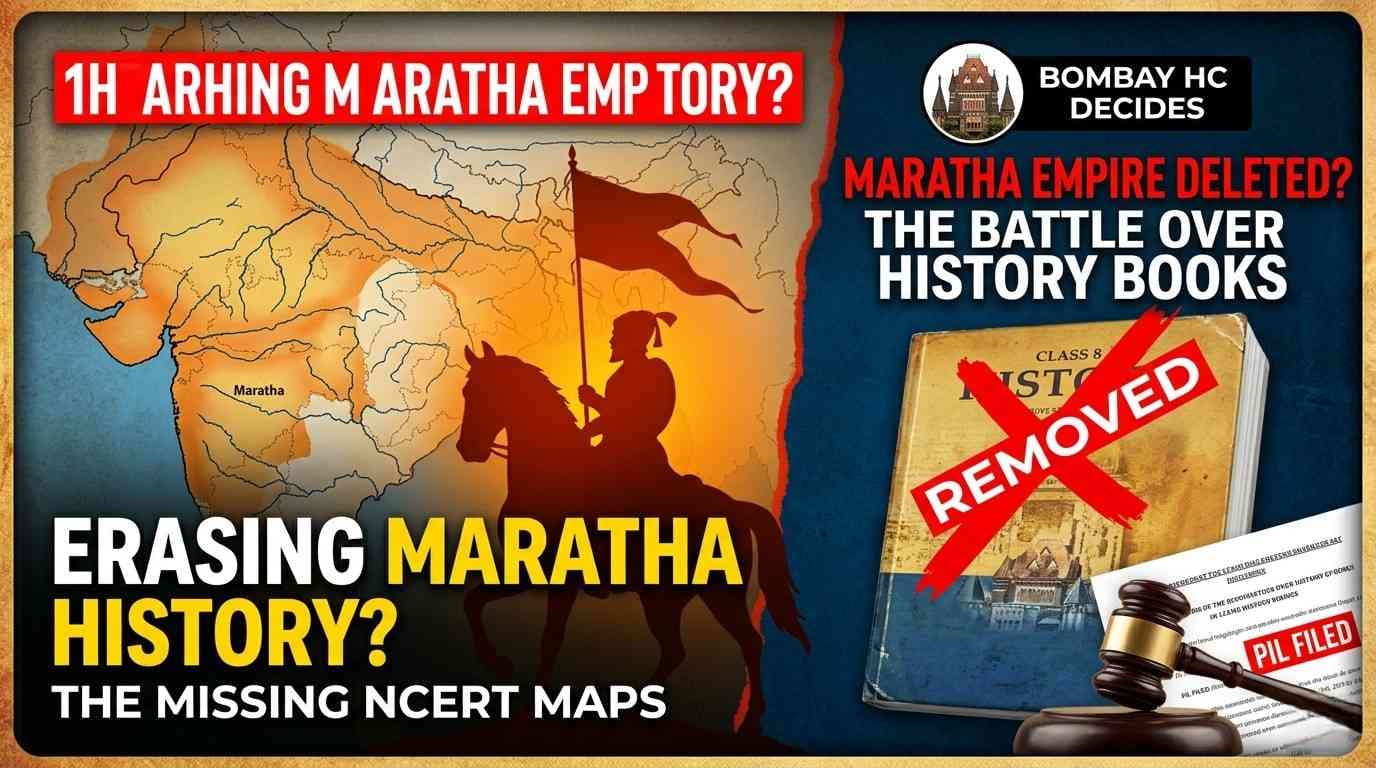
The Bombay High Court has been approached through a Public Interest Litigation (PIL) seeking the reinstatement of the Maratha Empire’s geographical map in NCERT Class 8 history textbooks. The petition claims that recent revisions by the national educational body have led to the "erasure" of vital visual representations of the Maratha Confederacy’s territorial extent during its peak in the 18th century.
The petitioner, a social activist and history enthusiast, contends that the Maratha Empire played a foundational role in resisting foreign rule and shaping the political landscape of pre-colonial India. By removing the map, the PIL argues, the NCERT is providing an incomplete historical narrative to young learners, which fails to highlight the Maratha contribution to the administrative and military history of the subcontinent.
From a legal perspective, the PIL invokes Article 21A (Right to Education) and Article 51A (Fundamental Duties), arguing that providing accurate and holistic history is a constitutional obligation. The petition emphasizes that textbooks should not merely list facts but must provide a geographical context to help students understand the scale and reach of indigenous empires. The removal is described as "arbitrary and discriminatory" against the cultural and historical legacy of the Maratha region.
This development follows a series of recent "textbook rationalization" exercises conducted by the NCERT, which the council has defended as an effort to reduce the curriculum load on students post-pandemic. The NCERT has previously stated that overlaps and irrelevant content were removed based on expert recommendations. However, the move has often met with resistance from various states and groups who feel that local or regional histories are being sidelined in favor of a more centralized narrative.
The Bombay High Court is expected to examine whether the exclusion of the map constitutes a violation of educational standards or if it falls within the "academic discretion" of the NCERT. Historically, Indian courts are hesitant to interfere in academic policy unless there is a clear case of malice or a gross violation of constitutional principles.
As the legal proceedings begin, the case has reignited a national debate on how history is taught in Indian schools. Proponents of the PIL argue that maps are essential pedagogical tools that visualize the transition of power, while others suggest that curriculum changes should be left to academic experts rather than judicial review.
In conclusion, the PIL against the NCERT marks another chapter in the ongoing struggle over historical representation in India’s school system. The Bombay High Court’s observations will be crucial in determining the balance between administrative curriculum design and the right of students to access a complete and unedited version of their national heritage.