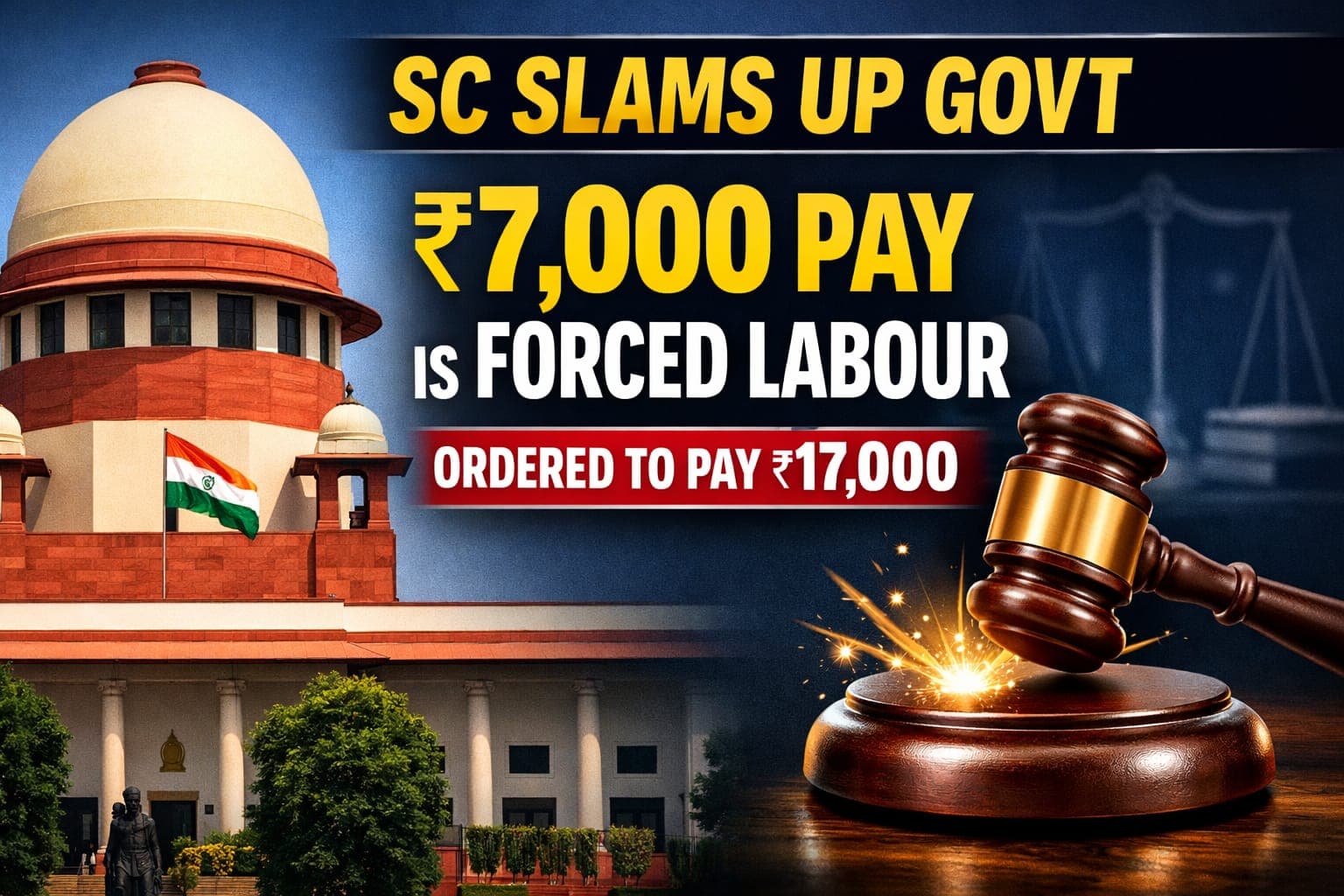
In a landmark judgment that brings massive relief to thousands of contractual educators, the Supreme Court of India on Wednesday (February 4, 2026) slammed the Uttar Pradesh government for its "unfair practices." The Court ruled that keeping primary school instructors on a meager, stagnant salary of ₹7,000 per month for over a decade amounts to 'Begar' (forced labour) and is a clear violation of the Constitution.
A bench comprising Justices Pankaj Mithal and Prasanna B. Varale directed the UP government to increase the honorarium to ₹17,000 per month. This hike is not just for the future—the Court has made it effective from the financial year 2017-18, ordering the state to clear all arrears within six months.
The Background:
The dispute dates back to a 2013 Government Order (GO). Under the then Sarva Shiksha Abhiyaan (now Samagra Shiksha Scheme), the UP government appointed part-time instructors for physical education, art, and work education. These teachers were hired on an 11-month contract with a fixed monthly pay of ₹7,000.
While the contracts were renewed annually, the salary remained frozen. In 2017, a Project Approval Board (PAB) actually recommended and approved an increase to ₹17,000 per month. However, the teachers never saw that money. Instead, their pay was occasionally tweaked to small amounts like ₹8,470 or ₹9,800, and in 2019, it was shockingly pushed back down to the original ₹7,000.
During the hearings, the Uttar Pradesh government tried to shift the blame onto the Central Government. They argued that because the Samagra Shiksha Scheme is a centrally sponsored project, the financial burden is shared in a 60:40 ratio between the Centre and the State. The State’s logic was simple: "If the Centre doesn't send its 60% share, we cannot be forced to pay the full amount."
The Supreme Court rejected this excuse outright. The bench clarified that internal administrative or financial arrangements between the State and the Centre cannot be used as a shield to deny teachers their basic rights.
The Court invoked the "Pay and Recover" principle, stating:
"The initial burden to pay honorarium is upon the State Government. If the Central Government fails to contribute its share, the State is free to recover it from them later, but it cannot deny payment to the teachers who are doing the work."
Key Conclusions of the Supreme Court
The judgment, titled State of Uttar Pradesh and Ors. vs. Anurag and Ors., laid down several powerful legal points that redefine the rights of contractual employees in the education sector:
- No Longer "Contractual": The Court observed that once a teacher has been working continuously for over 10 years, their job is no longer "contractual" in the traditional sense. By law, they are deemed to be employed against permanent posts that are created automatically over time.
- Prohibition of Other Work: A crucial point was that these teachers were specifically barred from taking any other job during their spare time. If they are forced to work for one employer at a low wage and prevented from earning elsewhere, it effectively becomes a form of bondage.
- Violation of Article 23: The Court held that paying a fixed, stagnant wage of ₹7,000 since 2013 is an "unfair practice" and constitutes 'Begar' (forced labour), which is strictly prohibited under Article 23 of the Constitution of India.
- The Finality of the PAB: The Court ruled that once the Project Approval Board (the central authority for the scheme) approved the ₹17,000 figure in 2017, no other state authority had the right to reduce it or ignore it.
- Mandatory Periodic Revision: The bench emphasized that wages cannot remain stagnant forever. It directed that the honorarium must be revised at least once every three years.
The judgment went beyond just numbers. The bench spoke passionately about the role of teachers in nation-building. Calling teachers a "divine channel" and the "guiding force" for the next generation, the Court noted that primary education is the foundation of the country.
By ensuring that the "architects of the future" are not subjected to financial exploitation, the Supreme Court has sent a stern message to all state governments: budgetary constraints are no excuse for violating the fundamental rights of those who educate the nation's children.
The Uttar Pradesh government now has a ticking clock. They must implement the ₹17,000 monthly pay scale immediately and ensure that all teachers receive their back-dated arrears (from 2017 onwards) within the next six months. For thousands of teachers who have spent years struggling on a pittance, this verdict is not just a financial win—it is a restoration of their dignity.