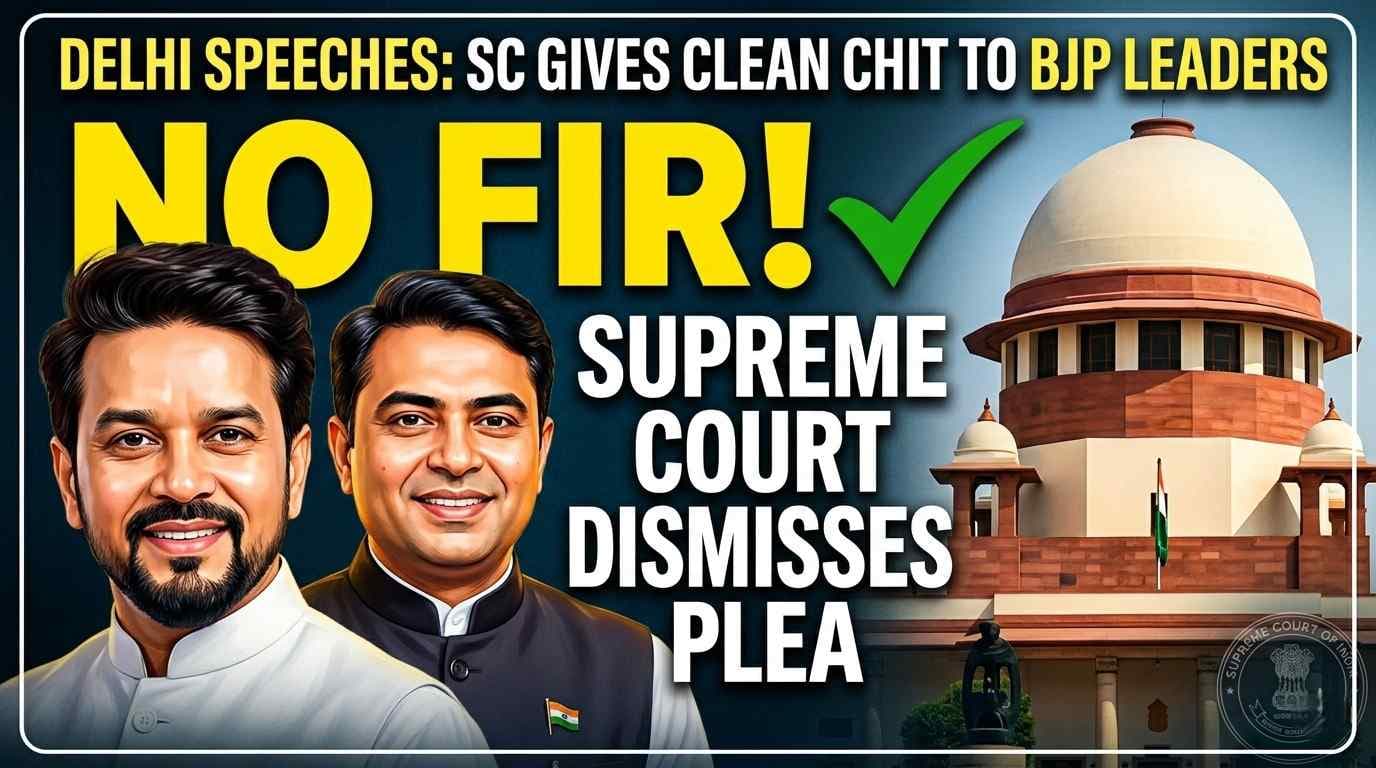
The Supreme Court of India has brought a definitive end to the long-standing legal battle over controversial speeches delivered during the 2020 Delhi Assembly elections. On Wednesday, April 29, 2026, a Bench of Justice Vikram Nath and Justice Sandeep Mehta dismissed petitions seeking the registration of First Information Reports (FIRs) against BJP leaders Anurag Thakur and Parvesh Verma. The Court held that the remarks, while controversial, did not disclose the commission of a cognisable offence.
The case centered on a high-decibel campaign period in January 2020, marked by intense protests against the Citizenship Amendment Act (CAA). The petitioners, CPI(M) leaders Brinda Karat and K.M. Tiwari, had alleged that Anurag Thakur’s call-and-response slogan—"Desh ke gaddaron ko, goli maaro saalon ko"—and Parvesh Verma’s comments regarding Shaheen Bagh protesters constituted hate speech and incitement to violence.
In its judgment, the Supreme Court upheld the merits of the Delhi High Court’s earlier decision. The Bench observed that after a careful consideration of the material on record and the police status reports, the speeches were not found to be directed against any specific community in a manner that would attract criminal liability. Furthermore, the Court noted that the material did not disclose an incitement to violence or public disorder sufficient to warrant criminal prosecution.
However, the Supreme Court did clarify a significant legal point regarding procedural law. While the lower courts had previously rejected the plea on the grounds that prior "sanction" from the government was required before a Magistrate could order an FIR under Section 156(3) of the CrPC, the Supreme Court disagreed with this specific reasoning. The Bench ruled that the requirement of prior sanction is not applicable at the pre-cognisance stage. Despite this procedural clarification, the Court dismissed the plea on its merits, agreeing that no criminal offence was made out.
The ruling marks the final chapter in a legal saga that moved from the Magistrate’s court to the Delhi High Court and finally to the apex court. For Anurag Thakur, currently a Member of Parliament, and Parvesh Verma, now the Deputy Chief Minister of Delhi, the verdict provides significant legal closure.
The judgment also touches upon the delicate balance between high-pitched political rhetoric and criminal hate speech. By ruling that these specific statements did not cross the threshold of a cognisable offence, the Supreme Court has reinforced the high bar required to initiate criminal proceedings for political campaigning speeches.
As the political landscape continues to evolve, this verdict will likely be cited in future debates regarding the limits of free speech during election cycles. For now, the Court has made it clear: while words may be provocative and controversial, they do not always equate to a crime in the eyes of the law.