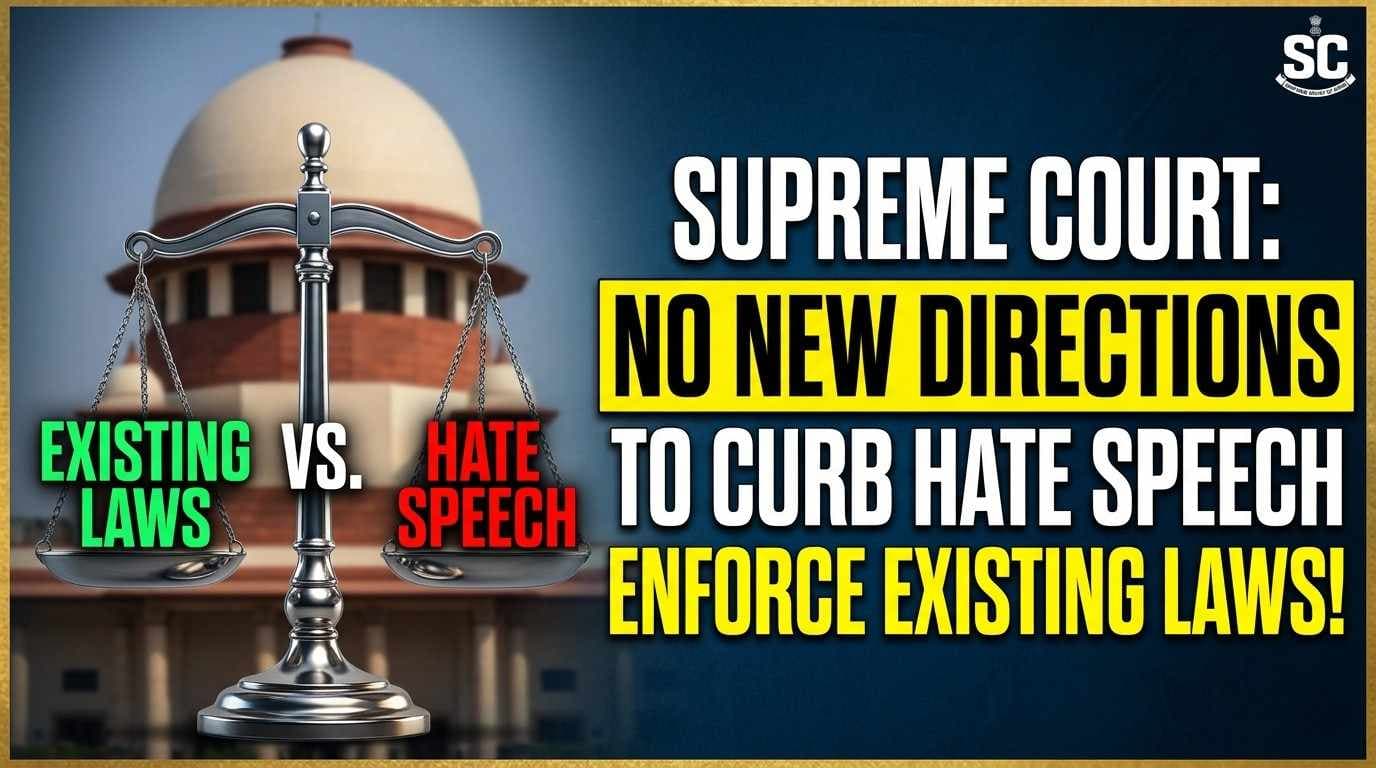
In a significant ruling that underscores the principle of judicial restraint, the Supreme Court of India has refused to pass any additional or fresh directions to curb hate speech. A Bench comprising Justices Vikram Nath and Sandeep Mehta dismissed a batch of petitions on Wednesday, April 29, 2026, holding that the country’s existing legal framework is robust enough to handle the issue. The Court emphasized that the problem lies not in a lack of laws, but in the inconsistent enforcement of those already on the books.
The batch of petitions, which included pleas from Advocate Ashwini Kumar Upadhyay and others, sought more stringent guidelines and a specialized monitoring authority to check the rising tide of provocative speeches. However, the Bench noted that the creation of new criminal offences or the expansion of current ones falls squarely within the domain of the legislature. "We cannot assume that there is a legislative vacuum," the Court remarked, pointing to provisions in the Bharatiya Nagarik Suraksha Sanhita (BNSS) and the outgoing Indian Penal Code.
During the hearing, the Court took note of the various forms hate speech has taken in recent years, migrating from local platforms to digital and mainstream media. While acknowledging the gravity of the "punching down" phenomenon against marginalized communities, the Justices maintained that the judiciary cannot function as a "National Monitoring Authority." For every instance of hate speech across the vast geography of India, the Bench suggested that the appropriate remedy lies with the local police and the existing statutory machinery.
The Union government, represented by Additional Solicitor General S.V. Raju, argued that action is indeed being taken. The government pointed to several instances where FIRs have been registered, charge sheets filed, and even disciplinary action taken against police officials who failed to act. Similarly, the Election Commission of India (ECI) informed the Court that comprehensive guidelines are already in place to deal with hate speech during political campaigns.
This judgment marks a shift from the Court’s previous proactive stance. In earlier hearings, the Supreme Court had issued interim directions requiring police to register suo moto cases against hate speech without waiting for a formal complaint. By closing these petitions, the Court has signaled that while the legal "sword" against hate speech exists, it is up to the executive and law enforcement agencies to wield it effectively.
The Bench did, however, keep one specific case open—Kazeem Ahmad Sherwani v. State of Uttar Pradesh—which involves specific allegations of police inaction in a hate crime. This indicates that while the Court will not create broad new policies, it remains committed to monitoring individual cases where the "existing laws" it touted are allegedly being ignored or bypassed by those in power.
For legal experts and activists, the ruling is a double-edged sword. On one hand, it reaffirms the separation of powers and the adequacy of the Indian Penal Code (and now BNSS). On the other, it places the burden of curbing communal disharmony back on the very administrative structures that petitioners claim have been partisan or lethargic in their response to hate speech.
As the Republic continues to navigate the complexities of free speech versus communal harmony, the Supreme Court’s message is clear: the laws are ready and waiting. The real question remains whether the political and administrative will exists to implement them without fear or favor. For now, the "thunder" of new judicial edicts has been replaced by a firm reminder of the duty of the State.