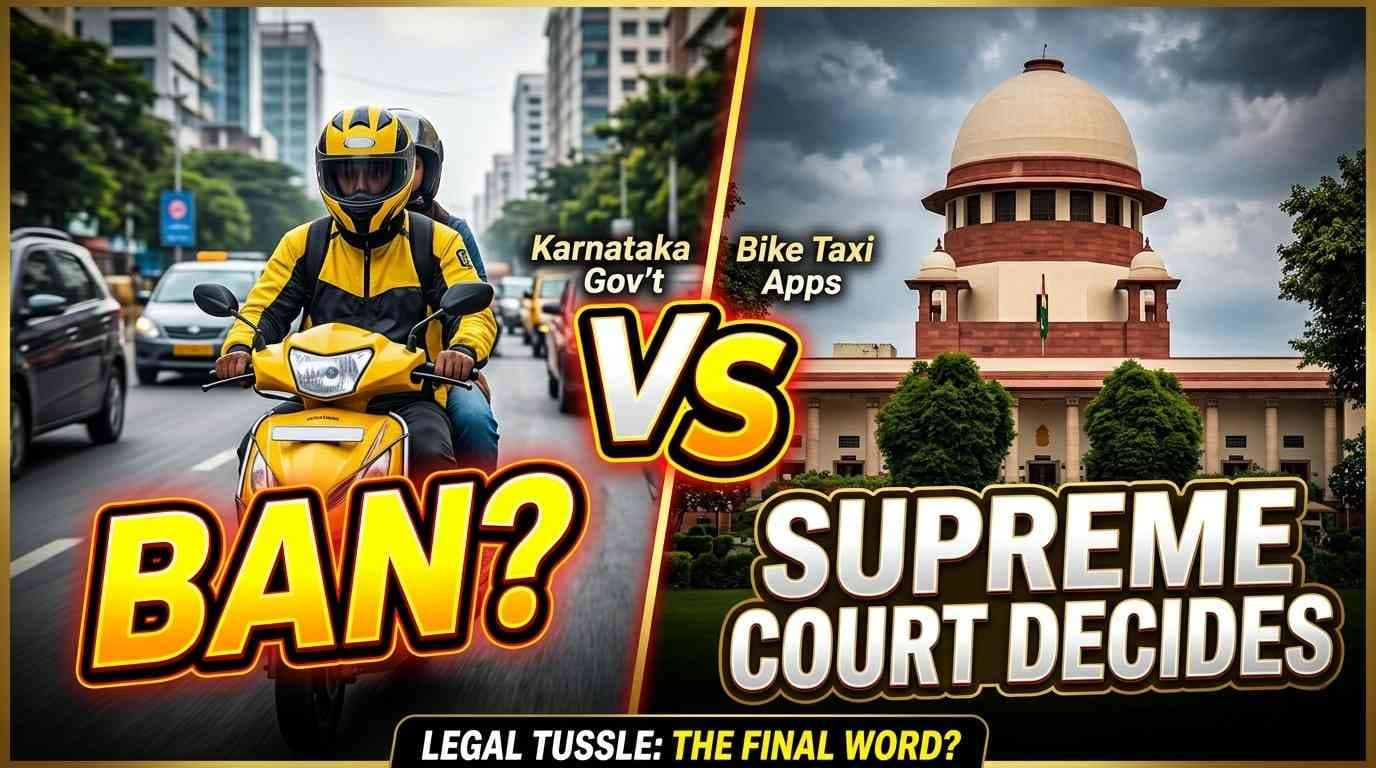
The long-standing legal tussle over the operation of bike taxis in Karnataka has reached the highest level of the Indian judiciary. The Karnataka government has officially moved the Supreme Court to challenge a High Court verdict that struck down the State’s blanket prohibition on motorcycle taxi services. This appeal marks a critical juncture for ride-hailing giants like Rapido, Uber, and Ola, who have been fighting for years to legitimize two-wheeler transport in the State.
The State’s appeal comes nearly three months after a Division Bench of the Karnataka High Court, comprising Chief Justice Vibhu Bakhru and Justice CM Joshi, delivered a significant ruling in favor of taxi aggregators. The High Court had declared that a total ban on bike taxis was unconstitutional and ran contrary to the provisions of the Motor Vehicles Act, 1988. The court’s stance was clear: the State cannot refuse permits simply because the vehicle in question is a motorcycle.
At the heart of the High Court's decision was the interpretation of "transport vehicles." The Bench observed that under the Motor Vehicles Act, motorcycles are not excluded from the definition of vehicles that can be granted permits as contract carriages. Furthermore, the court ruled that preventing individuals from using motorcycles for commercial taxi services amounted to an "unreasonable restriction" on their fundamental right to practice any profession or carry on trade under Article 19(1)(g) of the Constitution.
The High Court judgment had effectively set aside a previous 2025 order from a single-judge bench, which had halted bike taxi operations until the State framed a comprehensive regulatory policy. The Division Bench argued that while the State has every right to regulate the industry and impose safety conditions under Section 74(2) of the Act, it does not have the authority to issue an outright rejection of applications based solely on vehicle type.
For the Karnataka government, the primary concern remains the lack of a formal regulatory framework and the safety of passengers. The State has consistently argued that bike taxis operate in a legal gray area that complicates insurance claims, passenger safety protocols, and fair competition with traditional auto-rickshaws and cabs. By moving the Supreme Court, the State seeks a definitive ruling on whether it can maintain its prohibition until specific safety laws are enacted.
The outcome of this Supreme Court case will have far-reaching implications, not just for Karnataka, but for the entire country. Many states in India are currently grappling with how to integrate bike taxis into their urban transport ecosystems. A Supreme Court ruling will provide the much-needed legal clarity on whether motorcycles can be treated on par with four-wheeler taxis under federal transport laws.
As the case awaits listing before the apex court, the operation of bike taxis continues to be a point of friction between digital aggregators and traditional transport unions. Aggregators argue that bike taxis provide affordable, last-mile connectivity and generate significant employment, while the State remains hesitant to grant them full legal status without stringent oversight.
This legal battle underscores the friction between evolving technology-driven services and traditional regulatory structures. With the Supreme Court now set to have the final word, the future of the "bike taxi" as a legitimate mode of public transport in India hangs in the balance. All eyes will be on the apex court to see if it upholds the High Court’s view on professional freedom or sides with the State’s cautious regulatory approach.