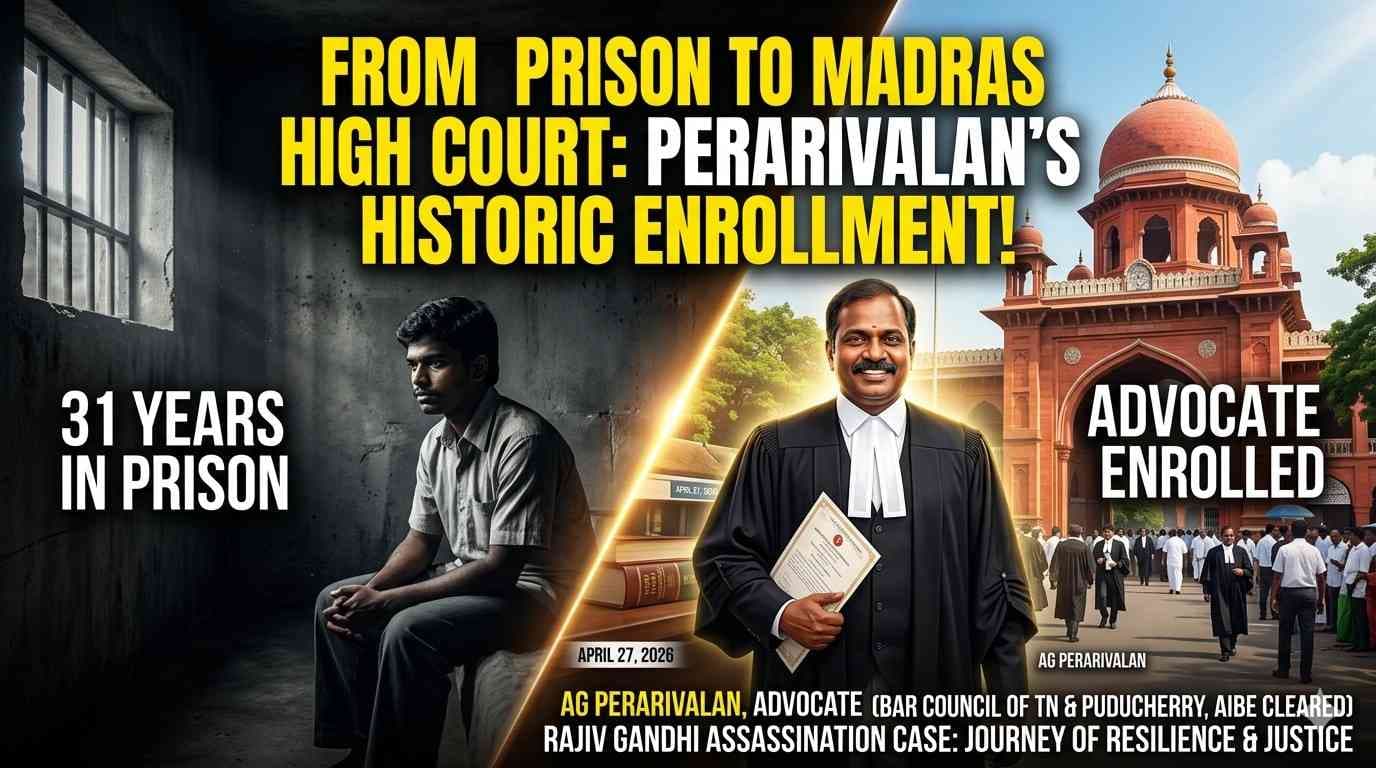
In a transition that marks a significant turning point in a decades-long legal saga, AG Perarivalan, who spent over 30 years in prison in connection with the Rajiv Gandhi assassination case, has officially enrolled as an advocate. On Monday, April 27, 2026, Perarivalan joined the Bar Council of Tamil Nadu and Puducherry, signaling his intent to begin a professional legal practice before the Madras High Court.
Perarivalan’s journey to the bar is as remarkable as his long-standing legal battle for freedom. After being released by the Supreme Court of India in May 2022 through the exercise of extraordinary powers under Article 142 of the Constitution, he chose to pursue a formal education in law. Having successfully completed his LLB and cleared the All India Bar Examination (AIBE) in 2025, his enrollment marks the culmination of years of academic effort while rebuilding his life post-incarceration.
The history of Perarivalan’s case is one of the most cited in Indian constitutional law. Arrested at the age of 19, he was accused of providing the batteries used in the bomb that killed former Prime Minister Rajiv Gandhi. While he was initially sentenced to death, the Supreme Court commuted his sentence to life imprisonment in 2014, citing an inordinate delay in the President’s decision on his mercy petition.
His eventual release in 2022 came after a prolonged standoff between the Tamil Nadu state government and the Governor. The Supreme Court eventually intervened, noting that the Governor’s delay in deciding on the state cabinet's recommendation for remission was unjustifiable. This landmark ruling paved the way for his walk to freedom after three decades behind bars.
During his time in prison, Perarivalan was known for his academic inclination, earning several degrees and diplomas. His decision to enter the legal profession is seen by many as a poetic conclusion to his personal experience with the judicial system. By becoming a lawyer, he moves from being a subject of the law to a practitioner of it, possessing a unique perspective on the criminal justice system.
The enrollment has drawn significant attention from the legal community and the public alike. Practicing at the Madras High Court—the very institution that witnessed many chapters of his legal struggles—Perarivalan will now represent clients in the same corridors of power where his own fate was argued for years.
For Perarivalan, this is more than just a career move; it is a symbol of rehabilitation and reintegration. His case remains a pivotal reference for discussions on federalism, the powers of the Governor, and the rights of life convicts. Now, as a member of the Bar, he stands ready to contribute to the legal field from the other side of the courtroom.
As he dons the black robe, Perarivalan’s story serves as a reminder of the transformative power of education and the complexities of the Indian justice system. His practice at the Madras High Court will undoubtedly be watched closely by legal experts and human rights advocates across the country.