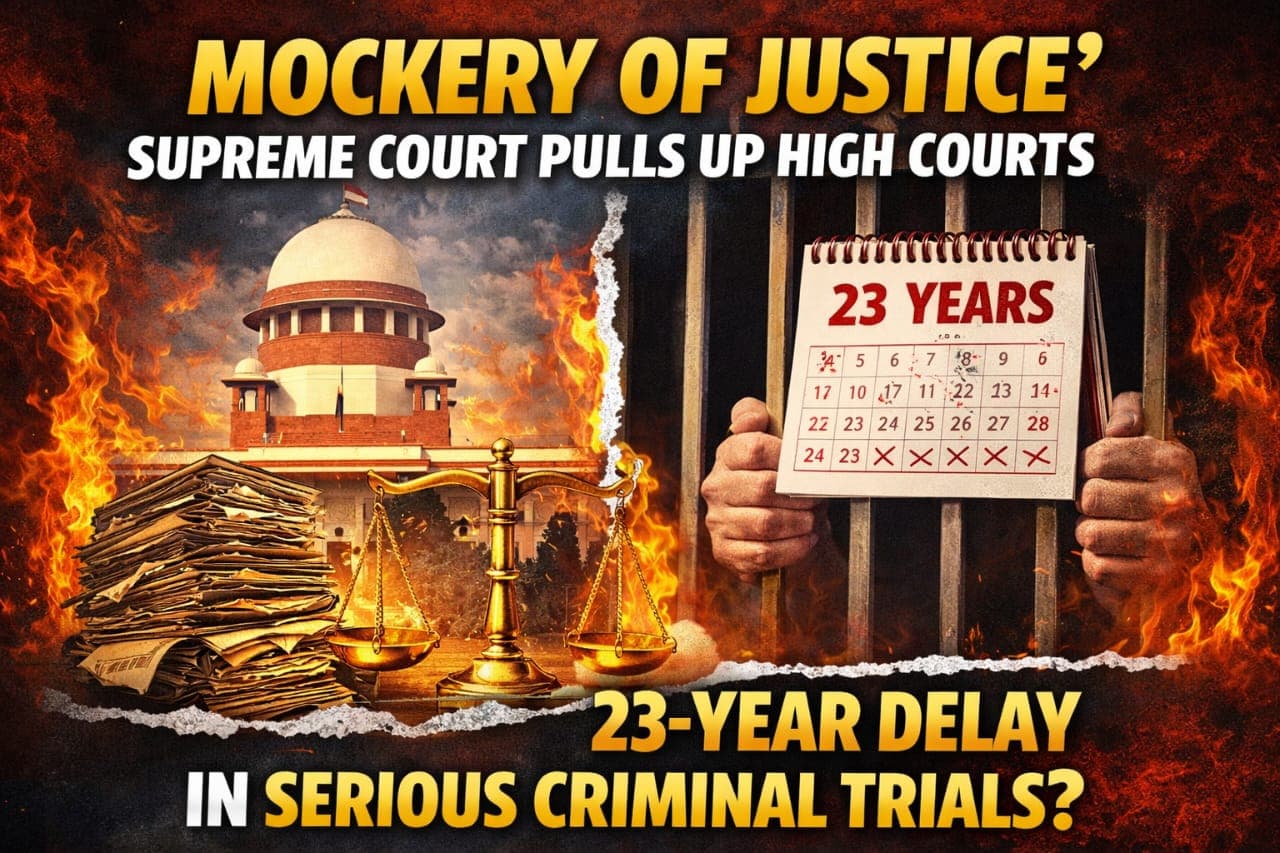
In a scathing observation that highlights the deepening crisis of judicial pendency in India, the Supreme Court has issued a stern directive to all High Courts across the country: prioritize sensitive and serious criminal matters such as murder, rape, and dowry deaths.
Disturbed by a case that remained stuck in the Rajasthan High Court for over two decades due to an interim stay order, a bench of Justices J.B. Pardiwala and K.V. Vishwanathan remarked that such delays lead to nothing but a "mockery of justice."
The Supreme Court’s observations came during the hearing of a Special Leave Petition filed by one Vijay Kumar and others. The case dates back to November 21, 2000, when a woman named Deepa got married to Vijay Kumar. Within just one year of the marriage, on December 31, 2001, Deepa died at her matrimonial home under mysterious circumstances.
Following her death, an FIR was registered in January 2002 at Nazirabad City Police Station, Ajmer, under Sections 498A (cruelty) and 304B (dowry death) of the Indian Penal Code. The victim’s brother alleged that she was harassed for dowry and eventually poisoned.
The legal journey that followed is what the Supreme Court described as "painful" and "disturbing":
- November 2002: The Trial Court framed charges against the husband and six other relatives.
- January 2003: The accused filed a Revision Petition in the Rajasthan High Court challenging the framing of charges.
- February 2003: The High Court stayed the trial proceedings.
- The 20-Year Silence: That stay remained in place, and the petition was not taken up for a meaningful hearing until August 2023.
- August 2025: The High Court finally dismissed the revision petition—22 years after it was filed.
While the Supreme Court dismissed the accused's petition to challenge the High Court's final order, it refused to let the matter rest. The bench expressed deep perturbation over why a serious trial involving a woman's death was held up for 23 years.
"Justice has to be done with all the parties. Justice cannot be done only with the accused persons. Justice has to be done even with the victim and the family members of the victim," the bench noted.
Quoting the famous words of Martin Luther King Jr., the Court added: "Injustice anywhere is a threat to justice everywhere."
The Apex Court has now initiated a detailed inquiry to fix accountability for this delay. It has directed the Registrar General of the Rajasthan High Court to submit the entire record of the proceedings via a "Special Messenger."
The Court has demanded answers to specific, hard-hitting questions:
- The Statistics of Delay: The Court wants a year-wise breakup (from 2001 to 2026) of how many Criminal Revision Petitions were filed and disposed of by the High Court.
- Frequency of Hearings: The Court wants to know how many times this specific case was actually "notified" or listed for hearing during the 23-year gap.
- State’s Silence: The bench questioned the State of Rajasthan’s role as the prosecuting agency. Why did the State remain quiet for 23 years and not move any application to vacate the stay or expedite the trial?
Recognizing that this is not an isolated incident, the Supreme Court has requested the Chief Justices of all High Courts to take immediate action. The bench directed that:
- Petitions where "interim orders" (stays) are holding up criminal trials must be taken up for hearing immediately.
- Priority must be given to "sensitive and serious matters" like murder, dowry death, and rape.
The Supreme Court has listed the matter for further hearing on January 15, 2026, as a "Part-Heard" case. The Court intends to examine the records and the explanations provided by the High Court and the State Government before passing further orders.
This case serves as a landmark reminder that while "life and liberty" of the accused are important, the right of a victim’s family to see a trial conclude within a reasonable timeframe is equally fundamental to the rule of law.
Case Details: Vijay Kumar & Ors. vs. The State of Rajasthan Special Leave Petition (Criminal) Diary No. 71965/2025 Bench: Justice J.B. Pardiwala and Justice K.V. Vishwanathan