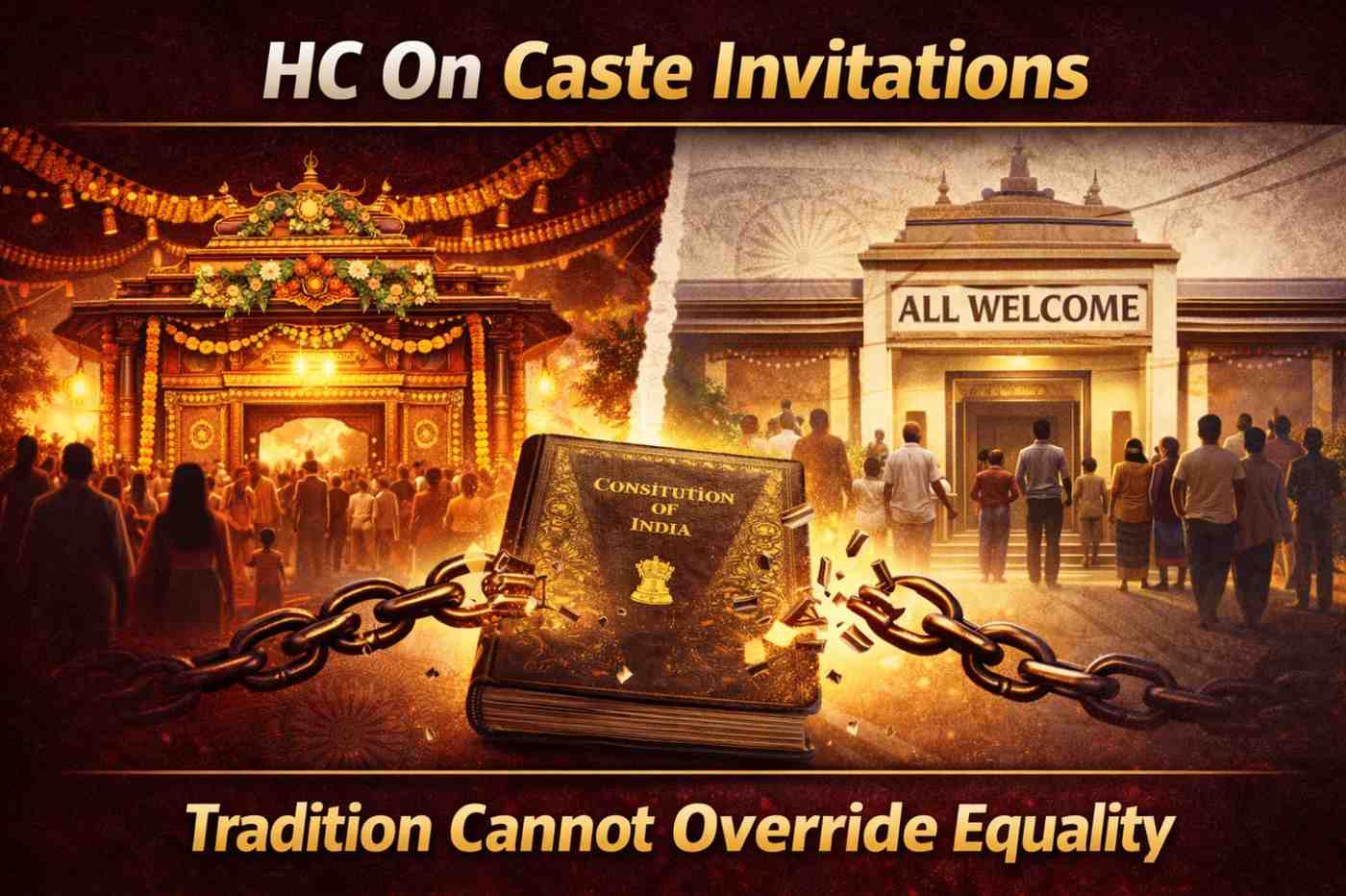
In a significant ruling addressing caste discrimination in public religious events, the Madras High Court held that State authorities cannot issue or endorse temple festival invitations that segregate or identify participants based on caste.
The Court emphasised that government machinery must remain constitutionally neutral and cannot legitimise social exclusion in the name of tradition.
The case arose from a temple festival invitation printed and circulated with caste-based references identifying particular communities in hierarchical terms. The involvement of local administrative officials in facilitating or approving such invitations was challenged before the Court.
The petitioner argued that when State officials participate in or validate caste-segregated invitations, it amounts to official endorsement of discrimination prohibited under the Constitution.
Court’s Constitutional Reasoning
The Bench held that the Constitution overrides customary practices whenever those practices undermine equality and dignity.
The Court relied upon:
- Article 14 — Equality before law
- Article 15 — Prohibition of discrimination
- Article 17 — Abolition of untouchability
“The State cannot perpetuate caste divisions through official actions or recognition.”
The judges clarified that while religious festivals are protected cultural expressions, State participation transforms the event into a public function governed by constitutional norms.
Role of Government Officials
The Court drew a clear distinction between private religious practice and State-endorsed activity.
If a purely private religious body conducts rituals — autonomy exists.
But once government authorities:
• Print invitations
• Provide administrative backing
• Use official designation
the event acquires a public character and must comply with constitutional equality.
“Public power cannot be used to legitimise social hierarchy.”
The Court warned authorities against mechanically approving traditional formats without examining constitutional implications.
The High Court directed officials to refrain from issuing or endorsing any temple invitations containing caste-based references or discriminatory identification.
Authorities were instructed to ensure all future public religious communications remain neutral and inclusive.
The judgment represents a powerful assertion of constitutional morality over social custom.
Historically, many discriminatory practices survived because they were seen as “traditional.” The Court has now clarified:
Tradition cannot override fundamental rights.
The ruling expands anti-discrimination jurisprudence beyond physical exclusion into symbolic discrimination — such as printed recognition of caste hierarchy.
Its implications extend nationwide:
• Government-assisted temple festivals
• Public religious processions
• Official cultural celebrations
The decision strengthens the constitutional promise that dignity must exist not only in law but also in social representation.
In essence, the Court reaffirmed a core constitutional idea:
The State must dismantle caste barriers — not print them.