Skip to content

    Karnataka High Court Holds Criticism of Supreme Court Judgment Not an Offence Under Sections 153A and 295A IPC

    HC News

    1. Home
    2. /HC News

    Karnataka High Court Holds Criticism of Supreme Court Judgment Not an Offence Under Sections 153A and 295A IPC

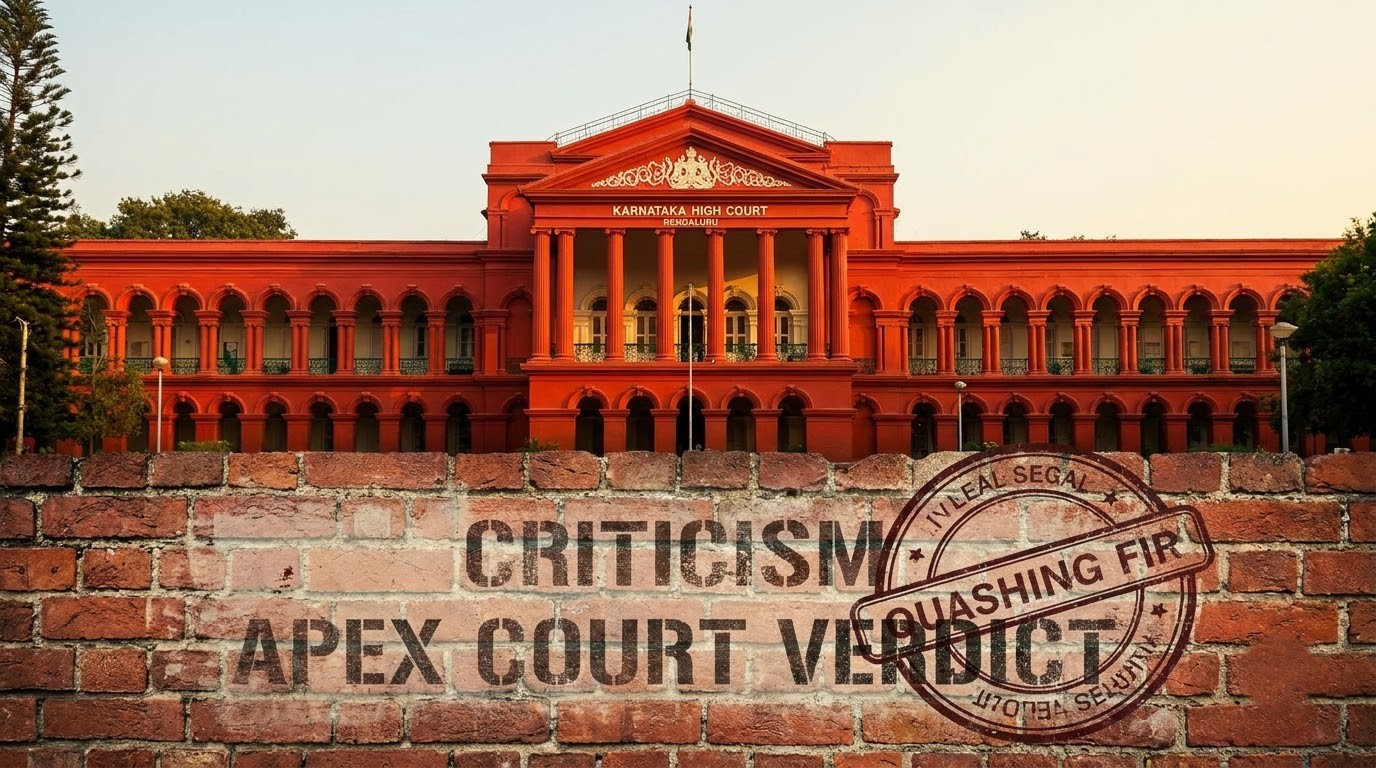
    The Karnataka High Court has quashed a First Information Report filed against individuals for alleging that a Supreme Court judgment constituted a denial of justice, observing that such criticism, however strong, does not attract penal provisions related to promoting enmity or outraging religious feelings.

    Hydar Choudhury
    Oct 20, 2026·3 min read
    Karnataka High Court Holds Criticism of Supreme Court Judgment Not an Offence Under Sections 153A and 295A IPC — HC News Legal Analysis | Jurisight

    This article was prepared with AI assistance and reviewed by the Jurisight Desk.

    Key Legal TakeawayHC News

    The Karnataka High Court has quashed a First Information Report filed against individuals for alleging that a Supreme Court judgment constituted a denial of justice, observing that such criticism, however strong, does not attract penal provisions related to promoting enmity or outraging religious feelings.

    The Karnataka High Court has quashed a First Information Report registered against individuals who had painted slogans on a wall criticising a judgment of the Supreme Court, holding that describing such a judgment as a 'denial of justice' does not constitute an offence under Sections 153A and 295A of the Indian Penal Code.

    The court was hearing a petition challenging the FIR filed under Sections 153A (promoting enmity between different groups on grounds of religion, race, place of birth, residence, language, etc.) and 295A (deliberate and malicious acts intended to outrage religious feelings of any class by insulting its religion or religious beliefs) IPC. The allegations stemmed from wall slogans that characterised a particular Supreme Court verdict as amounting to a denial of justice.

    After examining the contents of the slogans and the context in which they were made, the Bench observed that expressing disagreement with a judicial decision, even in strong or critical terms, falls within the realm of legitimate public discourse and does not, by itself, amount to promoting enmity between groups or insulting religious beliefs. The court emphasized that the language used in the slogans did not target any religious, racial, or linguistic group, nor did it contain any malicious intent to outrage the religious sentiments of any particular class.

    The judgment clarified that while Section 153A IPC requires proof of an intention to promote disharmony or feelings of enmity, hatred, or ill-will between different groups, the mere act of criticising a court judgment does not satisfy this threshold. Similarly, for an offence under Section 295A IPC to be made out, there must be a deliberate and malicious intention to insult the religion or religious beliefs of a group. The court found no such intention evident from the slogans in question.

    Advertisement

    The Bench further noted that a vibrant democracy thrives on the freedom to criticise public institutions, including the judiciary, and that such criticism, unless it crosses into hate speech or incitement to violence, is protected under the right to freedom of expression. It warned against the misuse of criminal provisions to silence dissent or penalise legitimate critique of judicial decisions.

    Consequently, the court allowed the petition and quashed the FIR in its entirety, holding that the allegations made in the slogans did not disclose any offence punishable under the invoked provisions of the Indian Penal Code. The order reinforces the principle that judicial accountability and public debate on court judgments are essential components of a democratic society and cannot be stifled through misapplication of penal laws.

    The decision underscores the judiciary’s role in safeguarding free speech while maintaining the balance between expression and responsible discourse, particularly in cases involving allegations against judicial verdicts.

    Explore Related Topics, Courts & Statutes

    Karnataka High CourtFreedom of expressionSection 153A IPCSection 295A IPCSupreme Court CriticismFIR Quashed

    Explore related legal coverage

    Continue with reporting and analysis connected to this article.

    Browse HC News

    More from this court

    • Can Mother Inherit Son’s Property? Karnataka HC Explains

      Karnataka High Court

    • Bike Taxi Ban Lifted For Ola, Uber And Rapido By Karnataka HC

      Karnataka High Court

    Statutes and provisions

    • SC Hate Speech Ruling: No Contempt if Complaint Not Made to Police

      Section 153A IPC

    • Supreme Court Move: Communist Parties Seek Action Against Assam CM Himanta Biswa Sarma Over Alleged Hate Speech

      Section 153A IPC

    Related legal topics

    • ​"Rasgulla Is Not Hate Speech": Bombay High Court Quashes 2010 FIR Against Shekhar Suman and Bharti Singh

      FIR Quashed

    • Artistic Expression and CBFC Overreach: The 'Haal' Producer's Challenge in Kerala High Court

      Freedom of expression

    Advertisement

    Hydar Choudhury

    See more from Hydar →
    Jurisight logoJurisight logo

    Simplifying legal knowledge for professionals and citizens. Your daily source for Supreme Court, High Court, and Business Law updates.

    Platform

    HomeAll ArticlesTop NewsSC UpdatesHC Updates

    Categories

    Business LawConstitutionalCriminal LawCivil LawKnow Your Law

    Weekly Digest

    Join 15,000+ others and get the week's most important legal updates.

    © 2026 Jurisight. All rights reserved.
    Privacy PolicyCookie PolicyCookie ConsentLegal Disclaimer