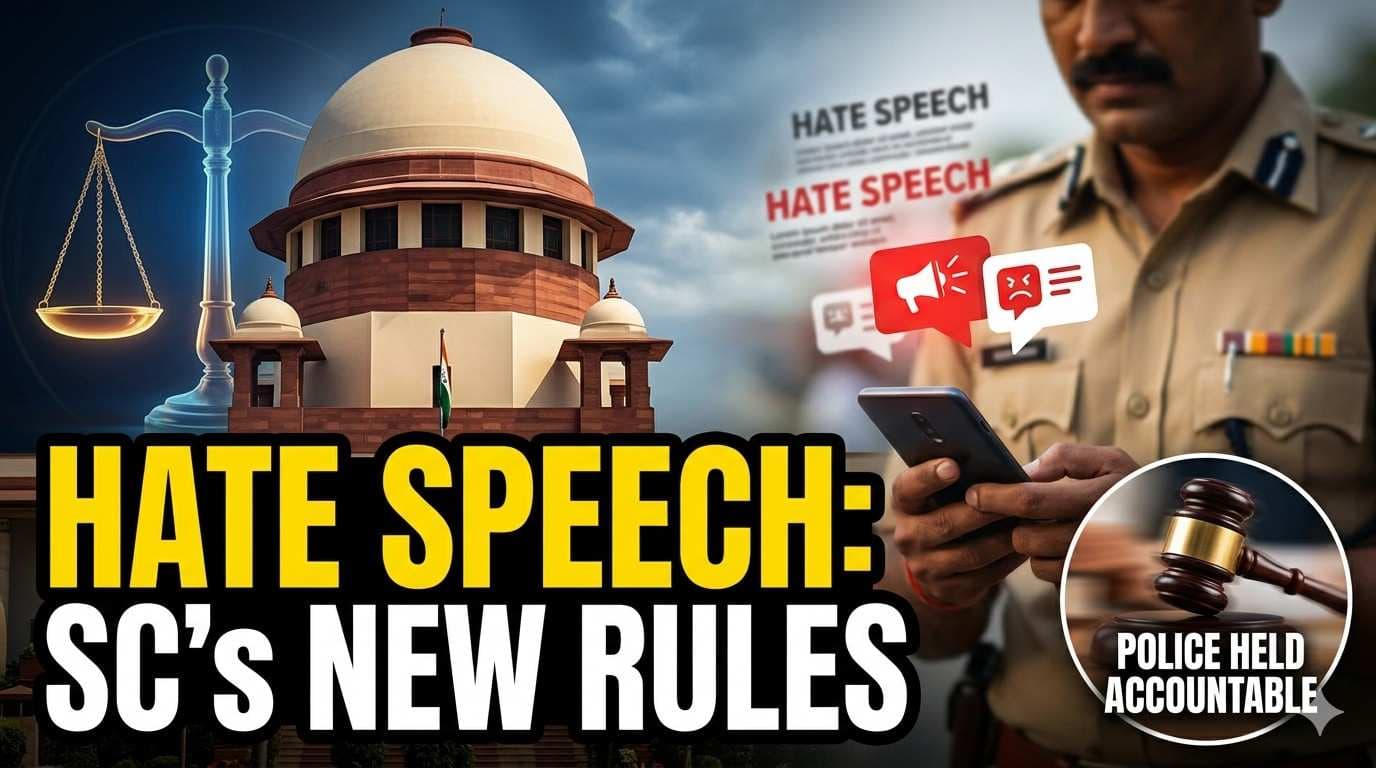
The Supreme Court has addressed the complexities of policing hate speech in a multi-faith democracy, offering a nuanced interpretation of its own previous mandates. While the Court remains firm on its 2022 directive—which requires police to register cases against hate speech regardless of the religion of the speaker—it has now clarified the threshold for "contempt of court." The bench, led by Justice Sanjiv Khanna, noted that for a contempt petition to succeed against a police official, there must be a documented failure to act after being alerted to the offense.
In earlier landmark orders, the apex court had directed all States and Union Territories to register suo motu (on their own motion) FIRs in cases of hate speech. This was intended to remove the burden from private citizens to initiate criminal proceedings in sensitive communal matters. However, in recent hearings involving a batch of petitions alleging widespread non-compliance, the Court observed that "contempt is a serious matter" and cannot be invoked simply because an officer did not happen to see or hear a specific broadcast or speech.
The Court clarified that the primary trigger for a contempt action is the failure to act upon a complaint. If a citizen or organization brings a specific instance of hate speech to the notice of the police and the authorities still refuse to register an FIR or take preventive measures, that "inaction" would then qualify as a willful disobedience of the Supreme Court’s orders. This distinction is crucial for protecting field officers from indiscriminate litigation while still maintaining the "automatic" nature of hate speech prosecution.
During the proceedings, the bench emphasized that the spirit of the law is to prevent the "festering of communal disharmony." The Court reiterated that the definition of hate speech under Sections 153A, 153B, 295A, and 505 of the IPC (now mapped to the Bharatiya Nyaya Sanhita) remains the standard for police intervention. The judiciary's role is to ensure that the police remain a neutral and proactive force in upholding the secular fabric of the nation.
The ruling also touched upon the practical challenges faced by the police in monitoring 24/7 digital and social media content. By requiring a "complaint-first" approach for contempt proceedings, the Court has provided a procedural safeguard for the administration. However, it explicitly warned that this does not absolve the police of their suo motu duty in obvious or high-profile cases of incitement to violence. The police are still expected to take the initiative when a threat to public order is manifest.
For legal practitioners and activists, this update provides a clear roadmap for accountability. If hate speech occurs, the immediate step must be to file a formal report with the local police station or the Superintendent of Police. This documentation creates a "legal trail" that can eventually support a contempt petition if the state fails in its constitutional duty to prosecute the offenders.
In conclusion, the Supreme Court’s latest stance on hate speech reflects a pragmatic judicial philosophy. It reinforces the mandate for strict enforcement against communal vitriol while ensuring that the "sword of contempt" is used judiciously. The focus remains on making the state machinery responsive and accountable to the citizens it is sworn to protect, ensuring that the rule of law prevails over the "rule of the mob."