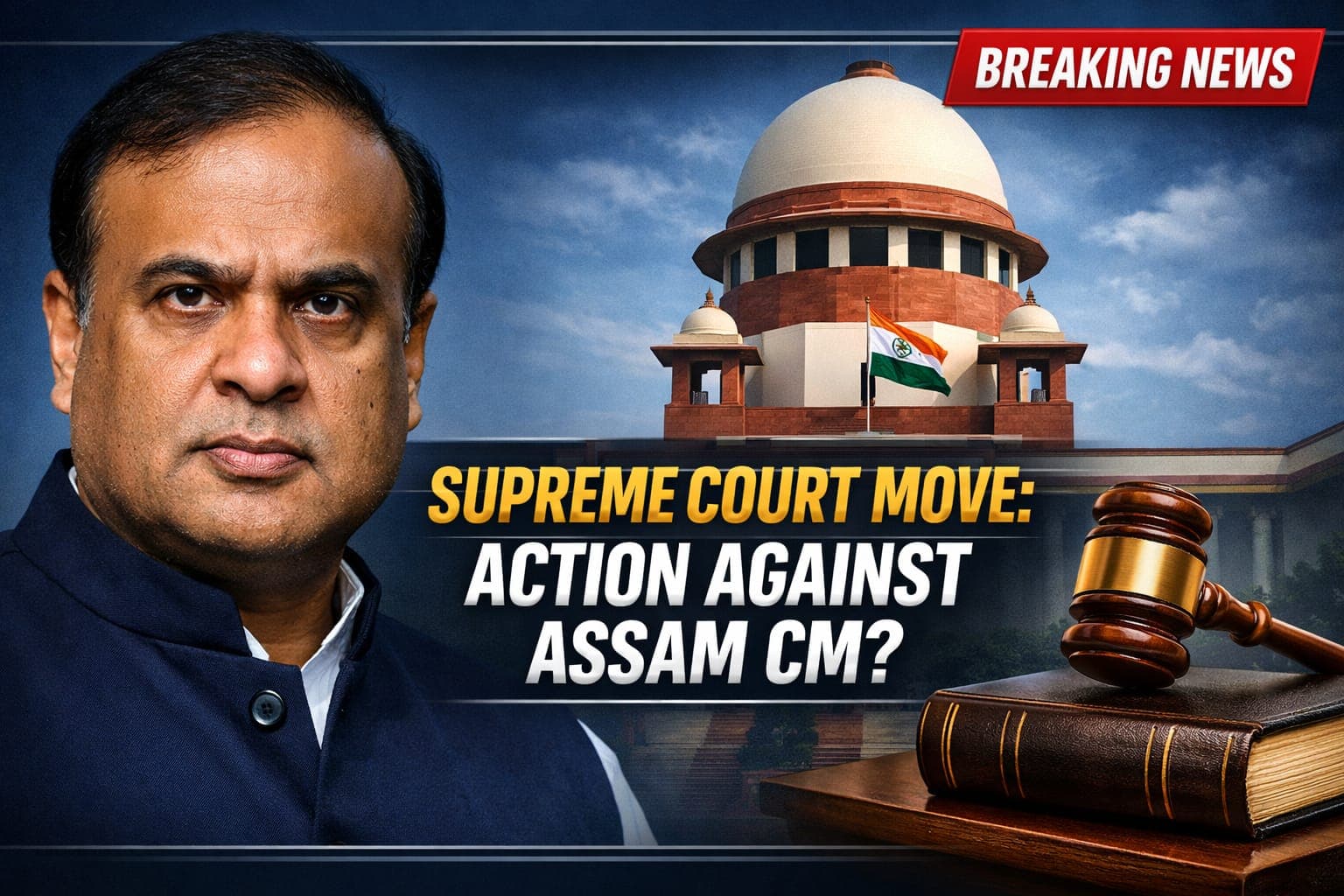
In a significant legal development that underscores the growing concern over communal rhetoric in public discourse, the Communist Party of India (Marxist) [CPI(M)] and senior leaders of the Communist Party of India (CPI) have approached the Supreme Court of India. The petition seeks urgent judicial intervention against Assam Chief Minister Himanta Biswa Sarma for his allegedly provocative and "hate-filled" public statements targeting a specific community.
The matter was mentioned on February 9, 2026, before a Bench headed by Chief Justice of India (CJI) Surya Kant. Advocate Nizam Pasha, appearing for the petitioners, sought an urgent listing of the plea, highlighting that the Chief Minister’s remarks were not merely political rhetoric but a direct threat to social harmony and the constitutional rights of citizens
The petition specifically brings to the Court's attention a series of disturbing speeches and social media posts. A primary point of concern is a recent video where the Chief Minister is allegedly depicted or described in a context involving "shooting" at members of a particular community.
Furthermore, the petitioners have cited statements where the Chief Minister reportedly encouraged the public to make members of the "Miya" (Bengal-origin Muslim) community "suffer." This included suggestions of economic discrimination, such as underpaying for services like rickshaw rides. The plea argues that when such calls for economic and physical harm come from the highest executive authority of a state, they normalize cruelty and strip a community of its right to live with dignity under Article 21 of the Constitution.
The move to the apex court comes after what the petitioners describe as a total failure of the state machinery to act. Despite multiple complaints filed at various police stations across Assam and even in New Delhi, the petitioners claim that no First Information Reports (FIRs) have been registered against the Chief Minister.
Advocate Nizam Pasha submitted before the CJI, "Complaints are filed, but no FIRs registered. We seek the urgent intervention of this Court with respect to disturbing speeches made by the sitting CM of Assam."
The CJI, while acknowledging the mention, noted a trend that often sees political battles shifting to the courtroom as elections draw near. However, the legal weight of the petition rests on the Supreme Court’s previous stringent guidelines regarding hate speech.
The Indian judiciary has repeatedly held that "hate speech" is a direct violation of the principle of fraternity and the secular fabric of the nation. In several landmark orders, the Supreme Court has directed State authorities to take suo motu action (action on their own) and register FIRs against hate speech offenders, regardless of their religion or political stature.
The petitioners argue that the Chief Minister’s statements violate:
- Article 14 (Equality): By targeting a specific group based on their origin and religion.
- Article 21 (Right to Life and Dignity): By inciting economic and social humiliation.
- The Constitutional Oath: Under Article 164(3), a Chief Minister is sworn to act "without fear or favour, affection or ill-will." The plea alleges that his "hate-filled" rhetoric is a clear breach of this oath.
This is not the first time CM Himanta Biswa Sarma has faced such allegations. In recent weeks, a group of 43 eminent citizens in Assam—including retired DGPs, academicians, and religious leaders—also submitted a memorandum to the Gauhati High Court. They alleged that the CM’s remarks regarding the Special Revision of electoral rolls were designed to intimidate the "Miya" community and interfere with a quasi-judicial process.
The current petition before the Supreme Court claims that the term "Miya," often used as a derogatory reference in the state, is being weaponized by the executive to "stigmatize and dehumanize" an entire population.
Legal scholars point out that the Supreme Court's response to this petition will be a litmus test for the enforcement of its own guidelines. While "free speech" is a fundamental right, it does not cover "hate speech" that incites violence or discrimination.
The petitioners are not just asking for an FIR; they are seeking a directive that reaffirms constitutional discipline. They argue that if a sitting Chief Minister is allowed to use communal tropes without legal consequence, it sets a dangerous precedent for the rule of law in India.
The Supreme Court has not yet fixed a specific date for the hearing, but the mention has put the spotlight back on the legal accountability of constitutional functionaries. As the CJI remarked, political battles are indeed fought in courtrooms, but the court’s role remains focused on whether the "battle" has crossed the red line of the Indian Penal Code (IPC) and the Constitution.
For now, the legal fraternity and the citizens of Assam wait to see if the apex court will issue notices to the state government and the Chief Minister, or if it will direct the police to follow the established law of the land regarding the registration of FIRs in hate speech cases.
This case is more than just a political tiff between the Left parties and the BJP-led Assam government. It is a fundamental question of whether a person holding high office is subject to the same laws as an ordinary citizen when it comes to speech that can incite public animosity. As the petition moves through the halls of the Supreme Court, it carries the weight of India’s secular identity and the promise of "Justice, Liberty, and Equality" for all.