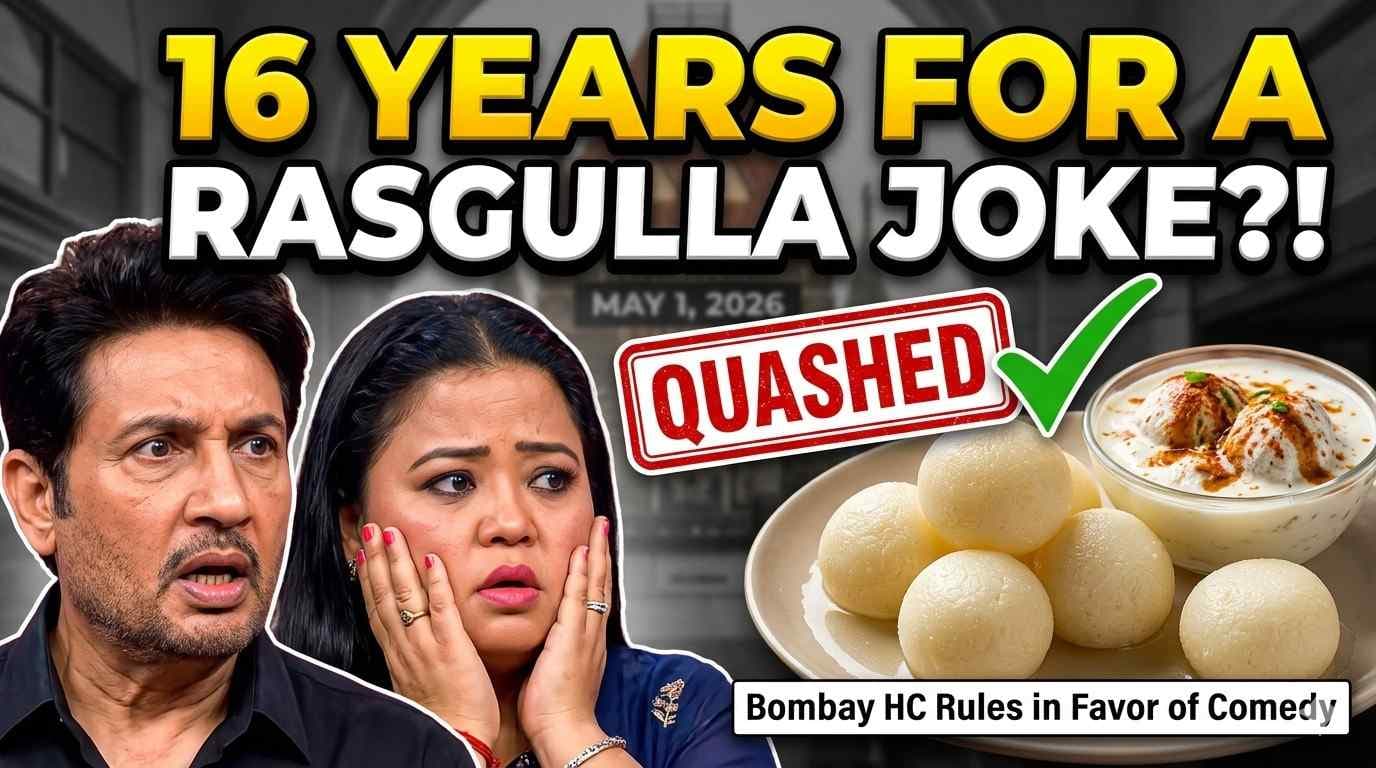
In a victory for creative freedom and the comedy circuit, the Bombay High Court has quashed a 16-year-old hate-speech case against actor Shekhar Suman and comedian Bharti Singh. On Friday, May 1, 2026, Justice Amit Borkar set aside an FIR from 2010 that alleged the duo had outraged religious feelings during an episode of the television show Comedy Circus Ka Jadoo.
The case was originally filed by the president of the Raza Academy, taking issue with a performance themed around humorous depictions of professions. The complainant objected to a rhyming exclamation used in the act: "Ya Allah! Rasgulla! Dahi Bhalla!" It was alleged that these words insulted religious sentiments under Section 295A of the Indian Penal Code (IPC).
Justice Borkar’s ruling brings a necessary perspective to the application of criminal law in the entertainment industry. The Court held that the words "Rasgulla" and "Dahi Bhalla" are neutral food items and that their use in a light-hearted comic act lacked any "malicious intent" to hurt religious sentiments.
"The words by themselves are neutral in ordinary social use," the Court observed. "Mere mention of food items in a comic act cannot amount to insult of religion. Something more is required. There must be material to show that the words were selected as a weapon of offence."
The judgment also highlighted the distinction between a performer's scripted act and a deliberate declaration against a religious group. Justice Borkar noted that a judge or a performer on a comedy show typically follows a script and does not stand in the position of a speaker making a formal theological or political statement. The Court warned against the "casual" invocation of criminal law against artists simply because a performance is viewed out of context or causes individual offense.
A critical procedural point also led to the quashing of the FIR: the lack of prior sanction under Section 196 of the Code of Criminal Procedure (CrPC). This section acts as a mandatory safeguard to prevent the misuse of hate-speech laws, and its absence in this case made the proceedings legally unsustainable.
This ruling is a significant reminder that for an offense to be made out under Section 295A, there must be a "deliberate targeting" of religious feelings. By quashing the 16-year-old proceedings, the Bombay High Court has reinforced the principle that humor, even when it involves rhyming religious exclamations with everyday objects, should not be branded as a crime without evidence of malice.
For the entertainment community, the verdict provides a layer of protection against long-drawn legal battles sparked by subjective interpretations of performance art. It reaffirms that in a diverse society, the law must distinguish between what is perceived as "insulting" by some and what is intended as "malicious" by the law.
The case of the "Rasgulla joke" finally reaches its conclusion, serving as a precedent for the protection of artistic expression against overzealous litigation.