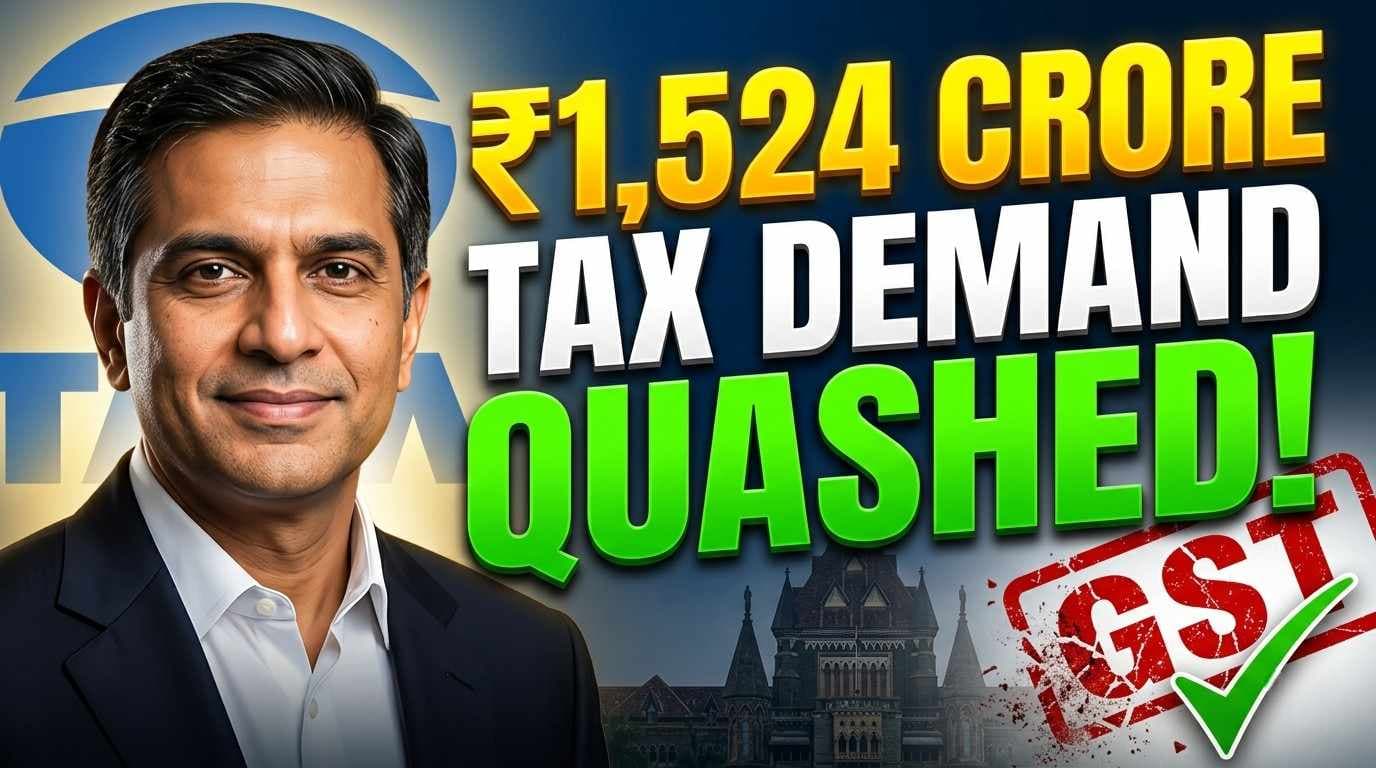
In a significant legal victory for Tata Sons, the Bombay High Court has quashed a ₹1,524 crore Integrated Goods and Services Tax (IGST) demand and penalty. On Thursday, April 30, 2026, a Division Bench of Justice GS Kulkarni and Justice Aarti Sathe held that payments made to settle a foreign arbitral award do not attract GST, as they do not constitute a "supply of service" under the law.
The case originated from a long-running dispute between Tata Sons and the Japanese telecom giant NTT Docomo. Following the breakdown of their partnership in Tata Teleservices, Docomo secured a London arbitral award for approximately $1.17 billion in damages. When the award was enforced by the Delhi High Court in 2017, Tata Sons deposited roughly ₹8,450 crore. Under the consent terms, Docomo agreed to withdraw its enforcement actions in global jurisdictions like the UK and the US once the funds were received.
The Directorate General of GST Intelligence (DGGI) had proposed the ₹1,524 crore tax levy by interpreting Docomo's agreement to withdraw legal proceedings as a taxable service. The department argued that this amounted to an "obligation to refrain from an act or to tolerate an act," a category classified as a "supply" under Entry 5(e) of Schedule II of the CGST Act.
The High Court dismantled this interpretation, calling the Revenue's approach "absurd" and "wholly unrecognized by law." The Bench clarified that once the arbitral award for damages was satisfied, the withdrawal of parallel enforcement proceedings was a natural legal consequence—not an independent commercial service.
"The recovery of amounts under a decree of a court or an arbitral award for damages cannot by any stretch of imagination amount to supply of services," the Court held. The judges emphasized that for GST to apply, there must be an independent agreement where one party agrees to tolerate an act for a specific consideration. In this instance, the payment was a judicial determination of damages, and the subsequent withdrawal of cases was "integral to" and "intricately connected" with the principal award.
The ruling reinforces a critical boundary between commercial transactions and judicial outcomes. The Court noted that the tax department's attempt to levy GST appeared to be driven more by the "large quantum of the award amount" rather than any sound legal basis.
For India's corporate sector, this judgment provides much-needed clarity on the taxability of arbitration settlements. It confirms that the satisfaction of a court-enforced award is a discharge of a legal obligation and cannot be treated as a commercial "supply" merely because money has changed hands.
As the matter concludes, the decision stands as a firm reminder that judicial exercises—and the procedural steps required to fulfill them—remain outside the net of the Goods and Services Tax.