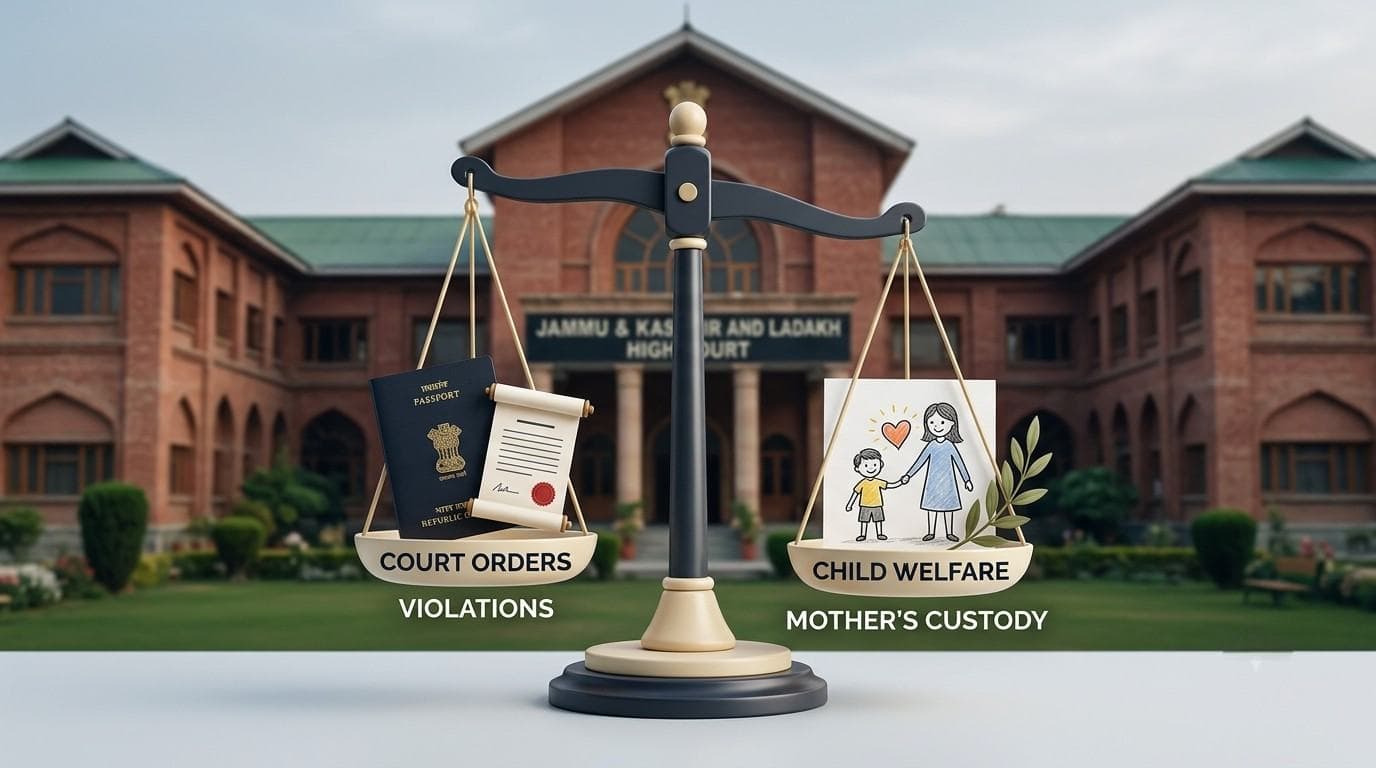
The High Court of Jammu & Kashmir and Ladakh has allowed an appeal by a mother challenging the Family Court, Srinagar’s order granting custody of her two minor sons to the father, setting aside the trial court’s judgment and remanding the matter for fresh consideration in light of the child’s welfare. The Bench, comprising Justice Sanjay Dhar, heard the matter after it was remanded by the Supreme Court for reconsideration of certain aspects.
The parties were married in Srinagar and subsequently moved to Qatar, where the husband was employed as an electrical engineer. Their marriage was dissolved by the Qatar Family Court, which granted physical custody of the two sons to the mother. Following the divorce, the mother returned to Srinagar with the children. The father then challenged her custody before the J&K&L High Court, alleging that the children had been taken away unlawfully in violation of the Qatar court’s order restricting their removal from Qatar.
During proceedings, the mother agreed to return to Qatar with the children but, after a brief stay, brought them back to India, leading to further contempt and custody proceedings. The father sought custody under Section 25 of the Guardians and Wards Act, 1890, contending that the mother had violated her undertaking before the court, disrupted the children’s education by removing them from a reputed school in Qatar, and exposed them to an unfamiliar environment in India.
The mother, in her defence, stated that she had left Qatar due to harassment by the father and asserted that the children were enrolled at Delhi Public School, Budgam, and were adjusting well to their new environment.
The trial court had ultimately granted custody to the father. Although the High Court initially set aside that order, the Supreme Court later remanded the matter for reconsideration of specific issues, prompting the present appeal.
Allowing the appeal, the Bench observed that mere violation of a condition imposed by the Qatar court — prohibiting relocation of the children — would not affect or alter the mother’s superior claim to custody, which had been affirmed on merits by the Qatar court’s judgment. The Court emphasized that the background and compelling circumstances under which the mother took the extreme step of relocating the children required serious consideration.
The Court further held that revoking custody on technical grounds would not obliterate the finding that the mother was best suited to have custody, as determined by the Qatar court. It stated that her conduct, even if legally impermissible, would not by itself disentitle her from holding custody if it was otherwise in the best interests of the children’s welfare.
In examining the legal framework, the Court referred to Mohammedan law, noting that a mother’s right to hizanat (custody) of her male child continues until the child completes seven years of age, and this right persists after divorce unless she remarries or engages in conduct rendering her unfit for custody. The Court observed that the mother’s right to custody cannot be taken away except on account of her own misconduct or remarriage, and even after the child turns seven, she may retain custody if she has not remarried or engaged in disqualifying conduct.
The Bench relied on Rosy Jacob v. Jacob A. Chakramakkal (1973) 1 SCC 840, which held that the paramount consideration in proceedings under Section 25 of the Guardians and Wards Act is the welfare of the minor child, requiring due regard for the father’s right as guardian and all other relevant factors affecting the child’s well-being.
It also cited Nil Ratan Kundu v. Abhijit Kundu (2008) 9 SCC 413, which affirmed that in appointing a guardian, the court exercises parens patriae jurisdiction and must prioritize the child’s welfare above all other considerations.
The Court concluded that the mother’s actions, while constituting a breach of the Qatar court’s order, did not automatically negate her claim to custody, especially when the children’s welfare, educational stability, and emotional adjustment in India were found to be favourable. The matter was remanded to the Family Court, Srinagar, for a fresh determination of custody in accordance with these principles.