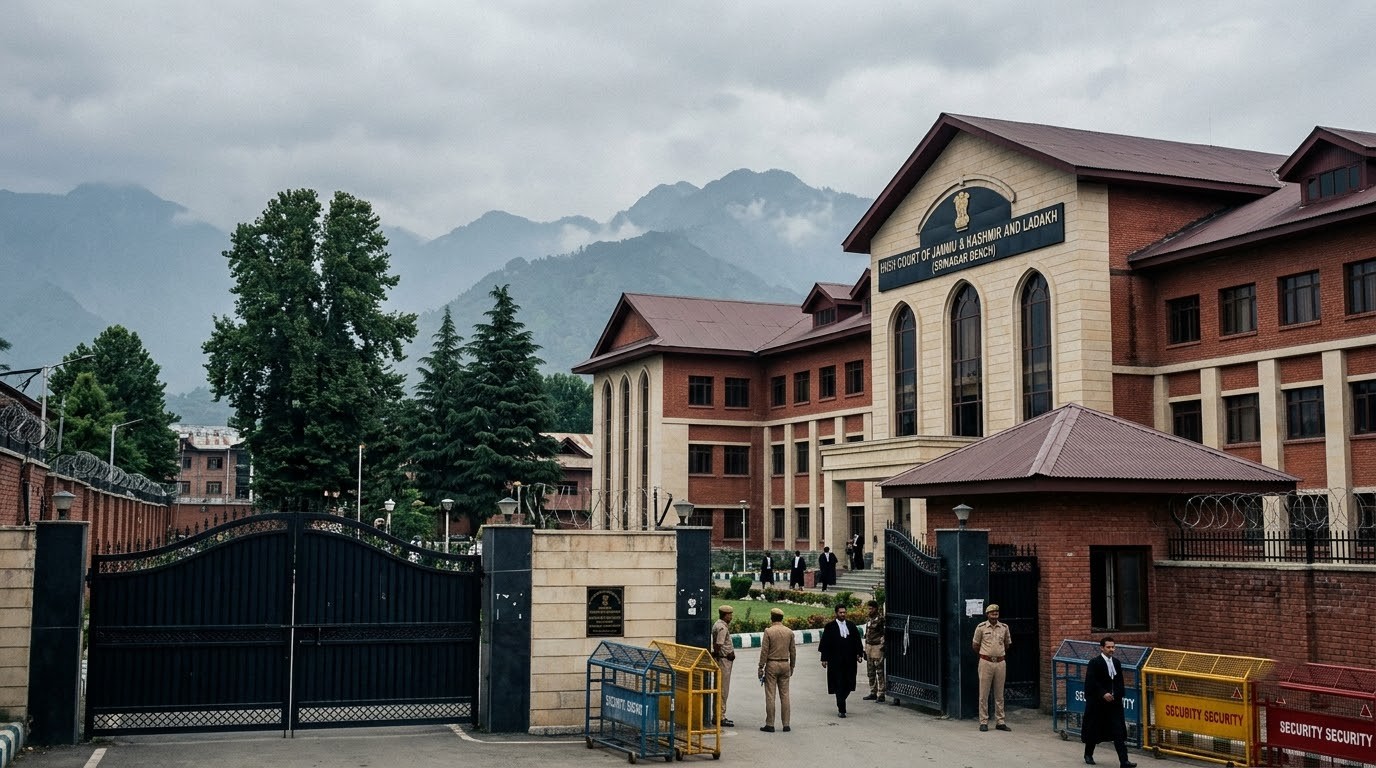
The Jammu & Kashmir and Ladakh High Court has dismissed an appeal filed by Younis Mushtaq Bhat challenging the refusal of bail by a Special Court in connection with a terrorist attack at Kakapora Railway Station in April 2022. A Division Bench comprising Justice Sanjeev Kumar and Justice Mohd Yousuf Wani held that the material on record attracts the statutory embargo on bail contained in Section 43D(5) of the Unlawful Activities (Prevention) Act (UAPA). The court concluded that reasonable grounds exist to believe the accusations against the appellant under Sections 18 and 39 of the UAPA are prima facie true.
Background Of The Case
The appeal arose from an order passed by the Special Court (Additional Sessions Judge), Pulwama, on November 17, 2025, rejecting Bhat's bail application. The First Information Report was registered at Police Station Kakapora following intelligence that terrorists opened indiscriminate fire at the railway station. The attack resulted in the death of Head Constable Surinder Singh, while Sub-Inspector Dev Raj, who sustained injuries, succumbed on April 23, 2022.
During investigation, police obtained CCTV footage from railway authorities which allegedly led to the identification of suspects, including the appellant. According to the prosecution, Bhat initially denied involvement but admitted his role when confronted with the footage. The prosecution alleged that Bhat accompanied co-accused Mukhtar Ahmad Bhat to the railway station on a motorcycle on the day of the incident. As per the disclosure attributed to the appellant, Mukhtar had concealed the motorcycle's number plate and carried a pistol. Bhat allegedly kept the motorcycle running near the entry point while Mukhtar proceeded towards the station and opened fire. The investigation culminated in a chargesheet against four accused persons. The trial court framed charges against Bhat and co-accused Tawheed Bashir Bhat under Sections 18 and 39 of the UAPA on December 27, 2022. By the time the bail application was decided, the prosecution had examined 17 of 42 listed witnesses.
Appellant's Submissions
Before the High Court, the appellant argued that no substantive material connected him to the alleged offences of conspiracy or raising funds for terrorist activity. He contended that no recovery had been effected from him or at his instance and that the prosecution case rested substantially on an alleged extra-judicial confession. He further relied on his prolonged incarceration, the progress of trial, and his right to a speedy trial under Article 21 of the Constitution. Citing the Supreme Court decision in Union of India v. K.A. Najeeb, the appellant submitted that prolonged detention without an immediate prospect of conclusion of trial could justify bail notwithstanding the statutory restrictions under the UAPA.
Prosecution's Response
The Union Territory, represented by Senior Additional Advocate General Mohsin Qadri, opposed the appeal. Qadri submitted that the appellant's involvement was supported by CCTV footage and the statements of prosecution witnesses, specifically PWs 5, 31 and 34. It was further argued that the appellant's disclosure statement had been corroborated through evidence led during trial.
Court's Analysis On 'Prima Facie True' Standard
The Bench explained that Section 43D(5) of the UAPA imposes an additional restriction on the grant of bail to a person accused of an offence under specified chapters of the Act. The provision mandates that the court shall not release such a person on bail if, after hearing the public prosecutor, it is of the opinion that there are reasonable grounds for believing that the accusation against the person is prima facie true. The court observed that the expression "prima facie true" cannot be read and understood to mean "proved" as used in the Bharatiya Sakshya Adhiniyam, 2023. The Bench clarified that the standard requires something more than mere suspicion but does not call for proof beyond reasonable doubt or a mini-trial at the bail stage.
How Does Section 43D(5) UAPA Differ From Ordinary Bail Provisions?
Section 43D(5) of the UAPA creates a statutory presumption against bail by requiring the court to deny release if reasonable grounds exist to believe the accusation is prima facie true, a standard lower than proof beyond reasonable doubt but higher than mere suspicion, unlike ordinary bail provisions under the BNSS where the court retains broader discretion based on the nature of the offence and the accused's antecedents.
Aspect | Section 43D(5) UAPA | Ordinary Bail (BNSS/CrPC) |
|---|---|---|
Statutory Bar | Mandatory denial if accusation prima facie true | No statutory bar; discretionary based on offence gravity |
Standard of Scrutiny | Reasonable grounds to believe accusation prima facie true | Prima facie case, but balanced with liberty under Article 21 |
Judicial Approach | No mini-trial; assessment on broad probabilities | Detailed appreciation of evidence permissible |
Speedy Trial Exception | Available per K.A. Najeeb (prolonged detention) | Inherent in Section 479 BNSS / Section 436A CrPC |
Application To Facts And Disposition
Applying this standard, the Bench noted that the trial court had already framed charges against the appellant under Sections 18 and 39 of the UAPA. The statements of prosecution witnesses examined during trial supported the prosecution's case. The court found that the CCTV footage, the appellant's alleged disclosure, and the corroborative witness testimony collectively constituted reasonable grounds to believe the accusations were prima facie true. The Bench rejected the reliance on K.A. Najeeb, observing that the trial had made substantial progress with 17 witnesses examined and there was no indication of inordinate delay attributable to the prosecution. Consequently, the Division Bench dismissed the bail appeal, upholding the Special Court's order.