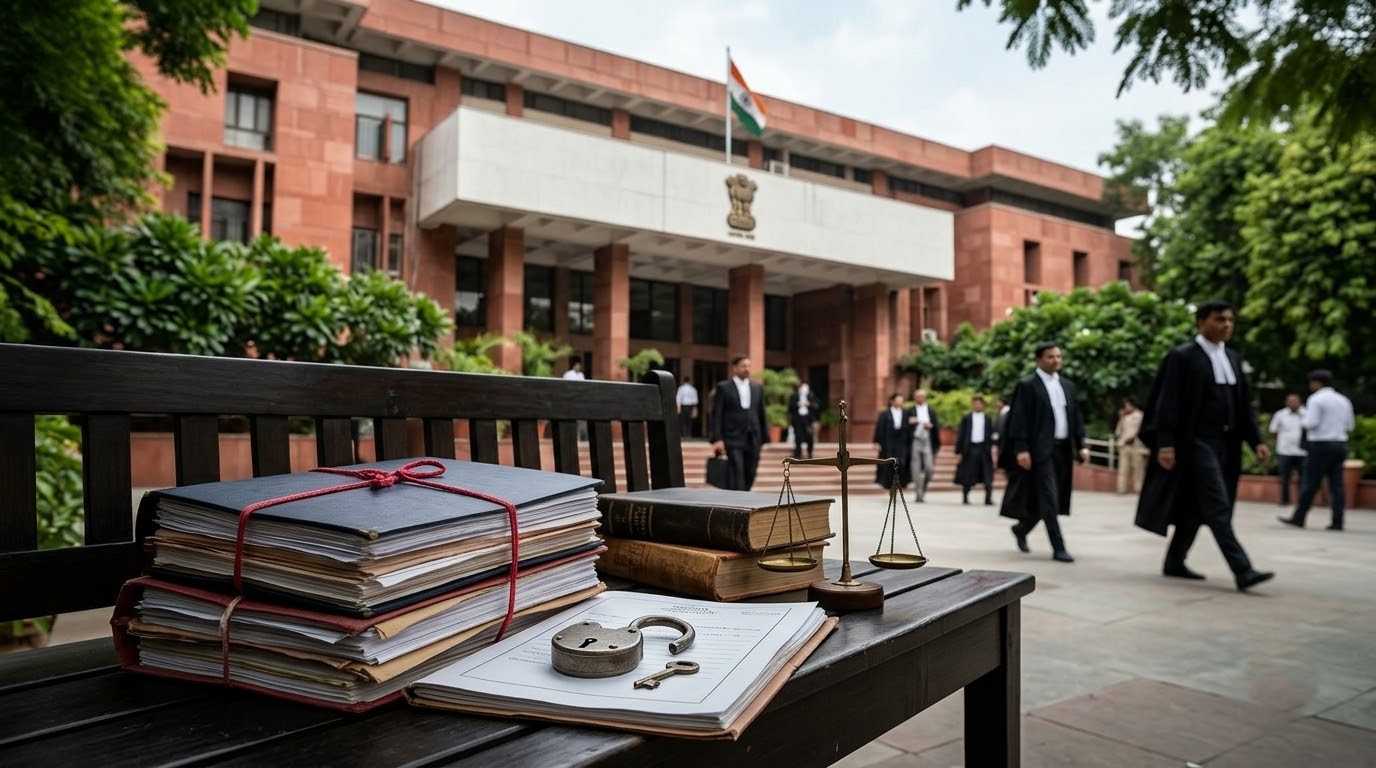
The Delhi High Court has dismissed an appeal filed by the National Investigation Agency (NIA) challenging the bail granted to Mateen Ahmed Bhat in a case registered under the Unlawful Activities (Prevention) Act (UAPA) and the Indian Penal Code (IPC). A bench comprising Justices Navin Chawla and Arun Bhardwaj delivered the judgment on October 30, affirming the trial court's May 3, 2023 order releasing Bhat on bail. The High Court held that the seriousness of the allegations alone does not justify continued incarceration when the trial is unlikely to conclude expeditiously.
The NIA had alleged that Bhat willingly joined a conspiracy to function as an Over Ground Worker (OGW) for active terrorists in the Kashmir Valley. The agency claimed he was involved in procuring arms and ammunition for proscribed organisations, including Hizbul Mujahideen and Lashkar-e-Taiba, to foment unrest. According to the prosecution, following the abrogation of Articles 370 and 35A, local youths were allegedly brainwashed into joining separatist outfits. The investigation purportedly established that Bhat had met a Hizbul Mujahideen operative and was working for Pakistan-based handlers linked to these banned groups.
Bhat was arrested on October 13, 2021. The NIA filed a chargesheet in April 2022 invoking Section 120B (criminal conspiracy) and Section 121A (conspiracy to wage war against the Government of India) of the IPC, alongside relevant UAPA provisions. Charges in the matter were formally framed in 2024.
Before the High Court, the investigating agency contended that the trial court's bail order suffered from contradictions and errors, particularly in light of the subsequent order framing charges against the accused. The NIA argued that the framing of charges demonstrated a prima facie case warranting the cancellation of bail.
Why did the High Court reject the NIA's argument regarding the framing of charges?
The High Court ruled that the trial court correctly assessed whether the material on record showed the accusations were prima facie true at the bail stage. The bench clarified that the subsequent order framing charges is not a relevant consideration while adjudicating an appeal against a bail order, as the standards for framing charges and granting bail operate on distinct legal thresholds.
The bench observed that although the allegations against Bhat were grave in nature, they are required to be tested during the trial. The court noted that the trial was unlikely to conclude in the near future. Consequently, the High Court found no merit in the NIA's appeal and dismissed it, allowing the trial court's bail order to remain in force pending the conclusion of the trial.
Stage | Legal Standard Applied | Relevance to Bail Appeal |
|---|---|---|
Bail Hearing (Trial Court, May 2023) | Whether accusations are prima facie true based on material on record | Primary basis for grant of bail; upheld by High Court |
Framing of Charges (Trial Court, 2024) | Whether there is sufficient ground for presuming the accused committed the offence | Held irrelevant for the purpose of the bail appeal by the High Court |
Trial (Pending) | Proof beyond reasonable doubt | Allegations to be tested here; trial unlikely to conclude soon |
The judgment reinforces the principle that the framing of charges, which occurs at a later procedural stage and applies a different evidentiary threshold, does not retrospectively invalidate a bail order that was correctly decided on the material available at the time. The High Court's disposition ensures that Bhat shall remain at liberty while the prosecution substantiates its case during the trial proceedings.