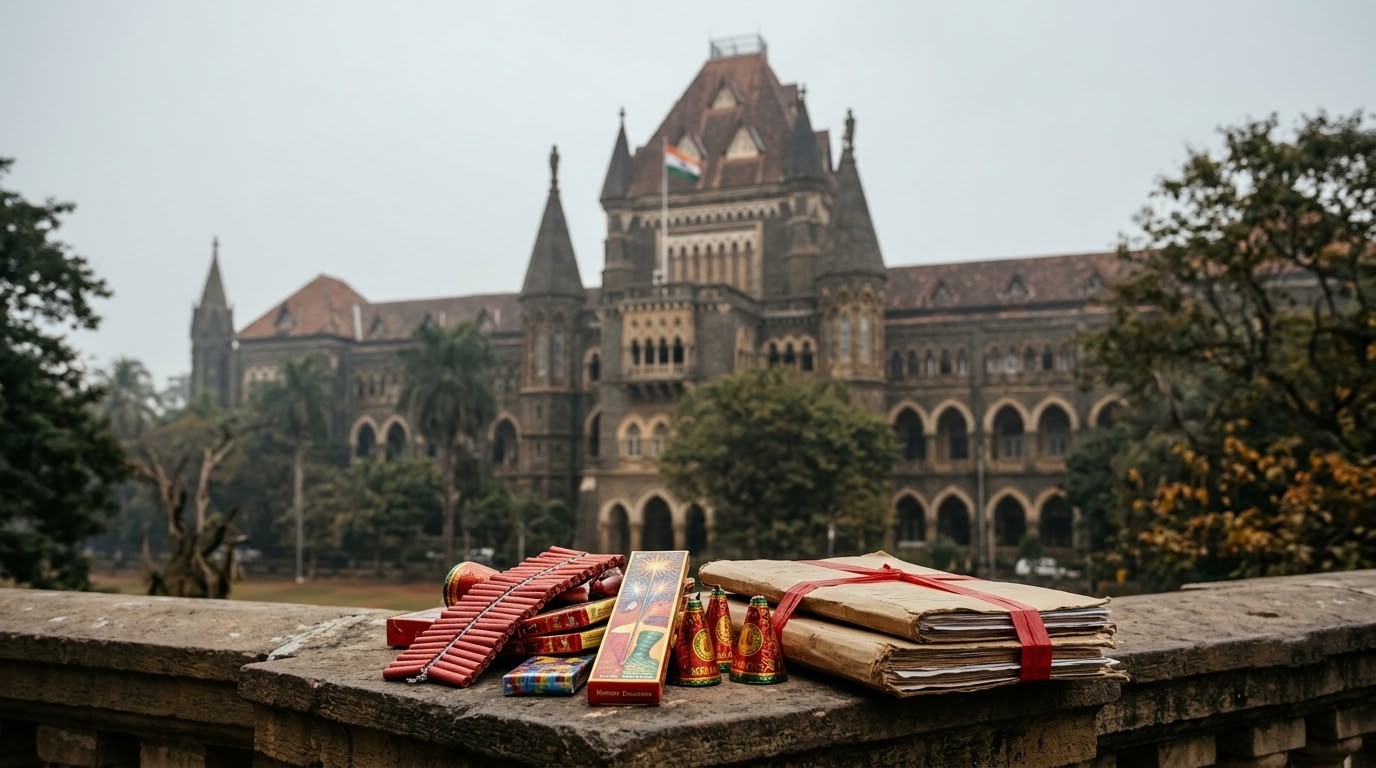
A division bench of the Bombay High Court, comprising Justice Girish Kulkarni and Justice Dr Neela Gokhale, on Thursday indicated that it was actively considering a complete prohibition on the sale and manufacture of firecrackers in Mumbai. The bench took serious note of rising air and noise pollution levels, observing that existing restrictions had failed to curb indiscriminate bursting, particularly during the recent Diwali festival, with violations continuing until the early hours of the morning despite concerted efforts by the police and civic authorities.
Why is the Bombay High Court considering a total ban on firecrackers in Mumbai?
The court observed that current regulations are unenforceable because the police machinery is "helpless" to control violations, citizens lack sensitivity towards pollution hazards, and the Air Quality Index reached hazardous levels during Diwali, causing property damage and health risks to vulnerable populations.
During the hearing, the judges remarked that the city was "breathing poisonous gases" and highlighted that the Air Quality Index (AQI) on Diwali day, 9 November, was the highest recorded. The bench noted that over 300 cases of property damage were reported during the festival, alongside injuries and deaths attributed to firecracker incidents. The judges emphasised that the mindset of citizens had not changed, stating that people appeared to have "no consciousness for the societal cause" and "no sensitivity in regard to pollution."
The bench underscored the fundamental rights of citizens to clean air and a safe environment, contrasting these with the commercial interests of manufacturers. The judges observed that unless firecrackers were stopped from being made available, people would continue to purchase and burst them. They pointed out that violations occurred not only during Diwali but also during cricket victories, election celebrations, and processions, infringing upon the fundamental rights of other citizens, including children and senior citizens who cannot afford air purifiers.
Justice Gokhale added that the spike in AQI could not be denied and urged stakeholders not to remain in "denial mode" but to accept the data and figure out how to combat the crisis. The bench made it clear that a proactive approach was essential, warning that without drastic measures, the future of the city's environment was left to imagination.
Police enforcement and regulatory gaps
The court recorded that the police machinery had acted to the best of its abilities but was ultimately unable to control the situation. The judges stated that the police were "totally helpless" and that the violations were "beyond control" despite clear High Court orders. They questioned the utility of rules and orders that were incapable of implementation, asking what recourse remained when the enforcement apparatus itself expressed inability to ensure compliance.
The bench also scrutinised the licensing regime for firecracker sales, noting that the common man was unaware of the chemical ingredients used in products sold to them. The judges asserted that if the activity posed a hazard to human life, the State could not permit it. They directed that manufacturers must consider the fundamental rights of the larger citizenry over their own right to carry on business.
Scope of proposed restrictions
The division bench indicated that if a ban were imposed, only community firecracker displays or regulated fire shows would be permitted. The judges appreciated the steps taken by the Municipal Commissioner to ban the sale of aerial firecrackers but stressed that noise-causing crackers also needed to be prohibited. They clarified that the measure was for the benefit of society as a whole and was not targeted at any particular segment of the population.
Aspect | Current Status | Proposed Direction |
|---|---|---|
Sale and Manufacture | Licensed sale permitted with restrictions | Complete ban under consideration |
Permitted Use | Individual bursting within time/decibel limits | Only community fire shows allowed |
Enforcement | Police "helpless" to control violations | Remove availability to enable enforcement |
AQI on Diwali (9 Nov) | Highest recorded (210-266 range noted) | Cited as primary justification for ban |
Property Damage | Over 300 cases reported | Supporting evidence for drastic measures |
The bench reiterated that all violations had occurred despite clear-cut orders and observations previously issued by the High Court. The judges warned that unless availability was curtailed at the source, the cycle of non-compliance would persist, rendering judicial directions ineffective. The matter remains under active judicial consideration with the court signalling its intent to pass appropriate orders to safeguard public health and environmental integrity in the metropolis.