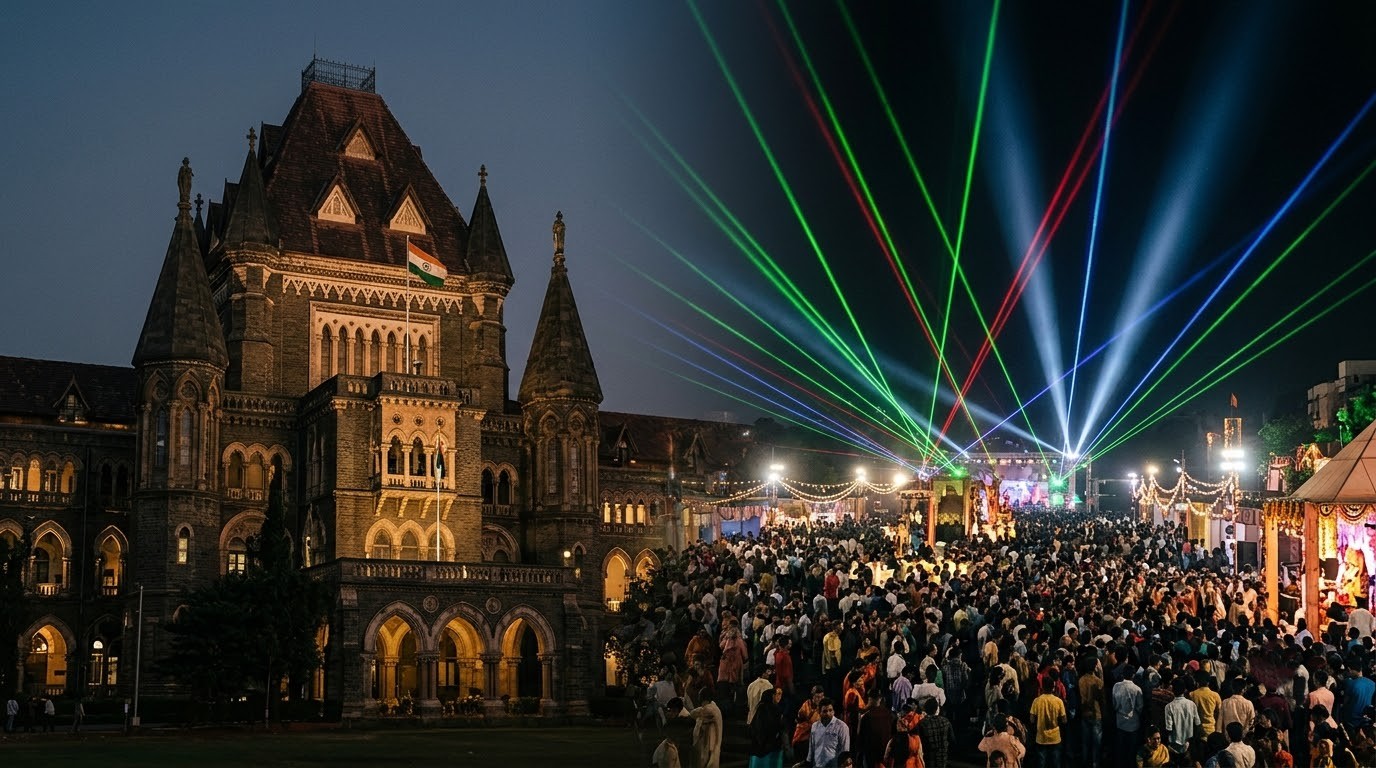
The Bombay High Court has directed the Nagpur Police and municipal authorities to impose a total prohibition on the use of laser lights, high-intensity lumen lights, and beams during festivities and processions in the city. A Division Bench comprising Justice Urmila Joshi-Phalke and Justice Raj D. Wakode issued the direction while hearing a batch of public interest litigations and a writ petition concerning noise and air pollution in Nagpur. The Court warned that strict action must be initiated against violators of the ban.
What specific directions did the Bombay High Court issue regarding firecracker licensing in Nagpur?
The Court directed the Deputy Commissioner of Police to impose a licence condition requiring Pollution Control Board clearance for firecracker sales. It mandated the Police Commissioner to designate officers to monitor compliance with licence conditions and enforce Supreme Court guidelines on noise and air pollution.
The Bench was considering affidavits filed by the police detailing enforcement measures. However, the Court expressed dissatisfaction with the conditions imposed in licences issued to firecracker wholesalers and vendors. It emphasised the mandatory compliance with Section 6-D of the Explosives Act, 1884, read with Rule 84 of the Explosives Rules, 2008, which govern temporary fireworks shops during festivals.
The Court noted that Section 6-D empowers the licensing authority to impose conditions in addition to those prescribed under the statute. It observed that a licence granted under the provision may contain such other conditions as considered necessary by the authority in any particular case. Relying on this provision, the Bench directed the Deputy Commissioner of Police, Nagpur City, to incorporate a specific condition in the licences mandating clearance from the Pollution Control Board for the sale of firecrackers.
Furthermore, the Court directed the Police Commissioner, Nagpur City, to appoint designated officers to ensure compliance with the conditions imposed in the licences. The order stipulates that action must be taken against any person violating those conditions. The Police Commissioner was also directed to ensure compliance with the guidelines issued by the Supreme Court concerning noise pollution rules and air pollution rules.
Court Orders Probe Into Modified Silencer Manufacturers
The Bench took note of the police department's action against vehicles fitted with modified silencers and prohibited horns. Observing that the affidavit did not disclose any investigation into the manufacture of such silencers, the Court directed the Deputy Commissioner of Police to identify the manufacturers and vendors involved in their production and supply.
The Court remarked that it was surprised that despite the deponent stating various enforcement actions, there was no mention of an investigation regarding the manufacturing of the silencers. It ordered the Deputy Commissioner of Police to carry out the investigation and find out the agencies as well as various vendors who are manufacturing and supplying such silencers.
The Court also called for stringent action, including suspension or cancellation of licences of persons violating noise pollution rules. It specifically stated that there shall be a total ban on the bursting of firecrackers during festivities on public streets.
Statutory Provision | Relevance to Court's Direction |
|---|---|
Section 6-D, Explosives Act, 1884 | Empowers licensing authority to impose additional conditions beyond prescribed ones. |
Rule 84, Explosives Rules, 2008 | Prescribes conditions governing temporary fireworks shops during festivals. |
The matters were listed as Dr. Bhupendrakumar K. Wasnik v. The Secretary, Ministry of Environment, Forest and Climate Change (PIL No. 90 of 2025) and connected matters. The Court's directions aim to strengthen the regulatory framework for festivities in Nagpur by targeting pollution at its source, including firecracker retail licensing, vehicular modifications, and the newly identified hazard of high-intensity lighting equipment.