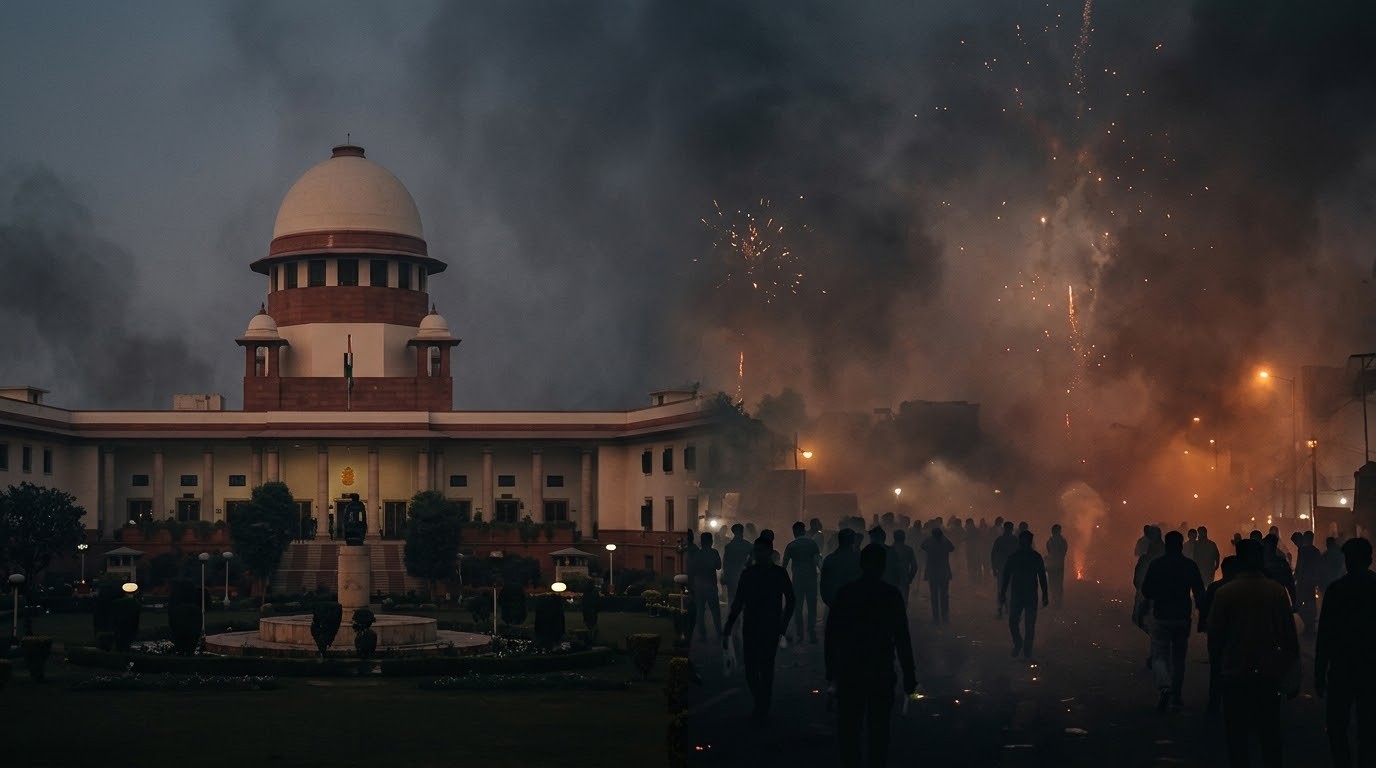
The Supreme Court has emphasised that efforts to curb air pollution during festive periods must evolve into a community-driven initiative, observing that the responsibility of ensuring cleaner celebrations cannot rest exclusively with the judiciary or law enforcement agencies. Stressing the need for greater public participation, the Court called upon the Delhi government and municipal authorities to actively involve local councillors in persuading residents to refrain from bursting polluting firecrackers during celebrations.
Can Judicial Orders Alone Ensure Compliance with Firecracker Restrictions?
The Supreme Court answered in the negative, observing that an excessive reliance on judicial intervention could prove counterproductive, with repeated directions potentially resulting in greater instances of non-compliance. A Bench headed by Chief Justice of India Surya Kant, along with Justices Joymalya Bagchi and V. Mohana, noted that public engagement must replace the sole dependence on court mandates to tackle seasonal pollution effectively.
The observations were made during proceedings in the suo motu matter titled In Re: Curbing Air Pollution in the National Capital Region. The ongoing proceedings examine regulatory frameworks, air quality governance, and ancillary issues concerning the continuous deterioration of air quality in the National Capital Region ahead of the winter season.
During the hearing, Senior Advocate Aparajita Singh, assisting the Court as Amicus Curiae, highlighted the practical limitations of enforcing restrictions on firecracker usage through physical policing alone. The submission pointed out that authorities cannot realistically deploy police personnel at every residential premises to ensure adherence to statutory bans and restrictions. The Amicus further flagged alleged misuse of limited permissions granted for green firecrackers, stating that certain vendors displayed green-labelled boxes at kiosks while keeping prohibited conventional crackers concealed inside shops.
Pollution Control Aspect | Enforcement Challenge | Proposed Remedial Measure |
|---|---|---|
Firecracker Restrictions | Practical impossibility of deploying police at every residence | Involving local councillors to foster a community-led movement |
Green Firecracker Sales | Concealment of prohibited conventional crackers inside shops | Stricter verification at vendor kiosks by authorities |
School-Level Restrictions | Delayed interventions tied to severe pollution categories | Treating school restrictions independently for early preventive action |
The Amicus also drew attention to the adverse impact of air pollution on children respiratory health, referencing a study by the Central Pollution Control Board. The study found that a significant percentage of schoolchildren in Delhi suffered from reduced lung function compared to peers outside the national capital, underscoring the severe health risks faced by vulnerable populations.
Additionally, a lawyer appearing in the matter suggested modifications to the existing Graded Response Action Plan, particularly regarding school-related restrictions. The proposal advocated for treating school protective measures independently and triggering interventions at earlier stages of deteriorating air quality. Additional Solicitor General Aishwarya Bhati, appearing for the government, supported enhanced public awareness initiatives and placed a sector-wise compliance chart before the Bench detailing measures undertaken by NCR States to control construction dust, waste burning, and vehicular emissions.