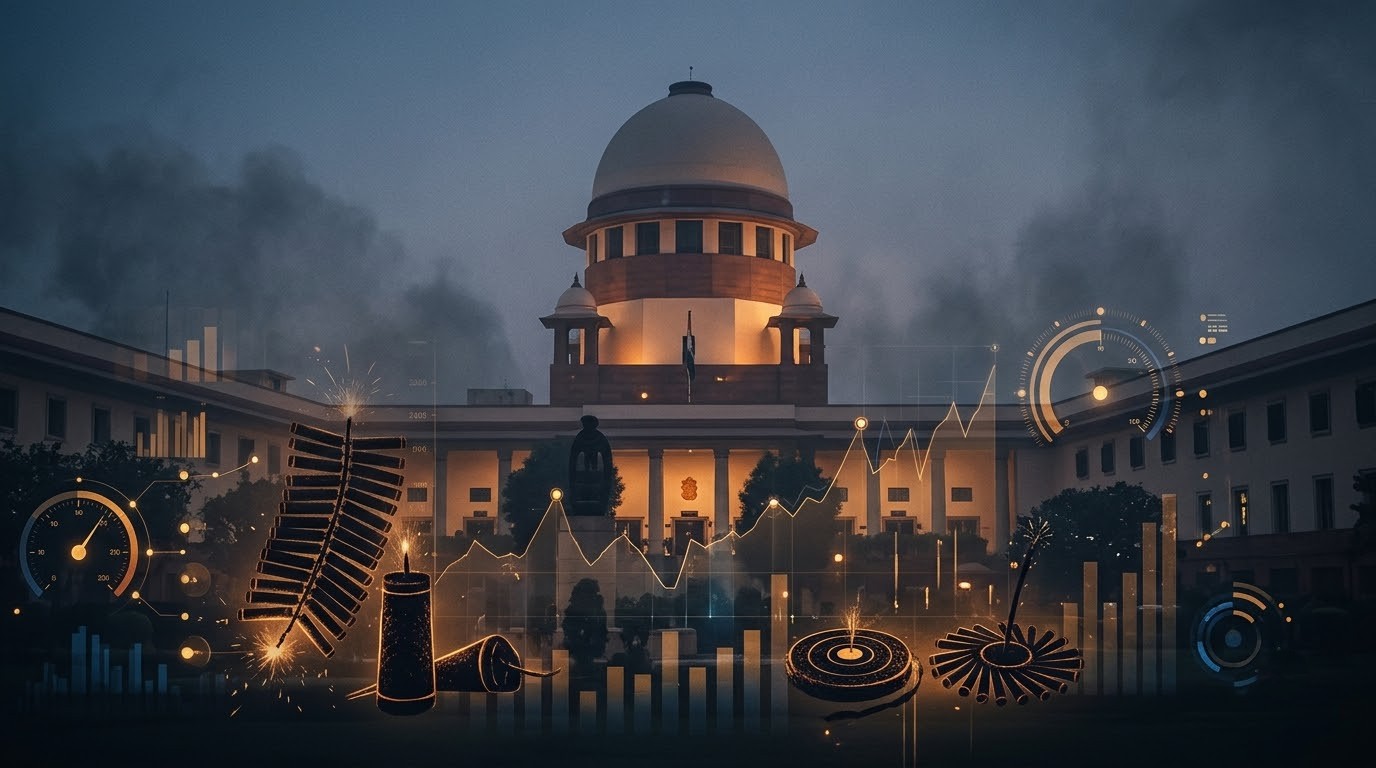
The Supreme Court on Thursday questioned the Union government and the Delhi administration over their failure to place on record enforcement data following last year's temporary relaxation of firecracker restrictions in the National Capital Region. A bench comprising Justice M.M. Sundresh and Justice Prasanna B. Varale observed that court orders become a mere mockery when they are not implemented on the ground. The proceedings arose in the context of the Court's previous direction permitting the sale of green crackers for a limited period during the festive season.
Why did the Supreme Court seek enforcement data on firecracker restrictions?
The Court sought data because authorities failed to demonstrate what action was taken after the limited relaxation for green crackers in 2025, including whether teams were formed, inspections conducted, seizures made, or prosecutions initiated. The bench stated that without an implementing mechanism, judicial orders have no effect.
Justice Sundresh posed a series of pointed questions to the counsel representing the authorities: whether enforcement teams were constituted, whether inquiries were made, whether searches of licence holders were carried out, what was found, how many FIRs were registered, how many cases were filed, and whether prohibited material was seized. The bench emphasised that there is no point in passing orders and issuing directions unless the implementing mechanism is put into operation on the ground. The Court directed the authorities to file an affidavit detailing the measures taken, the implementation difficulties encountered, and the steps required to improve enforcement. It indicated that the proceedings would remain pending to monitor the implementation of its directions.
Balancing Festive Sentiment and Regulatory Compliance
The Court clarified that it was not inclined to impose a complete ban on firecrackers at this stage, acknowledging the public's festive sentiments. Justice Sundresh noted that celebrating an occasion boosts morale and creates positivity. However, the bench warned the authorities against forcing it to adopt a very hard stand through continued non-compliance. The judge urged the authorities to call their officers and ensure ground-level verification, observing that booking challans, taking action against violators, and cancelling licences would automatically bring down violations.
The bench also called for wide publicity of the restrictions through television, newspapers, and other public platforms. Justice Varale referred to public-awareness messages being broadcast on radio. Justice Sundresh suggested involving prominent sportspersons and other respected public figures to encourage compliance. He illustrated the cultural evolution of fireworks, noting that the festival of light originally involved lighting lamps in a leisurely manner, while the introduction of gunpowder from the 14th or 15th century changed the practice. He distinguished between faith and practice, stating that practice must give effect to faith without causing harm.
Role of Educational Institutions and Future Monitoring
The Court further suggested that educational institutes should be directed to sensitise children about the effects of firecracker pollution, observing that children could influence their parents' behaviour. Justice Sundresh remarked that the present generation of children is sceptical about firecrackers, and the problem lies with others. The Court said it would pass an order within a couple of days and would keep the matter pending for monitoring purposes.
Aspect | Court's Observation |
|---|---|
Enforcement Data | Not filed by authorities; Court termed its absence a mockery of judicial orders. |
Complete Ban | Not inclined at this stage due to public sentiment and potential spiralling effect. |
Warning to Authorities | Do not force the Court to take a very hard stand through non-compliance. |
Public Awareness | Directed wide publicity via TV, newspapers, radio; suggested involvement of sportspersons. |
Educational Institutes | Suggested sensitising children to influence parental behaviour. |
Next Steps | Authorities to file affidavit; Court to pass order in a few days; matter kept pending for monitoring. |
The bench's observations underscore the judiciary's growing impatience with the gap between regulatory frameworks and their execution. By demanding specific enforcement metrics and proposing a multi-pronged approach involving public figures and educational institutions, the Court signalled that environmental regulation requires sustained administrative will rather than periodic judicial intervention. The decision to keep the matter pending for monitoring reflects a shift towards continuous judicial oversight of implementation.