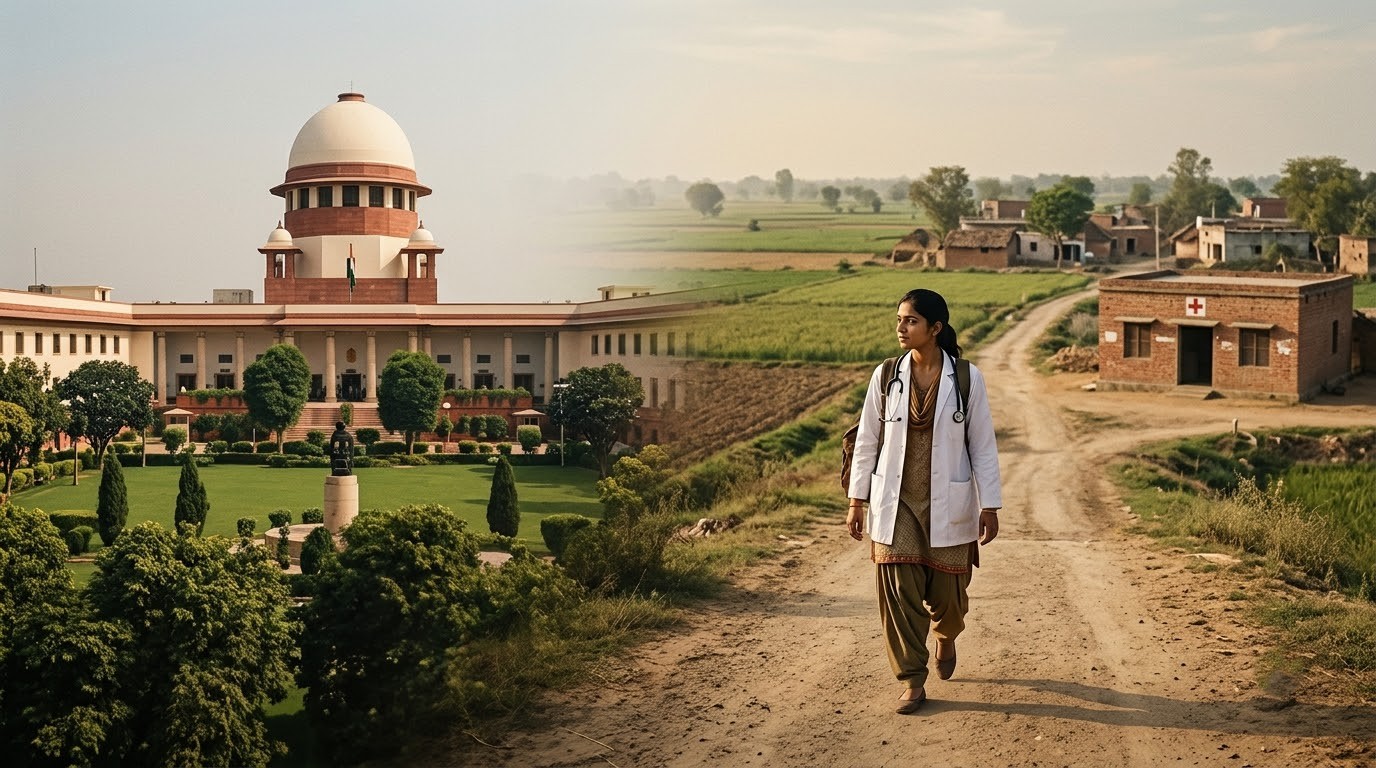
Supreme Court to Frame Constitutional Guiding Principles for Compulsory Rural Service by Medical Students
The Supreme Court has indicated its intention to formulate comprehensive guiding principles rooted in constitutional provisions to govern mandatory rural service by medical professionals across the country. A bench comprising Justice PS Narasimha and Justice Alok Aradhe made the oral observation during proceedings addressing the absence of a clear, unified stance from the Union government regarding compulsory rural medical postings. The judicial scrutiny arises from a pending writ petition challenging a state notification that mandates one year of public rural service for medical graduates seeking permanent registration with the state medical council.
What are the core legal and constitutional issues regarding compulsory rural service for medical graduates?
The core legal issue centers on whether mandatory rural service aligns with fundamental constitutional rights and the Directive Principles of State Policy, particularly given the absence of a uniform national policy. The Supreme Court is examining how the right to health under Article 21 imposes an obligation on the State to ensure adequate medical access in rural areas, while balancing regulatory hurdles across different jurisdictions.
During the hearings, Additional Solicitor General Aishwarya Bhati informed the bench that postgraduate students already face compulsory rotation requirements, whereas undergraduate mandates vary. The Union submitted that healthcare remains a state subject, with numerous states implementing bond systems based on committee recommendations. Conversely, the court-appointed amicus curiae, Senior Advocate Raju Ramachandran, suggested that judicial guidelines could bridge existing legislative gaps by anchoring rural service requirements directly to Article 21 and the Directive Principles of State Policy.
Aspect | Union Government Stance | Amicus Curiae Position |
|---|---|---|
Policy Scope | Health is a state subject; states issue individual execution bonds. | Legislative gaps require judicial guidelines. |
Constitutional Basis | Decentralized state-level implementation. | Rooted in Article 21 and Directive Principles. |
Justice Narasimha emphasized the gravity of the matter, noting that the ultimate judicial determination will profoundly impact the future trajectory of medical assistance and public health infrastructure in India. The bench remarked that the lack of a clear Union policy creates a distinct policy deficit. The Court clarified that its objective is not to issue an immediate rigid mandate that disrupts institutions nationwide, but rather to establish foundational constitutional principles. These principles aim to determine whether mandatory rural service for doctors is a necessary measure for national health betterment, leaving implementation mechanisms to the State in consultation with relevant medical commissions.
The underlying litigation originates from challenges directed against the Karnataka Compulsory Service Training by Candidates Completed Medical Courses Act, 2012, and the corresponding rules framed in 2015. Under this legislative framework, MBBS graduates, post-graduate degree or diploma holders, and super-specialty candidates from government institutions or government quotas in private universities must complete one year of public rural service. A notification issued in July 2023 extended this mandate to students enrolled in private seats within private and deemed universities. Fulfillment of this service is a strict prerequisite for receiving a no-objection certificate necessary for permanent registration with the Karnataka Medical Council.
Concluding the latest session, the bench adjourned the proceedings to the following week. The Court directed the Union government to secure definitive instructions on whether it intends to formulate a centralized policy, the consultative process it plans to adopt, and how it envisions reconciling state-level variations with overarching constitutional imperatives concerning rural healthcare access.