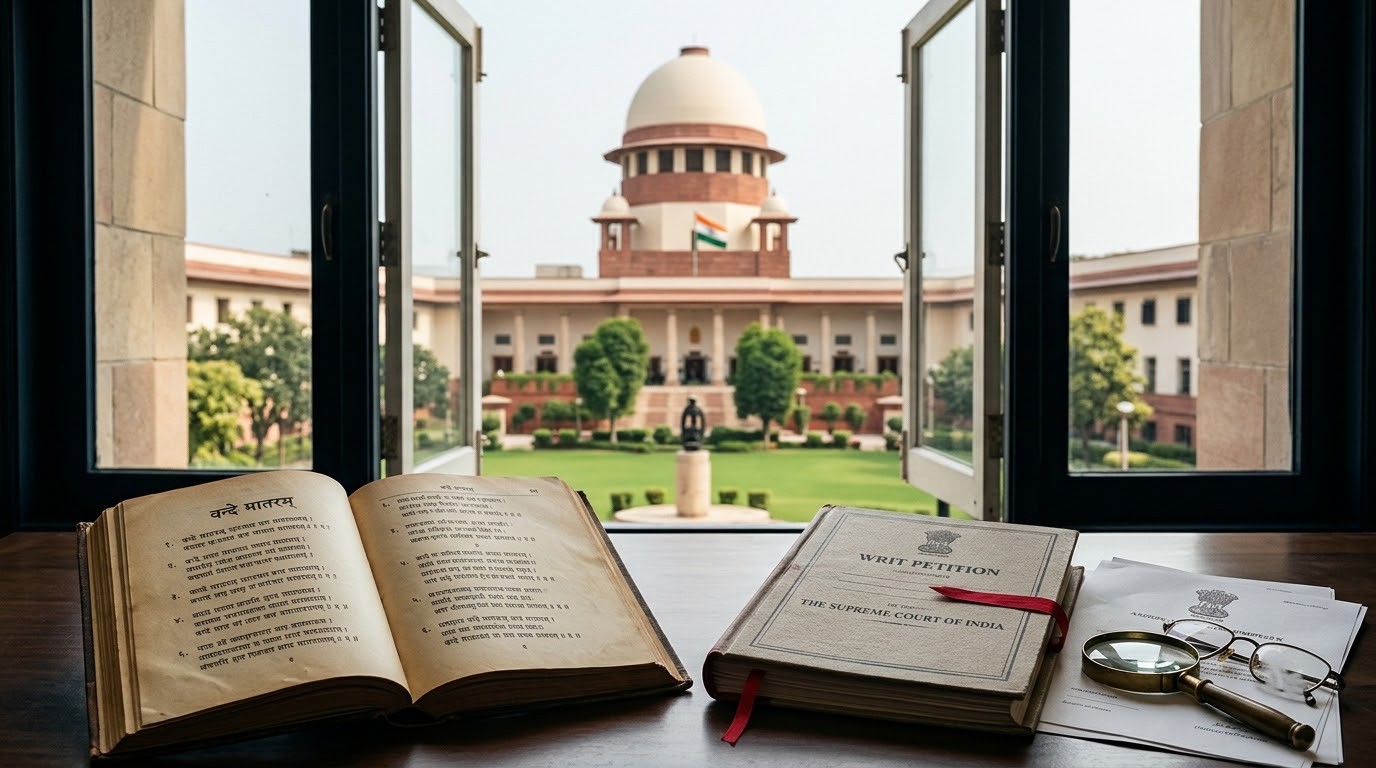
The Supreme Court on Tuesday issued notices to the Centre and other respondents on fresh petitions challenging the requirement to sing all six stanzas of Vande Mataram. A bench comprising Chief Justice Surya Kant and Justices Joymalya Bagchi and V Mohana directed that the matters be tagged with similar pending pleas and listed the consolidated hearing for November 30.
What is the legal basis for challenging the six-stanza Vande Mataram rule?
The petitions argue that the Ministry of Home Affairs orders dated January 28 and July 9, 2026, replaced a 79-year-old practice of singing a two-stanza version with the full six-stanza text from Bankim Chandra Chatterjee's Anandamath, which petitioners claim contains idolatrous and Islamophobic content violating freedom of conscience and the secular character of the Constitution under Articles 25 and 14.
The first petition was filed by Bhimrao Duryodhan Borkar, who contended that the impugned orders illegally repealed the existing National Song and imposed a new version described as a six-stanza civil war song with unconstitutional content. The second petition was filed by former IAS officer Balakrishnan Sathyabhama Mavoji, who argued that mandating the six-stanza version constituted an attempt to convert India into a divine, sectarian, and theistic state.
The bench linked these fresh challenges with a petition previously filed by Carnatic vocalist T M Krishna. During the earlier hearing on September 22, the court had observed that a conscientious objector should not be punished for refusing to sing Vande Mataram. The bench explicitly referenced the principle laid down in the 1986 judgment in Bijoe Emmanuel versus State of Kerala, where the Supreme Court protected schoolchildren who respectfully declined to sing the national anthem on grounds of conscience. The court indicated its expectation that this principle would govern the amended law.
The core legal controversy centres on the tension between a state-mandated patriotic practice and the fundamental right to freedom of conscience guaranteed under Article 25. Petitioners submit that the last four stanzas of the song contain explicit religious invocations incompatible with a secular polity, thereby compelling citizens to participate in idolatrous worship against their beliefs. The Centre is now required to respond to these contentions before the next date of hearing.
Aspect | Previous Practice / Precedent | Current Challenge |
|---|---|---|
Version Mandated | Two-stanza standalone poem (79-year practice) | Six-stanza full version from Anandamath (MHA Orders Jan/Jul 2026) |
Petitioners' Objection | Not applicable | Alleged idolatrous, Islamophobic content in last four stanzas; violation of Articles 14, 25 |
Key Precedent Cited | Bijoe Emmanuel v State of Kerala (1986) - Protection for conscientious objection to National Anthem | Invoked to argue protection must extend to National Song mandate |
Bench Composition | CJI Surya Kant, Justices Joymalya Bagchi and V Mohana | Same bench hearing consolidated matters |
Next Hearing | November 30 (Consolidated hearing) | November 30 |
The consolidation of the petitions signals the court's intent to undertake a comprehensive examination of the constitutional validity of the government's directive. The matter raises significant questions regarding the scope of state power to prescribe national symbols and the extent to which such prescriptions can infringe upon individual conscience. The Centre's response will be crucial in determining whether the state can justify the expansion of the mandated text from two to six stanzas, particularly in light of the specific religious imagery contained in the additional verses. The hearing on November 30 will determine the trajectory of this constitutional challenge.