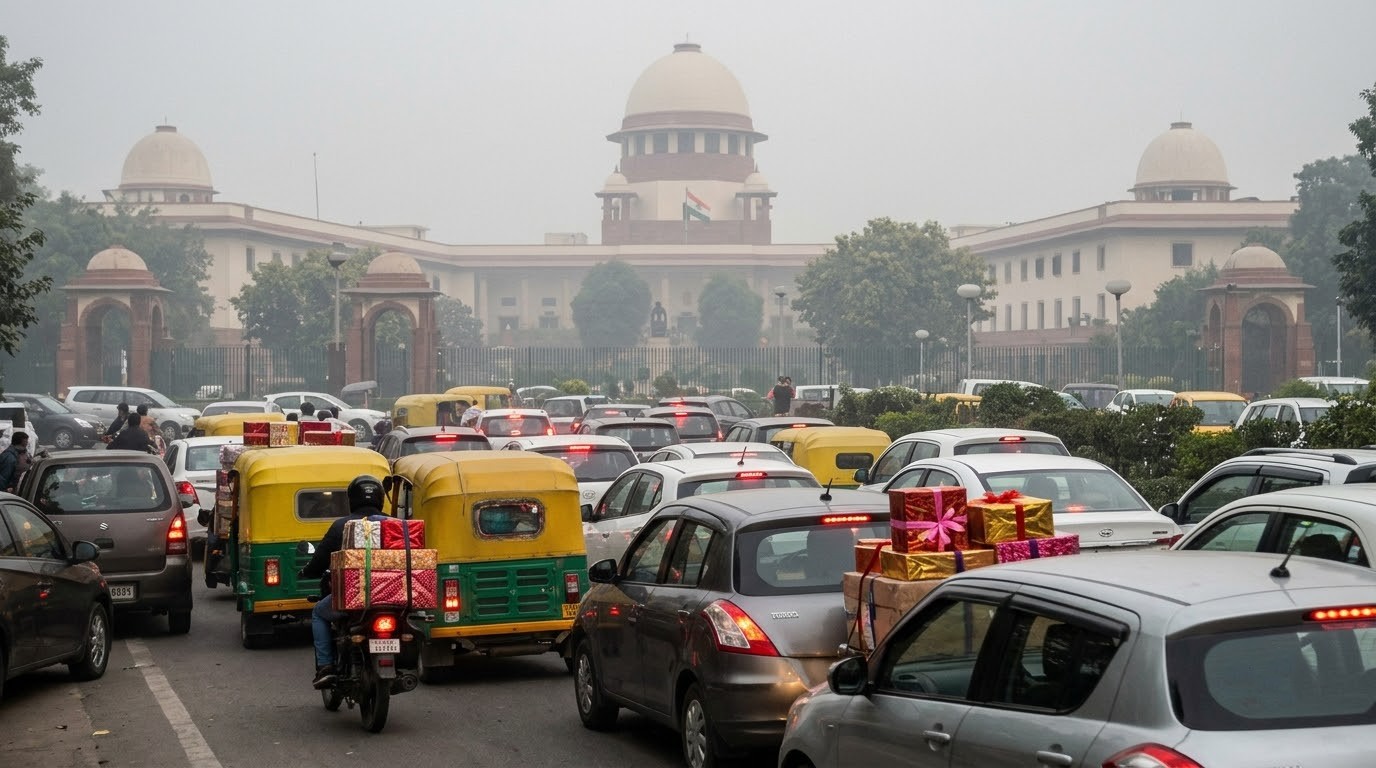
The Supreme Court on Friday identified the entrenched culture of exchanging Diwali gifts as a key factor aggravating vehicular pollution in the national capital, even as the overall Air Quality Index (AQI) neared the severe category. A three-judge bench led by Chief Justice of India Surya Kant observed that the practice had transformed into a social and status symbol for the affluent, directly increasing traffic volume and emissions during the festive period.
CJI Links Gift Culture to Vehicular Congestion
During the hearing on Delhi's recurring air pollution crisis, the CJI remarked that the root issue extended beyond the sheer number of vehicles registered in Delhi. He pointed out that vehicles from across the country enter the capital freely, making emission monitoring practically impossible. Even a vehicle staying in the city for two hours causes damage, the bench noted. The CJI stated that the culture of Diwali gifts adds to vehicular pollution, urging people to realise what the original culture entails and what corrective steps are necessary.
The observation came in response to a suggestion by counsel that the practice of exchanging gifts might need to be stopped to arrest pollution. The CJI characterised this as the kind of cultural change society must embrace. Justice Joymalya Bagchi, sitting on the bench, concurred, flagging the growing commercialisation and commodification of festivals like Diwali as a broader concern.
Centre Details GRAP Stage 2 and Geotagged PUC Measures
Additional Solicitor General Aishwarya Bhati, appearing for the Centre, submitted that Stage 2 of the Graded Response Action Plan (GRAP) had already been invoked. The measures include water sprinkling and stricter border checks to enforce vehicle restrictions. The ASG further informed the court that Pollution Under Control (PUC) certificates are now being geotagged at the testing location to prevent fraud, and steps are underway to stop visibly polluting vehicles from operating.
Bench Distinguishes Vehicle Volume from Duration
The bench, however, emphasised that the pollution challenge was not merely a function of vehicle density. The CJI clarified that the critical metric was the duration for which vehicles remain on the roads, rather than the total strength of the vehicular fleet. This distinction underscores the impact of festive-season congestion caused by non-local and gift-related traffic.
Court Protects Livelihoods of the Poor
While advocating for a cultural shift among the affluent, the CJI cautioned against overlooking the economic realities of the underprivileged. He noted that the festive season is a crucial earning period for the poor, who set up stalls to sell diyas and other items without generating pollution. The burden of behavioural change, the bench indicated, falls on those who can afford to make gift-giving a status symbol.
What did the Supreme Court say about the culture of Diwali gifts and pollution?
The Supreme Court stated that the culture of exchanging Diwali gifts has become a status symbol for the rich and significantly adds to vehicular pollution in Delhi. The CJI called for a cultural shift to curb the annual menace, distinguishing the polluting behaviour of the affluent from the livelihood needs of the poor during the festival.
Aspect | Court Observation | Government Submission (ASG) |
|---|---|---|
Primary Pollution Driver Identified | Culture of Diwali gift exchange increasing vehicular traffic and duration on roads | Stubble burning, vehicular emissions; addressed via GRAP Stage 2 |
Vehicle Monitoring | Impossible to monitor emissions of vehicles entering from across the country | PUC certificates now geotagged; border checks tightened |
Focus of Intervention | Behavioural and cultural change among affluent sections | Enforcement of vehicle restrictions and PUC compliance |
Impact on Poor | Cautioned against restrictions hurting festive livelihoods (diyas, stalls) | Not specifically addressed |
The hearing reflects the Court's attempt to broaden the pollution discourse beyond technical regulatory measures, targeting the socio-cultural drivers of seasonal air quality deterioration. The bench's emphasis on the duration of vehicular presence over mere fleet strength, coupled with its protection of informal sector livelihoods, frames the issue as one of equitable behavioural responsibility rather than blanket prohibition.