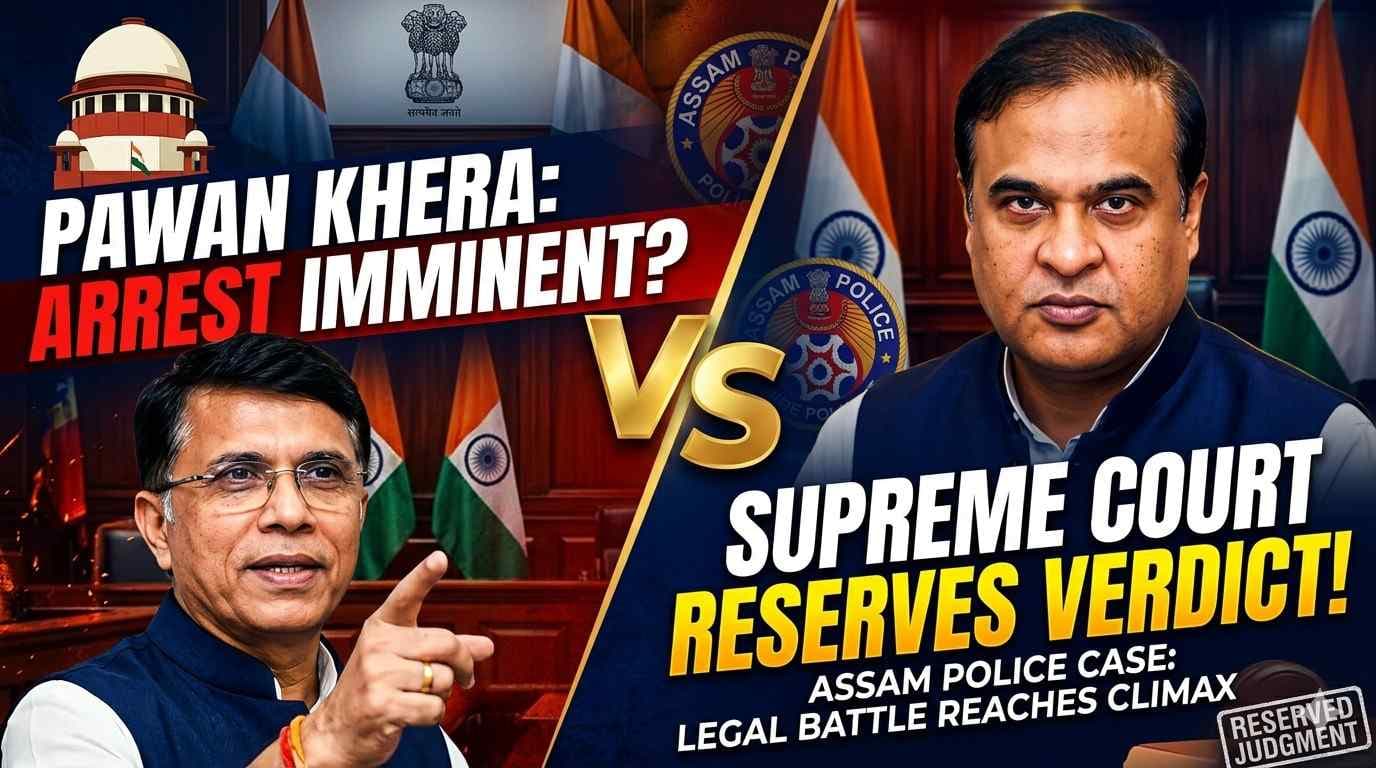
The Supreme Court of India has reserved its verdict on a petition filed by Congress spokesperson Pawan Khera, seeking protection from arrest in connection with an FIR registered by the Assam Police. The case, which has seen a flurry of legal activity across multiple High Courts, reached a critical stage on Thursday, April 30, 2026, as a Bench of Justice JK Maheshwari and Justice Atul Chandurkar concluded the hearing on Khera's anticipatory bail plea.
The legal battle stems from an FIR lodged by Riniki Bhuyan Sarma, wife of Assam Chief Minister Himanta Biswa Sarma. The complaint alleges that Khera made defamatory and forged claims regarding her holding multiple passports and substantial overseas assets during a press conference. Khera approached the apex court after the Gauhati High Court rejected his pre-arrest bail request on April 24, observing that custodial interrogation was necessary to "unearth the source" of his accusations.
Representing Khera, Senior Advocate Dr. Abhishek Manu Singhvi launched a pointed defense, characterizing the prosecution as a classic case of political vendetta. Singhvi argued that the case was being handled with "unprecedented" aggression, noting that dozens of Assam police officers had traveled to Delhi to effect an arrest as if Khera were a "terrorist."
The courtroom saw sharp rhetoric as Singhvi cited public statements made by Chief Minister Himanta Biswa Sarma, where the CM allegedly threatened that Khera would spend his life in an Assam jail. "Dr. Ambedkar would turn in his grave if he had imagined that a constitutional office holder will speak like a constitutional cowboy or a constitutional Rambo," Singhvi submitted, urging the court to protect his client from "humiliation" via custodial interrogation.
On the other hand, the State of Assam, represented by the Advocate General, maintained that the case extends far beyond mere defamation. The state argued that the charges involve the fabrication of documents and cheating—offences that require a deeper probe into the source and intent of the alleged forgeries. They contended that Khera had engaged in "forum shopping" by previously approaching the Telangana High Court for relief in a case registered in Guwahati.
The Supreme Court had earlier stayed a transit bail order granted to Khera by the Telangana High Court, directing him to seek relief from the jurisdictional courts in Assam. While the Gauhati High Court eventually denied that relief, the Supreme Court is now tasked with deciding if the nature of the allegations warrants the deprivation of Khera’s personal liberty before a trial begins.
As the Bench reserved its judgment, the legal community remains focused on how the Court will balance the State's power to investigate forgery with the protection of political speech and the prevention of administrative overreach. With the verdict pending, the case continues to be a focal point in the intersection of criminal law and high-stakes political rivalry.
The decision, expected in the coming days, will clarify whether the apex court views the "necessity of arrest" in this instance as a requirement of justice or an excess of executive power.