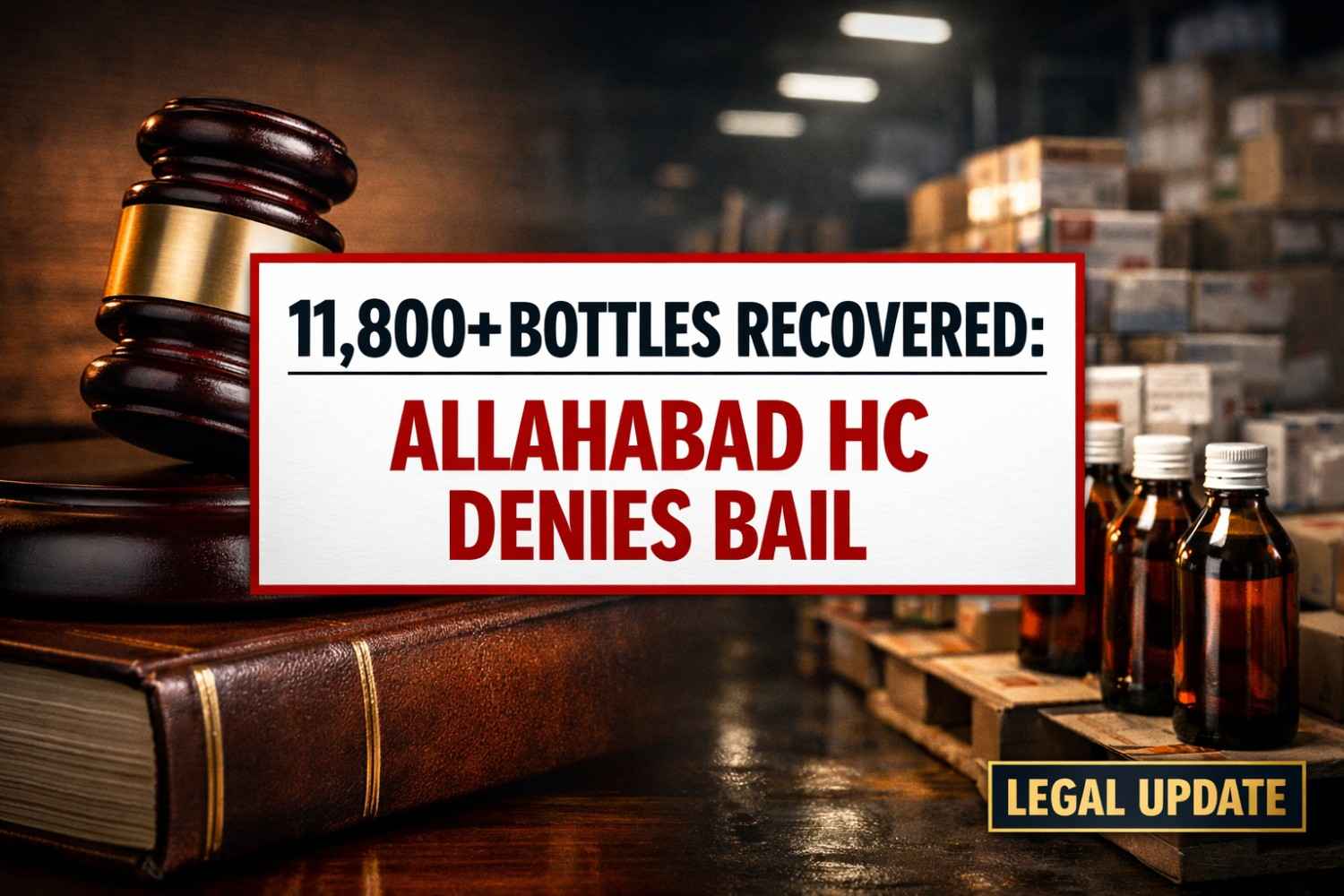
In a significant ruling aimed at curbing the illegal trade of pharmaceutical drugs for recreational use, the Allahabad High Court has refused to grant bail to two individuals allegedly involved in a massive Codeine-based cough syrup racket. The Court observed that while Codeine is a recognized medicinal ingredient, its "illegal diversion" in huge quantities strips it of its therapeutic exemption, bringing it squarely under the scanner of the Narcotic Drugs and Psychotropic Substances (NDPS) Act, 1985.
Justice Ashutosh Srivastava, while presiding over the case of Abdul Qadir and Another v. State of U.P., emphasized that the law provides exemptions for medicinal preparations only when they are strictly intended for "therapeutic practice."
The case dates back to an enforcement action where the authorities intercepted the accused while they were loading a large consignment into a vehicle. The recovery was staggering: 119 boxes containing a total of 11,885 bottles of Codeine-based cough syrup.
The applicants, Abdul Qadir and his associate, were subsequently booked under Sections 8 and 21 of the NDPS Act. Following the implementation of the new criminal laws in India, they were also charged under relevant sections of the Bharatiya Nyaya Sanhita (BNS), 2023, including Sections 318(4) (cheating), 338, 336(3), and 340.
Seeking relief from the Court, the counsel for the applicants argued that their clients were victims of procedural high-handedness. The primary defense points were:
- Valid Licensing: The applicants claimed to be licensed medicine dealers who had purchased the stock through valid invoices from legitimate distributors.
- Medicinal Exemption: It was argued that since the concentration of Codeine in the cough syrup was within the medicinal limits prescribed under the Drugs and Cosmetics Act, it should not be treated as a "manufactured drug" under the NDPS Act.
- Procedural Lapses: The defense contended that the Drug Inspector did not have the proper authority to collect and seal samples in the manner it was done, suggesting a violation of statutory protocols.
- Clean Antecedents: The counsel highlighted that the applicants had no prior criminal record and were being falsely implicated.
On the other hand, the State’s counsel, led by Additional Advocate General Anoop Trivedi, strongly opposed the bail. The prosecution argued that the sheer volume of the recovery—nearly 12,000 bottles—clearly indicated that the syrup was not meant for retail pharmacy sales but for illegal "diversion" to addicts. They maintained that when a drug is diverted for non-medicinal use, the "therapeutic" exemption no longer applies.
The core legal question before the High Court was whether a licensed medicine becomes a narcotic substance if possessed in bulk without a clear therapeutic explanation.
Justice Srivastava referred to the Central Government Notification dated November 14, 1985, which lists 'Codeine' (Methyl-Morphine) as a manufactured drug. While an exception exists for preparations containing less than 100mg of Codeine per dosage unit and a concentration of not more than 2.5%, the Court clarified that this exception is conditional.
"The exemption provisions are required to be strictly and literally complied with," the Court noted. "Any violation of any condition would disentitle the claimant to the exemption."
The Court observed that the phrase "established in therapeutic practice" is the most crucial condition for the exemption. In this case, the possession of 11,885 bottles during a suspicious loading operation was seen as a "flagrant violation" of this condition. The Court reasoned that no legitimate therapeutic practice requires two individuals to handle such a massive quantity in a non-clinical, non-warehouse setting without transparent logistical documentation.
Justice Srivastava held that at the stage of bail, the Court cannot conduct a "mini-trial" or deeply examine the evidence. However, given the gravity of the recovery and the potential impact on society, the Court found no reason to believe that the accused were innocent.
The Court stated: “No reason is found to falsely implicate the applicant/accused persons. Therefore, there is no good ground to release the applicant-accused persons on bail at this stage.”
The Bench further clarified that all arguments regarding the validity of invoices and the authority of the Drug Inspector were matters of trial and could not be used to bypass the stringent bail conditions of the NDPS Act at this juncture.
This judgment is a stern reminder to the pharmaceutical supply chain in Uttar Pradesh. The "diversion" of cough syrups like Phensedyl or Corex has become a major challenge for law enforcement in North India. By ruling that bulk possession without clinical justification cancels out the "medicinal" defense, the Allahabad High Court has strengthened the hands of the police and the Narcotics Control Bureau (NCB).
The denial of bail to Abdul Qadir and his co-accused underscores the judiciary's "zero-tolerance" approach toward the drug menace, especially when it is disguised as legitimate trade. The ruling makes it clear: having a license to sell medicine is not a "get out of jail free" card if that medicine is found being traded like a street drug.
As the trial proceeds, the focus will remain on the source of these 11,885 bottles and the larger network involved in this illegal diversion. For now, the accused remain in custody, facing the full weight of the NDPS Act.
Case Details:
- Case Title: Abdul Qadir And Another v. State of U.P.
- Bench: Justice Ashutosh Srivastava
- Legal Provisions: Sections 8/21 NDPS Act; Sections 318(4), 338, 336(3), 340 BNS.