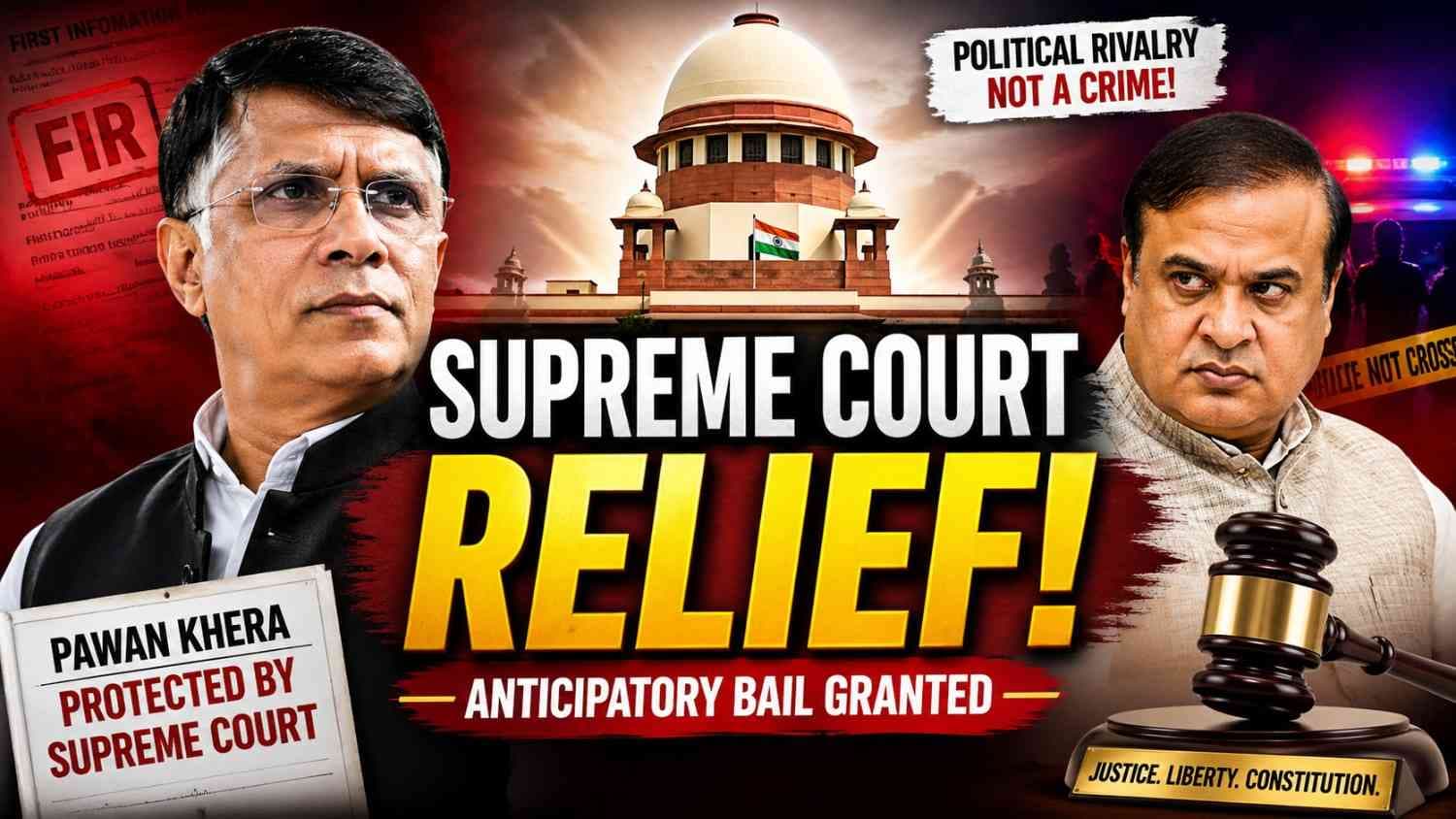
In a significant ruling for personal liberty and political discourse, the Supreme Court of India has granted anticipatory bail to Congress leader Pawan Khera. On Thursday, April 30, 2026, a Bench of Justices JK Maheshwari and AS Chandurkar set aside an earlier order from the Gauhati High Court that had refused to protect Khera from arrest in a case registered by the Assam Police.
The case stems from allegations made by Khera during a press conference, where he claimed that the wife of Assam Chief Minister Himanta Biswa Sarma held multiple foreign passports and undisclosed overseas assets. These claims led to an FIR involving charges of defamation, forgery, and criminal conspiracy. While the Gauhati High Court had previously suggested that "custodial interrogation" was necessary to uncover the source of Khera's documents, the Supreme Court took a different view.
The apex court observed that the circumstances of the case were heavily colored by "political rivalry." The Bench emphasized that in cases with such clear political overtones, personal liberty cannot be lightly curtailed. By granting anticipatory bail, the Court has reinforced the principle that the criminal justice system should not be used as a tool for political vendetta.
The legal journey to this verdict was complex. After an initial transit bail from the Telangana High Court was stayed, Khera was directed to approach the courts in Assam. The Gauhati High Court's rejection on April 24—which argued that dragging a "private individual" (the CM's wife) into political rhetoric warranted a stricter approach—was the final hurdle before the Supreme Court's intervention.
In his petition to the top court, Khera maintained that his statements were made in a public and political context and were being "selectively construed" to initiate criminal proceedings. The Supreme Court's decision to grant relief suggests a judicial priority on protecting individuals from pre-trial incarceration in cases where the primary dispute is rooted in political speech and public allegations.
The ruling is a notable precedent for how the judiciary navigates the intersection of free speech, defamation, and the power of state police in politically sensitive matters. It serves as a reminder that the "necessity of arrest" must be balanced against the constitutional right to liberty, especially when the allegations arise from the heat of political contestation.
As the legal proceedings continue, Khera will remain free from arrest, shifting the focus of the case from custodial questions to the actual merits of the defamation and forgery allegations. For the legal community, the verdict is a clear signal that the Supreme Court will act as a sentinel against the potential overreach of state machinery in the arena of political rivalry.