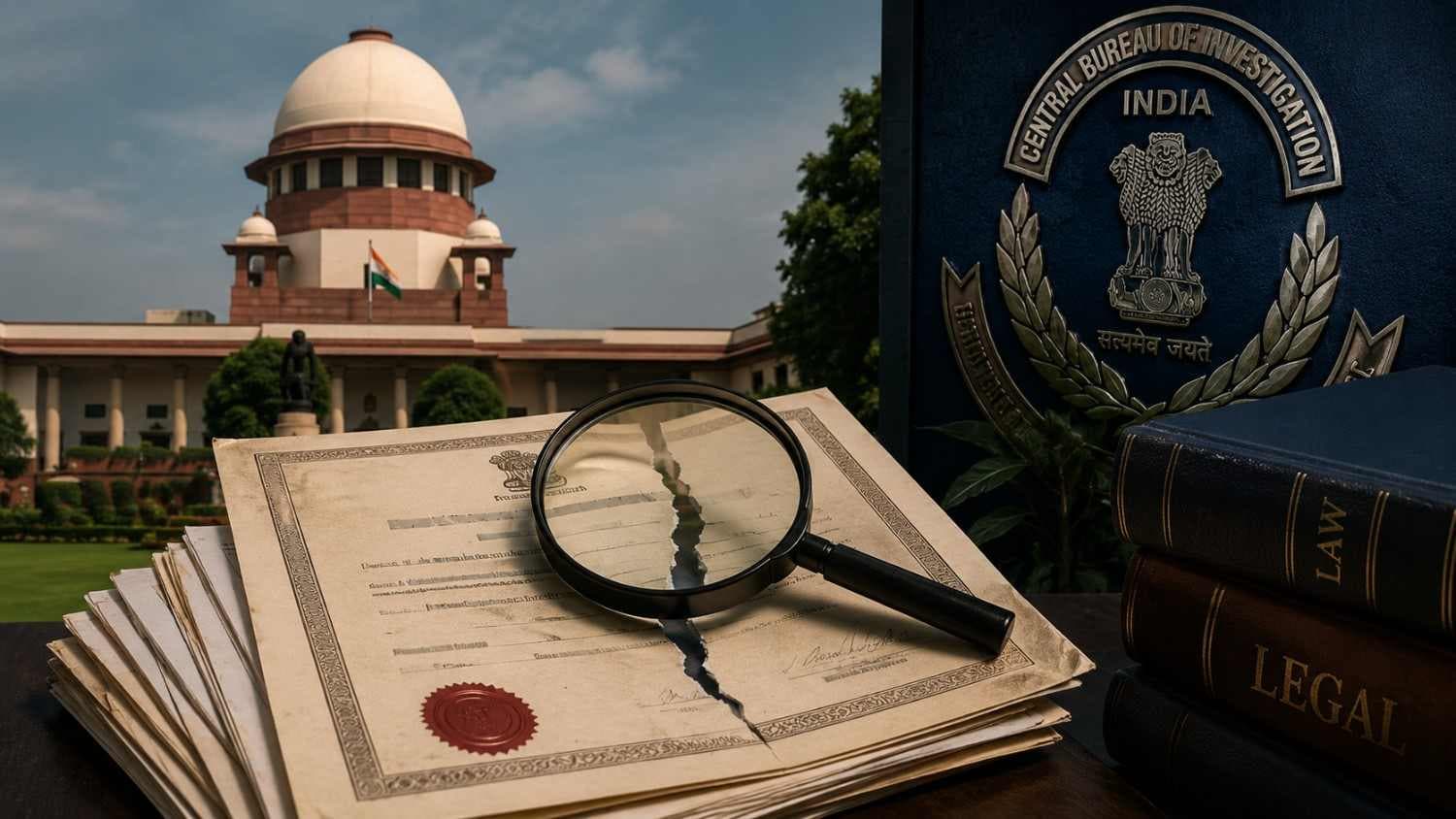
The Central Bureau of Investigation (CBI) has submitted a status report to the Supreme Court indicating prima facie evidence of cognizable offences, including forgery and fabrication of public documents, in connection with the B.Com degree relied upon by advocate Naresh Dilawari. The report was filed in a sealed cover and opened in Court on August 17, 2026, pursuant to the bench's order passed on that date.
The bench, comprising Justice Ujjal Bhuyan and Justice Atul S. Chandurkar, noted that the CBI's report stated: 'prima facie, commission of cognizable offences of forgery, fabrication of public documents etc., have been made out against the appellant-in-person and other unknown persons.' The observation was recorded in the context of ongoing proceedings concerning the genuineness of Dilawari's educational qualifications.
The matter originated from disciplinary proceedings initiated by the Bar Council of Punjab and Haryana, which suspended Dilawari's right to practise for two years on December 20, 2021. Dilawari challenged the suspension before the Disciplinary Committee of the Bar Council of India. On January 16, 2025, the BCI Disciplinary Committee directed the Bar Council of Punjab and Haryana to verify the authenticity of his educational qualifications through an inquiry, pending which his licence was to remain suspended.
The scrutiny of Dilawari's B.Com degree had previously arisen during an earlier Supreme Court hearing, where the Court took note of a communication from the Controller of Examinations of Magadh University, Bodh Gaya, stating that the mark sheet and B.Com degree in Dilawari's name for the 1991 examination were 'forged and not issued from the University.' Following this, the Court directed Dilawari to produce photocopies of the degrees he claimed to have obtained. He produced a photocopy of his B.Com (Hons.) degree certificate for the 1991 examination, but counsel for the respondent highlighted an annexure reiterating the University's position that the documents were fabricated.
Dilawari sought to explain the discrepancy by asserting that the University's records had been torn or were missing, which, according to him, could have hindered verification. The Court did not accept this explanation as sufficient to resolve the issue and, on September 15, 2025, directed the CBI to investigate whether the degree set up by Dilawari of having passed the B.Com examination from Magadh University in 1991 was genuine or forged. The Court had observed: 'as an issue regarding veracity of a degree has arisen, we deem it appropriate to require the Central Bureau of Investigation, Delhi to do the investigation and ascertain whether the degree set up by the Petitioner of having passed the B.Com examination from Magadh University in the year 1991 is genuine or forged.'
In its August 17, 2026 order, the Supreme Court also took note of subsequent disciplinary developments. The Bar Council of Punjab and Haryana produced before the Court a notification dated August 5, 2025, stating that an inquiry had been conducted pursuant to the BCI Disciplinary Committee's directions. Thereafter, following a direction issued by the BCI Disciplinary Committee on July 6, 2025, Dilawari's name was removed from the Roll of the Bar Council of Punjab and Haryana, with a further direction that he surrender his licence and related documents.
Appearing in person before the Supreme Court, Dilawari challenged the jurisdiction of the BCI Disciplinary Committee to direct the Bar Council of Punjab and Haryana to conduct a fresh inquiry and subsequently remove his name from the roll. He contended that the BCI Disciplinary Committee had exceeded its jurisdiction in issuing such directions. The Supreme Court did not examine the merits of this challenge in the present proceedings. The bench observed that Dilawari could challenge the legality and validity of the August 5, 2025 notification in an appropriate proceeding before the appropriate forum.
The Court further directed that if such proceedings were instituted within 30 days from the date of its order, the issue of limitation would not hinder the consideration of the challenge. The cause title of the proceedings is recorded as Naresh Dilawari versus Charanjit Singh Oberoi.